

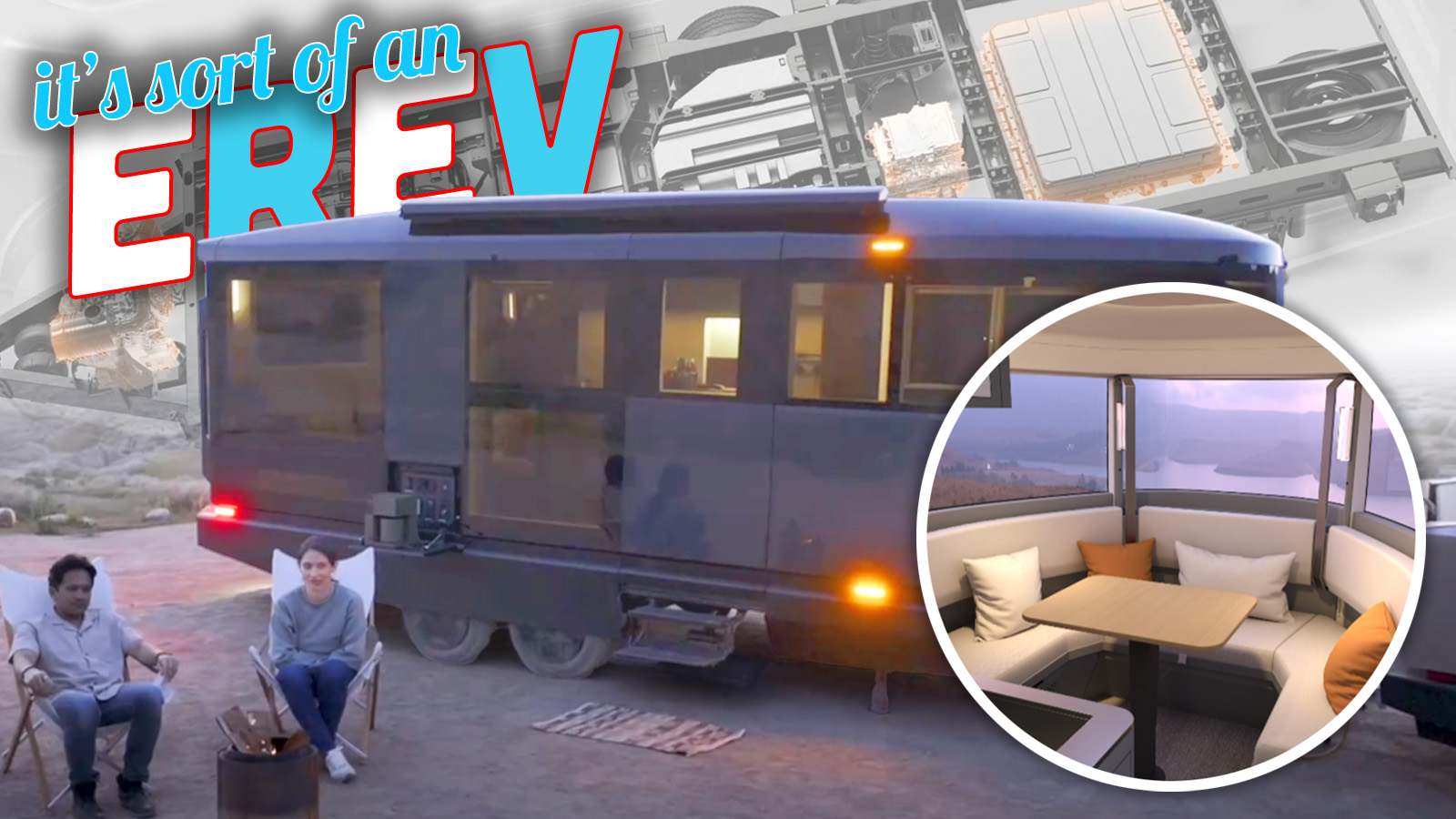
One of the biggest, most common complaints that I hear from RV owners is that far too many rigs aren’t put together very well. You’d hope that a box designed to thunder down the highway at 70 mph should be sturdy, but that isn’t always the case. A new California-based startup, Aboard RV, wants to change that. The Aboard is built like your car, and unlike most other electric campers, it features an extended-range electric vehicle system. Like a BMW i3, it’s all-electric until the juice runs low, then a generator kicks in.
I have noticed that there’s a rather amusing formula that seemingly every “techy” RV startup tries to follow. These companies always seem to feature engineers from the automotive world and have designs that look less like an RV and more like a shuttlecraft that might deploy from the USS Enterprise. All of these campers feature large lithium batteries, drive systems that help the tow vehicle haul the trailer, and varying levels of automation.


These startups have been coming on hard and fast, too. Last year, the Pebble Flow entered production as the world’s first production self-propelled travel trailer. Then it was followed up very closely by the production of the Lightship AE.1. The list of startups angling to reach production stretches even longer. There’s AC Future, which sees itself solving California’s housing crisis with a trailer, motorhome, or accessory dwelling unit. Then there’s Evotrex, which recently claimed — and I still say that claim is false — that it invented the “World’s First Power-Generating RV” with its EREV trailer. Airstream and Dethleffs also built prototype all-electric self-propelled trailers.
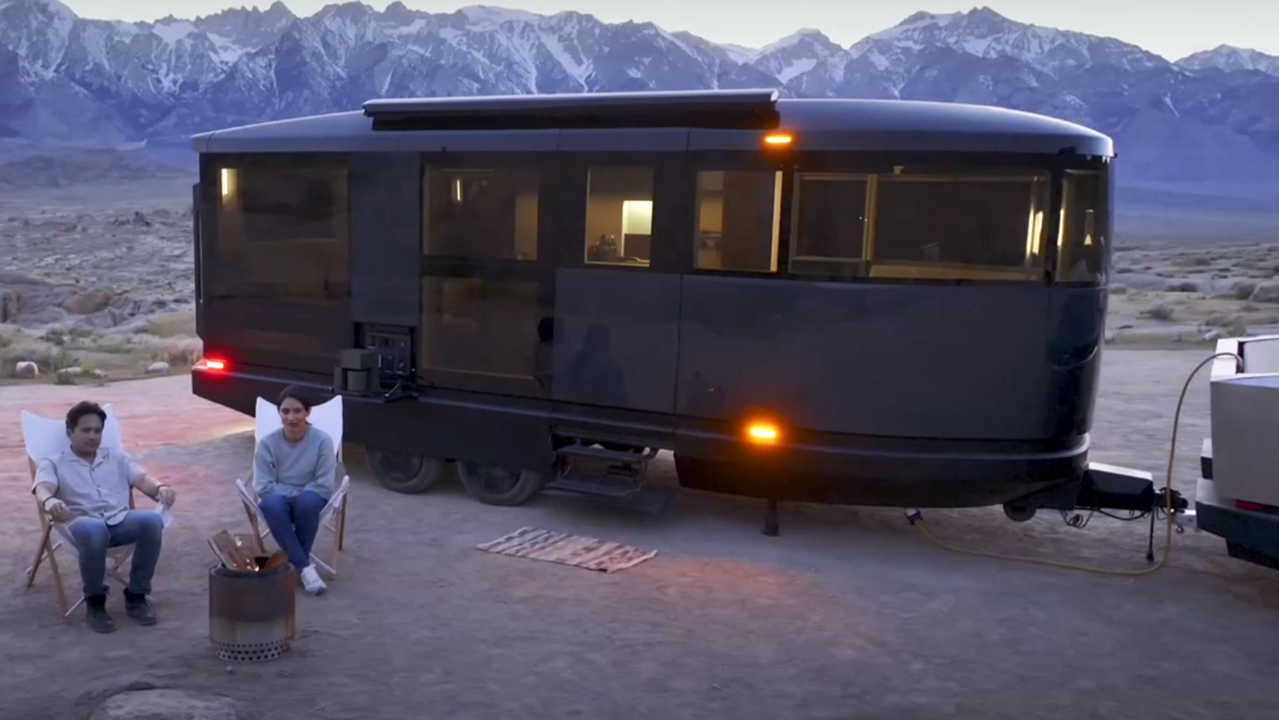
In case you thought there weren’t enough startups all trying to do the same thing, I have another one for you. Meet the Aboard, and it wants to stand out in the pack by being built like your car.
Welcome Aboard
Aboard RV was founded in Orange, California, in 2024 by Jiangtao Lyu. The company has been operating quietly with a few dozen employees, but has decided to roll itself out to the public after a Pre-Series A financing round of $13 million led by Ondine Capital and Llama Ventures. Talking with RVBusiness, Lyu explains why he started the company:
“Aboard was founded to bring automotive-grade design and engineering to the travel trailer category, so people can travel with the reliability, comfort, and confidence they expect from a modern vehicle without being limited by hookups or complicated RV systems,” said Jiangtao Lyu, founder of Aboard. “With our first travel trailer now in advanced prototype and validation, we’re investing in production readiness and bringing Aboard into the outdoor communities where our customers already live, travel and gather.”
Lyu says he brings over a decade of experience at BMW, the Volkswagen Group, and Li Auto to the table, and the company is filled with other automotive engineers and RV designers.

Aboard RV’s debut product, the Aboard trailer, is said to be built like a car. When Aboard RV says this, it is talking about the trailer’s structure. However, it is also talking about the trailer’s platform. Like a car platform, Aboard RV says, everything from the living space to the energy system will be integrated.
Building a camper like a car is not a new concept. Back in 2024, I wrote about the 1949 Palace Royale, which had an all-metal, die-formed body like the cars of the era. Brochures even went as far as to claim that the Palace Royale was the only trailer on the market with a car-like body.

In the modern day, there are quite a few campers out there that claim to have strength that’s inspired by cars. The plastic LIV campers, for example, are sometimes pitched as having car-like unibodies. Of course, many of the engineers behind the likes of the Pebble and the Lightship also came from the automotive world. The Lightship has a body made out of hand-laid composites backed with an aluminum space frame. The Pebble Flow has an aluminum chassis, an aluminum structure, and a composite body.
In a large way, the Aboard is just retracing ground that has already been covered, but with a different face and marketing. So, what does this car-inspired camper offer that the others don’t?
Aboard The Aboard RV
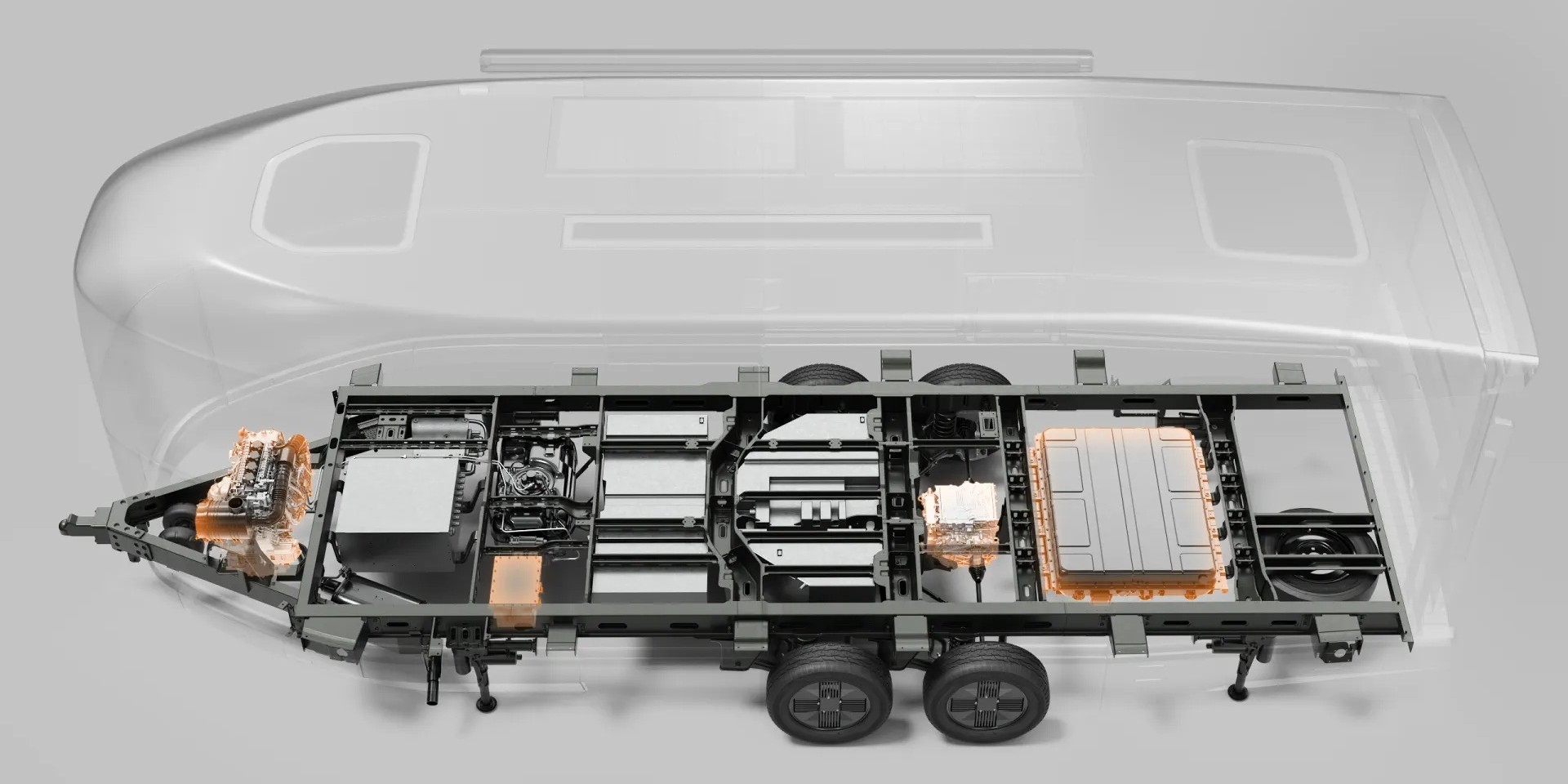
The Aboard starts as a chassis. Bolted to it is a 41kWh LFP battery, two axles, a drive motor connected to the rear axle, and a four-cylinder engine of unknown origin that works as a 60 kW generator.
On top of the chassis sits a body that Aboard RV says is built to automotive standards, or specifically, “high-precision stamped body and door systems.” Yep, even the split-folding tailgate and the entry door is said to be made of stamped components. Aboard RV isn’t saying much more about the build just yet. So, it’s unclear just how far this goes. For now, Aboard RV offers only a render of the structure.
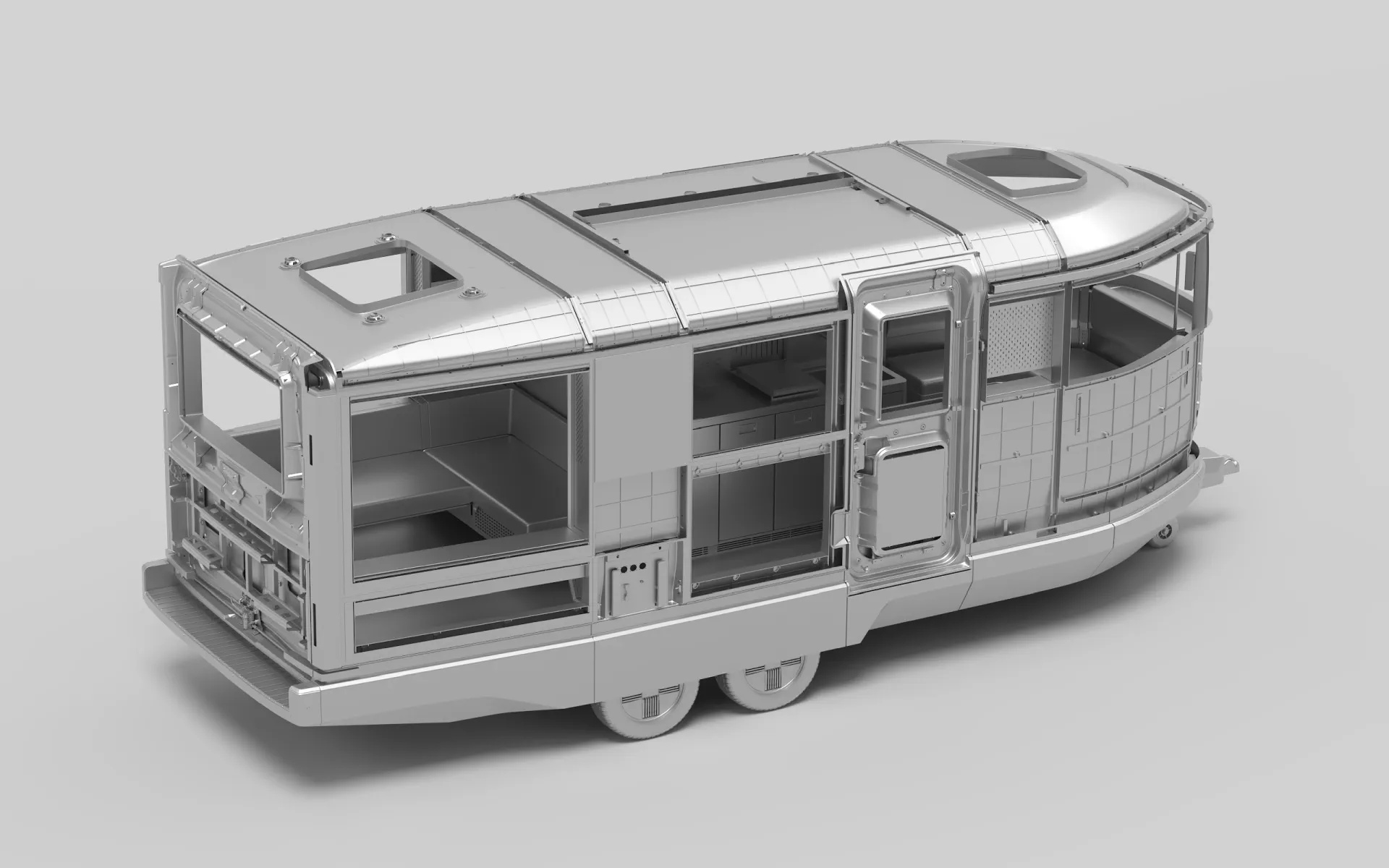
The interior of the camper is a mix of what we’ve seen before, with a couple of new tricks. The front of the trailer is a dinette that turns into a bed.
Curiously, the engine that runs as a generator sits directly in front of this area. Hopefully, the generator is quiet!

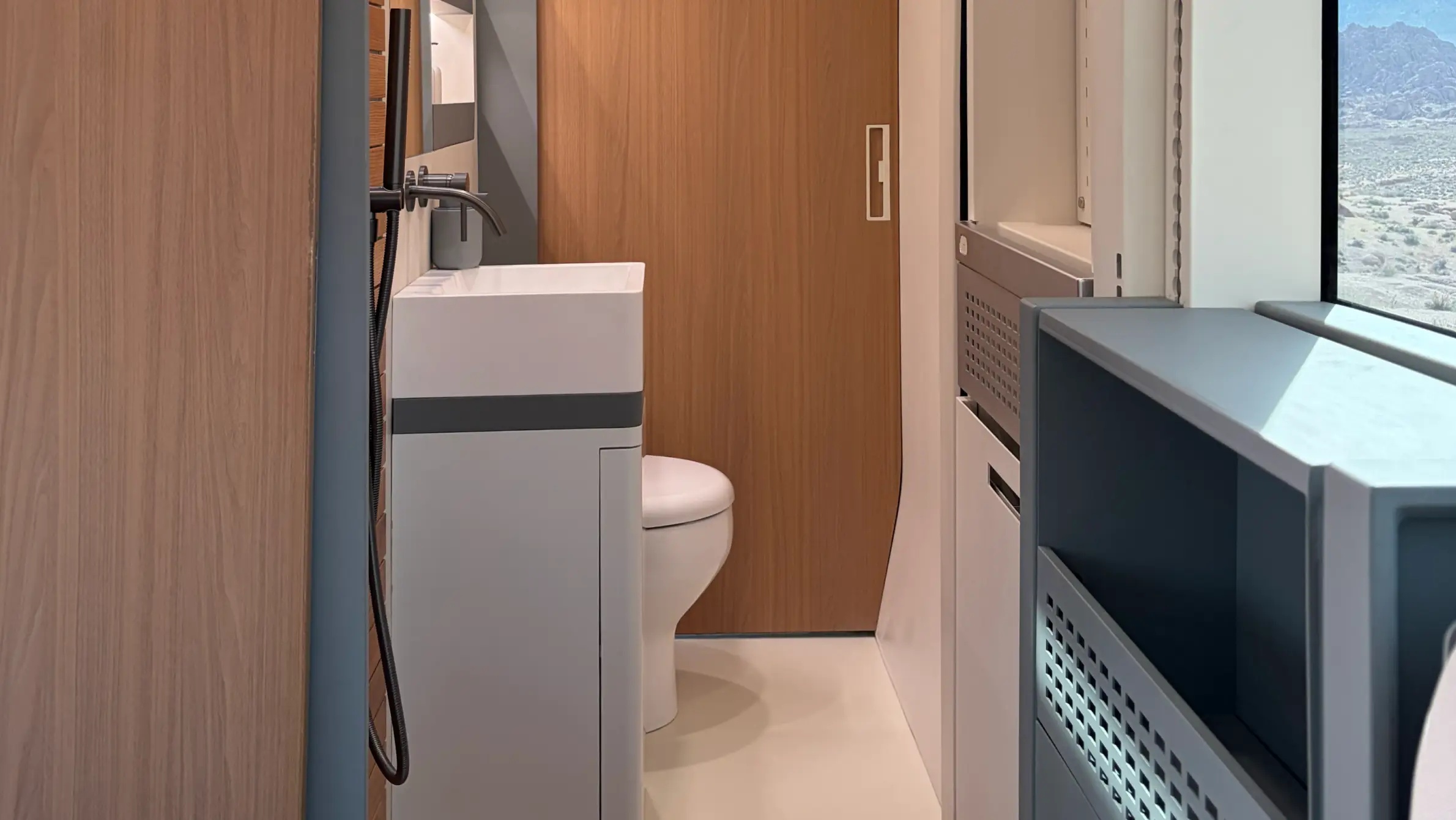
Behind the front area is the bathroom, which looks somewhat tight, but is of a dry bath design. A nice touch here is that there’s a second exterior door that leads to the bathroom. While this addition technically isn’t necessary because the Aboard doesn’t have slides that would block the bathroom, it is neat to have direct bathroom access from the outside.
On the other side of the bathroom is the kitchen, and Aboard RV says it was designed for two people to cook at once. My eyes spot an induction stove, a cutting board, a sink, a wine chiller, a microwave, and a hidden refrigerator.
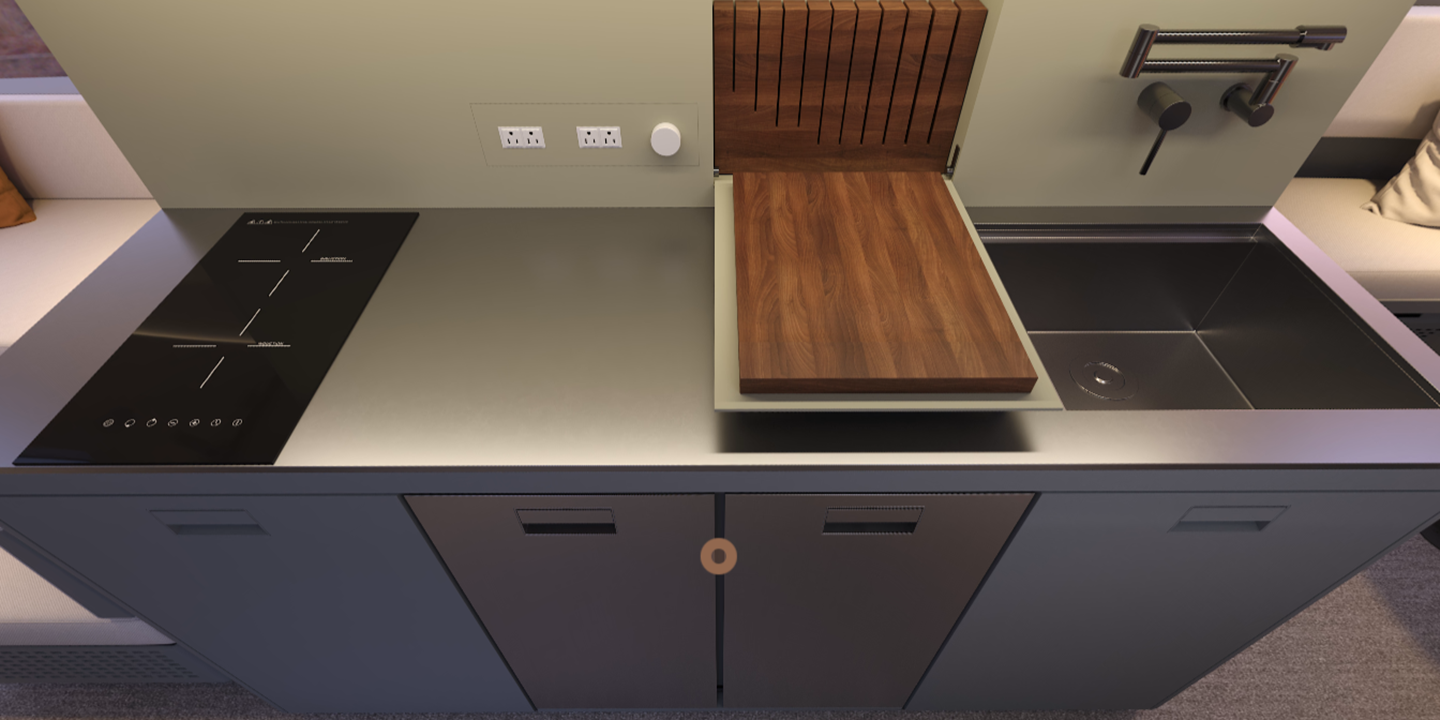
I’m hoping it’s just the perspective of the images, but the kitchen doesn’t look very large.

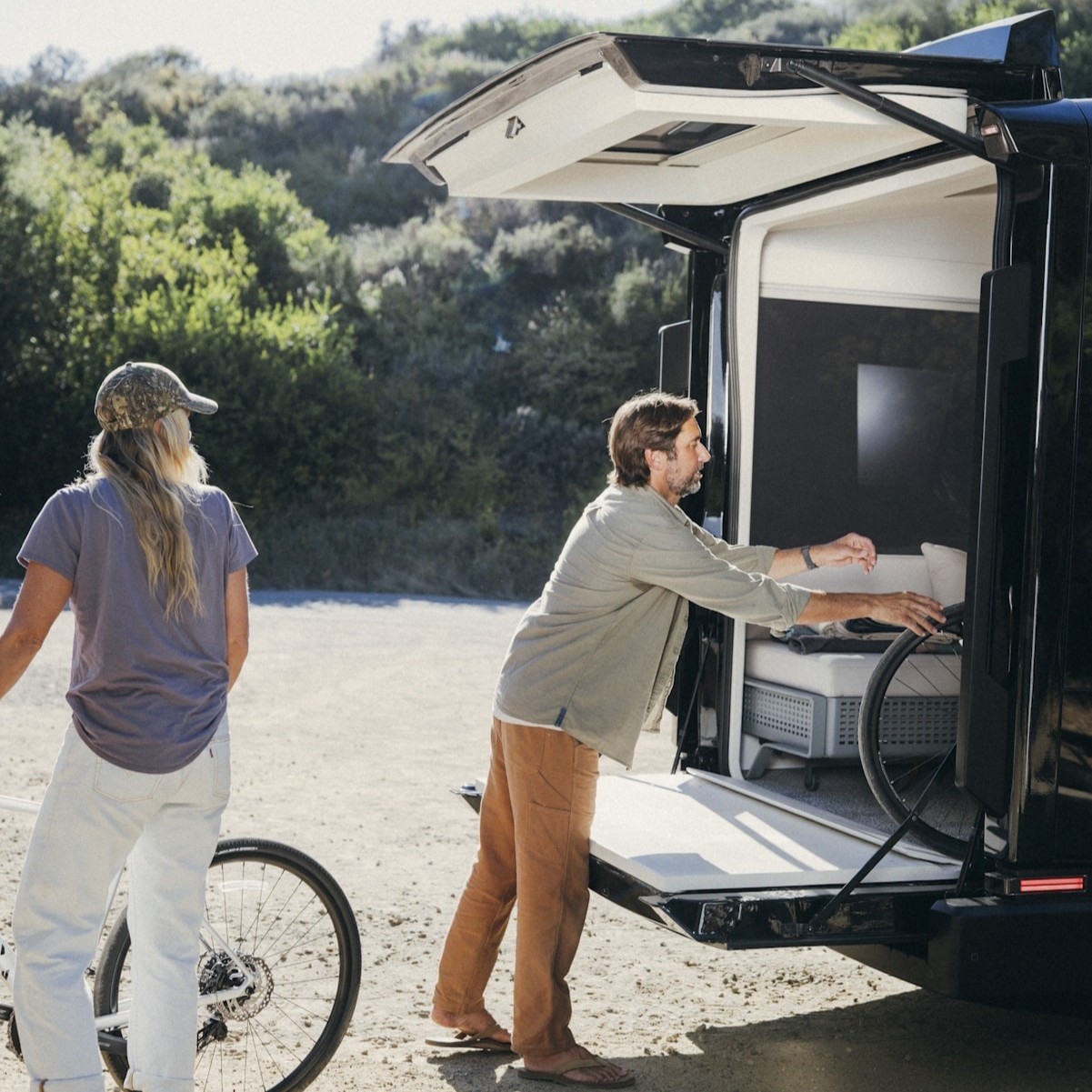
The rear of the trailer is a multifunctional space. By day, it can be a living room, a gear garage, or a workspace, and by night, you get a residential-style queen bed. The rear end also features a tailgate so you can either enjoy a nice patio or load in some bicycles. The windows are huge enough that you’re supposed to have an unimpeded 270-degree view of the outdoors.
Now, at least based on the images provided by Aboard RV, I see a few funny quirks. If you’re carrying gear in the back of the Aboard, it seems as though you cannot deploy the rear bed. Also, when the rear end of the Aboard is in living room mode, the third bathroom door is blocked.

Aboard RV says that the trailer is 24 feet long, weighs 7,500 pounds, and has 200 kWh of energy storage when you combine the 41 kWh battery with the 60 kW generator. The generator, which kicks in when the battery is low, refills the battery to 80 percent in 30 minutes, and Aboard RV claims that the power system is good enough for “weeks” of boondocking time.

Like other electrified trailers, the drive motor is supposed to assist the tow vehicle. A set of sensors and electric brakes make sure the trailer stays under control. Other tech bits that Aboard is claiming include a 360-degree camera and an app to couple or decouple the trailer from your tow vehicle.
Aboard RV has not really revealed any further details. We don’t know how big the tanks are, how high the ceiling is, how much range the EREV system has, how big the fuel tank is, what engine is being used for the generator, how much solar you get, or even what the dealer network will look like, if one exists.
Aboard RV says it’ll reveal more details on May 29 at Outside Days in Denver, Colorado. Until then, Aboard RV says, you can expect the trailer to start at $80,000. As of publishing, the company has one functional prototype, but it expects series production to begin in the fourth quarter of this year. Otherwise, Aboard RV is taking $100 refundable deposits right now. As always, I recommend waiting for something to get much closer to production, or actually in production, before parting ways with any money, but that’s just me.
I’d Love To See A Big Company Try Something Like This
A lot of what we see here is nothing new. It seems there’s always some sort of RV startup coming out of the woodwork, and they’re always showing off a slick design with electric power and bold promises to change the RV industry. The Aboard does things slightly differently with an EREV setup, but even that isn’t entirely novel anymore. Even the electric drive system is sort of old news, given the Pebble and Lightship. Yet, all of these RVs continue to take a path that the regular RV industry doesn’t really venture down.

Even if half of these startup companies never reach production, I hope the RV companies in Indiana are watching. Maybe they don’t need to go all crazy with self-propelling drivetrains or fill their campers with AI, but it would be so awesome if the big RV industry came up with a shape other than “white box that looks like a farmhouse inside.” Come on, give us some big windows and burly builds!
I think I’m most curious about the automotive parts. Aboard RV is leaning heavily on the idea that the camper is built like a car, so I expect that marketing to pay off. But I might have to wait until the 29th to find out.




Built more solid than the Cybertruck towing it.
This won’t be $80,0000. But again, where is my motorcycle storage? Bicycles? Plebeians. give me horsepower and a proper place to store it! That 4 cylinder generator could charge up a stark real nice like.
Well at least the price isn’t crazy high, $80k sounds alot better than the $330k from last week. Even if you add in a tow vehicle.
I assume, like a lot of the other “self propelled” campers that Mercedes has covered, that will be the price without the drive unit (and in this case probably without the generator). Honestly, $80k for a nicely build unit with just that much battery capacity still isn’t too bad. But probably add 50% to that for the starting price with the drive unit is my guess.
I don’t think there will ever be enough volume for these that they’ll actually be able to use stamping as a primary production method.
Stamped sheet construction is an incredible technology, and it’s what allows modern cars to be as light, safe, and rigid as they are, but the required investment to get there is massive.
To get all those benefits you have to spend millions of dollars in engineering time and effort to tailor all the stamped components and overall assembly into something that fulfills all your design goals. Then to actually produce the thing you have to buy millions of dollars of stamping tooling. A small, simple tool can be $400k+, and some of the larger multi-stage tools are $1-2million. Multiply that by how many individual parts you have and it adds up quick.
The only way to overcome that is volume, which is why even “low-volume” vehicle development projects are targeting tens of thousands of units over the life cycle. Mainline, affordable cars need to be closer to 500k+ to make sense.
These might sell in the couple hundred to 1k range per year, but I doubt there’s even that much demand. They’ll never recoup the tooling costs.
That’s a great point. There are a lot of big panels there.
To echo your point, when I was in the industry (which was quite a few years of inflation and steel tariffs ago), something like a hood or a door die was around $300-400k. A vehicle quarter panel was around $1 million.
It’s certainly a robust way to build these, and if you aren’t making a hundred different sizes of camper it will also be an efficient way to do it. But the up-front costs are certainly very high.
From my general observation, things have cooled quite a bit in this industry from Covid. I could be wrong as I have no data outside of my eyes for that. How much room for these dozens of start ups is there really?
There’s not. I’d love to go build campers as a little hobby, but in my head any VC fund throwing money at these startups is lighting it on fire, and for whatever reason I have the integrity to not make up a bunch of nonsense sales projections to slap on a slide and beg for money to do my hobby. I’d feel like I actually had to deliver on the promises I made, which is extremely unlikely.
VC funds already know this. 90%+ of their investments are misses that never return any cash. Their entire model is based on the 20:1, 30:1, or even 100:1 returns they get on their few hits. Give it a shot, maybe it pans out?
honest is for suckers, sadly.
That engine sits right under the seats in the front. I do hope they’ve insulated and muffled an engine with low NVH…and not thrown a Chinese Quad 4 clone in there. I’m okay with a massage bed, not numbingly high frequencies transmitted directly to my spine. If I wanted that I’d sign for Aston Martin F1.
“I’m hoping it’s just the perspective of the images, but the kitchen doesn’t look very large.”
What they’ve done is created a central wall where the plumbing is – one side is the bathroom, the other side is the kitchen.
So with the multiple bathroom doors you effectively have two corridors – one thru the kitchen side with it’s entrance, the other thru the bathroom side with its entrance.
Just like a car.
/s
This is the most unique unique selling point of all times; my RV has a bathroom with not one, not two, but three doors.
This will cause bathroom-door-lock-stress when you have to run for the toilet.
At least you don’t have to hear toilet noises from the kitchen.
(or kitchen noises from the toilet)
This amplifies my hot dog anxiety immensely.
I get that “built like a car” is marketing-speak for “not like all the other trailers/RVs” but it still sounds weird to me. It’s like trying to sell a microwave “built like a stove.” Try as you might, you cannot build a microwave like a stove because, at the end of the day, a microwave is not a stove.
That quibble aside, this thing looks cool and I’m curious to see how it is once it’s out in the wild.
Your point is accurate but underplays how bad RV construction can be. I’d rather have an RV built like a car than an RV built like my 6-year-old did the assembly with nothing but his little tykes tool set and some eighth-inch laminate sheets and one-by, which seems to be the current industry standard.
The i3 of campers, huh… does this mean we all need to pitch in to get one for DT?
This thing is calling out for a single make racing series, imagine the fun, frivolity and send it chaos it could revolve into.
Your comment about hoping the generator is quiet might be incorrect, depending on the generator. I lived on coaches for several years and always selected the bunk right above the generator. It created a white noise that overcame all of the other noises of the coach.
Well, it fills the battery in 30 min so I think the more likely outcome is listening to this thing cycle on and off. At least that probably won’t happen too often as long as you’re not in extreme temps.
My thoughts exactly, if the claim is accurate. Considering the size of the battery, if it can really charge to 80% in 30 minutes you might do that once in a week-long trip, so it seems like a non-issue.
It’s more likely that it will be cycling on and off while driving and no one is in the trailer to keep the drive system running, since that’s the only thing that will quickly drain the battery.