


Every year, over two and a half million people rent a U-Haul to move long-distance. Since seemingly the beginning of time, U-Haul’s familiar white and orange box trucks have been offered in lengths from 10 feet to 26 feet. Now, just in time for the busy moving season of the summer, U-Haul is bringing out the big guns. This is the new U-Haul EM “Easy Mover,” and it’s a 29-foot-long (36 feet total) beast of a moving truck based on a medium-duty Peterbilt. If that’s not cool enough, under the hood sits the first gasoline engine built by Cummins.
There has been a rumor of a bigger U-Haul coming for a while. Carspotters on the Internet have been seeing Peterbilts adorned with U-Haul’s unmistakable livery for over a month now, but U-Haul itself has been quiet. That changed yesterday when U-Haul teased the upcoming rig with only a dark picture and a caption without any real information. U-Haul has finally revealed the new truck today, and it’s glorious.


U-Haul says this truck is being launched now, right on time for the summertime moving rush. Just how much do Americans love moving during the summer? U-Haul says that almost half of America’s residential relocations happen between the Memorial Day and Labor Day weekends. Some of those households are large and, sometimes, U-Haul’s biggest truck, the 26-foot JH “Super Mover,” just isn’t cavernous enough. Instead of renting a second truck or a trailer, you now have the option of a truck that fits even more than before.

Based On A Peterbilt 536
U-Haul’s choice for its bigger rig is the Peterbilt Model 536. This Pete is a Class 6 medium-duty truck, a classification that runs from 19,501 pounds to 26,000 pounds gross vehicle weight rating (the maximum a vehicle can weigh with passengers, cargo, and fluids). The Model 536 was introduced in 2021 and targets non-CDL operators and rental firms. So it’s right up U-Haul’s alley.
Peterbilt says the Model 536 features a 2.1-meter-wide robotically-assembled aluminum cab that sits 40.5 inches off the ground. The cab is reportedly eight inches wider than Peterbilt’s previous generation medium-duty truck and features improvements like better NVH, self-closing doors, and bigger windows. The Model 536 is also advertised as being maneuverable thanks to its 51-foot turn radius, and safer thanks to TPMS, lane departure warning, and collision mitigation.
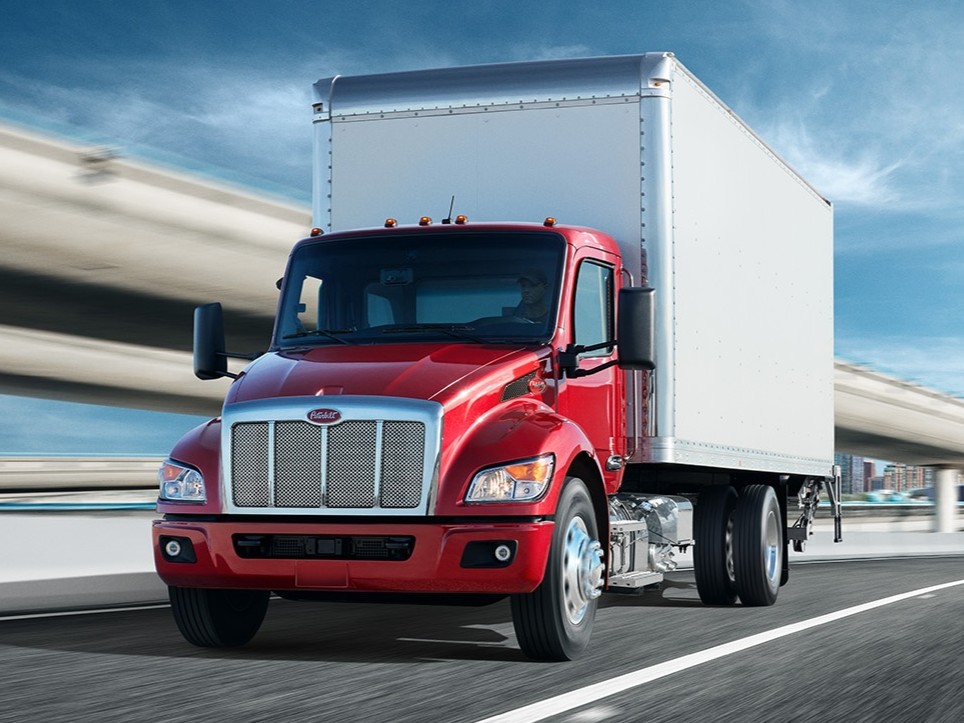
Of course, the average U-Haul renter probably won’t care about any of this, if they even notice! It’s notable that, despite having a larger box than the Ford F-650 Super Duty-based U-Haul JH, the Peterbilt has the same weight rating. As is standard practice for U-Haul, the rental version, which has a box built by U-Haul in Pomona, California, and Warrington, Pennsylvania, has a listed gross weight of 25,999 pounds. That means you can drive one on your standard driver’s license pretty much anywhere in America. Some states have stricter licensing. In Illinois, for example, your standard license gets you to 16,000 pounds. However, there is an exception for rental vehicles.
Here’s the spec sheet for the new U-Haul EM “Easy Mover,” from U-Haul:
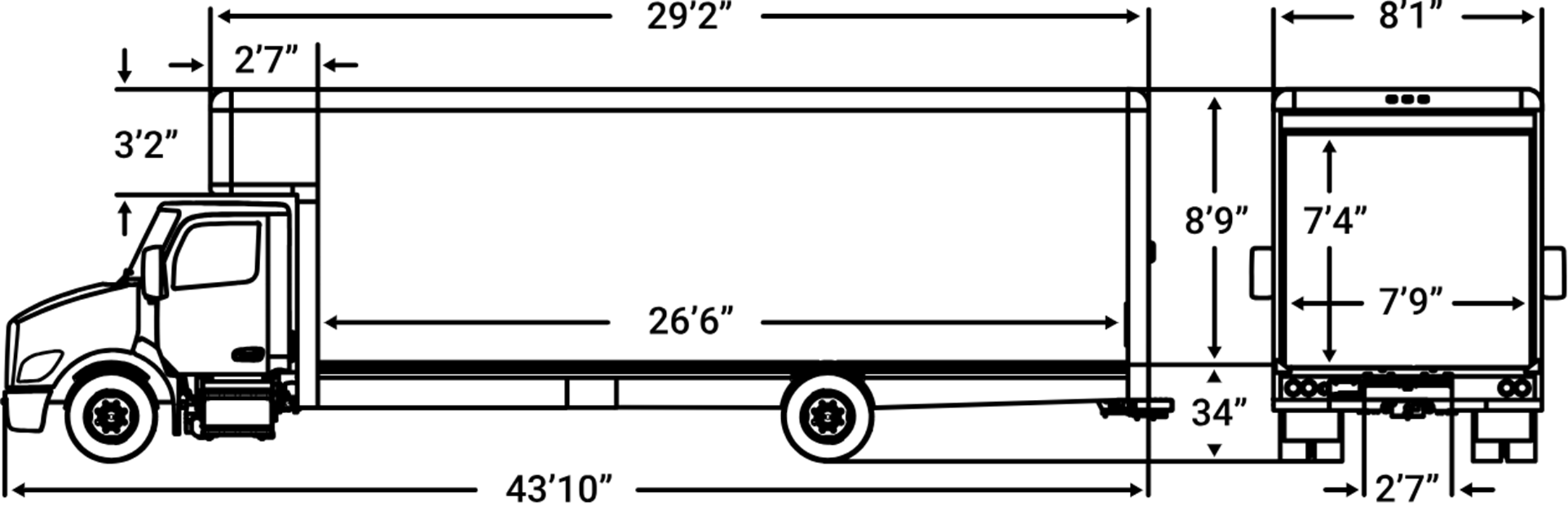
How big is a 29′ truck?
– Inside Dimensions: 29’2″ x 8’1″ x 8’9″ (LxWxH).
– Mom’s Attic: 2’7″ x 8’1″ x 3’2″ (LxWxH).
– Deck Height from Ground: 30-34″.
– Door Opening: 7’9″ x 7’4″ (WxH).
– Loading Ramp Width: 2′ 7″.
– Max Load: 11,939 lbs.
– Gross Vehicle Weight: 25,999 lbs. max.
– Empty Weight: 14,060 lbs.
– Towing Capacity: Up to 10,000 lbs.
– Volume: 2,057 cu. ft.
– Clearance Height: 12 ft.
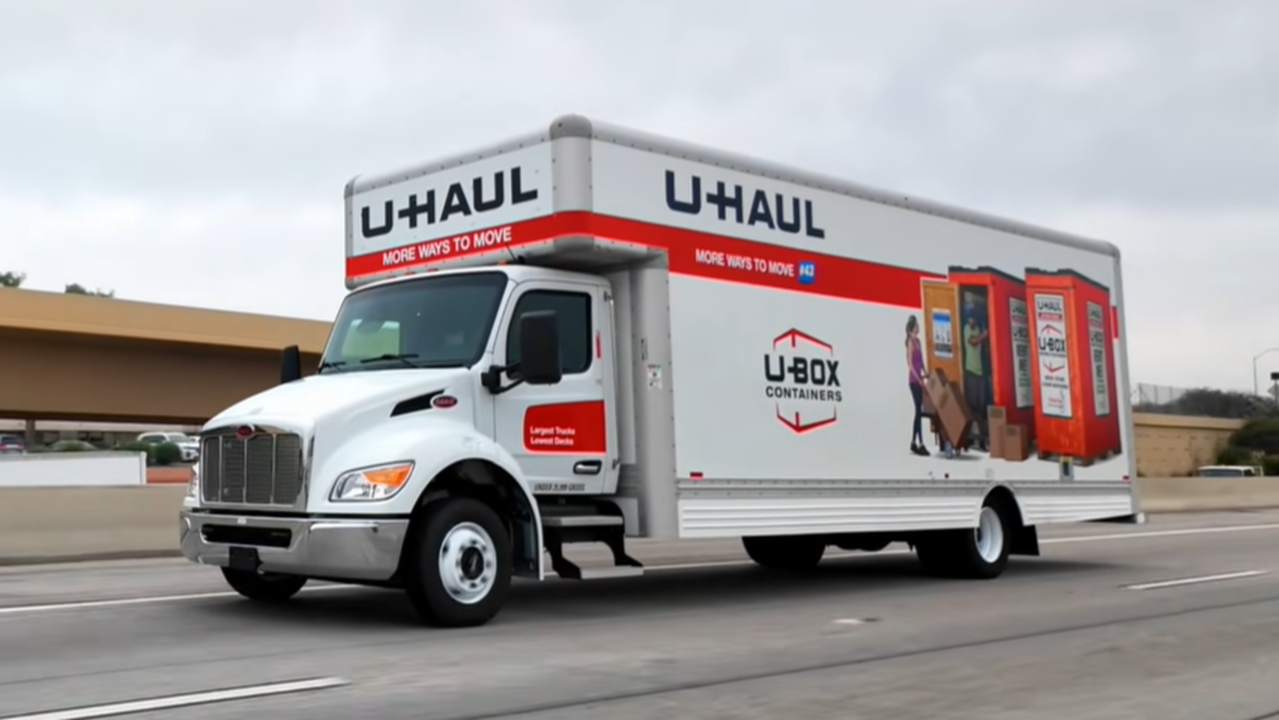
Additionally, the cab seats three, including the driver; the box fits 2,057 cu. ft. of cargo, and luxuries include air-conditioning, cruise control, power windows, and power locks. Hydraulic brakes are also standard.
The EM allegedly measures 43’10”-long, or over nine feet longer than the 34’5″-long U-Haul JH 26-foot truck. It also weighs around 900 more pounds empty and technically has a payload roughly 900 pounds lower than the shorter JH. Again, I doubt the average U-Haul renter will care, but the figures are fun to look at!
Update: Weirdly, if you run U-Haul’s numbers against Peterbilt’s spec of 107 inches from the front bumper to the back of the cab, this truck should be about 36 feet, not 43 feet as stated by U-Haul. It’s unclear where U-Haul is getting the extra 7 feet of length from on its spec sheet. In reality, the EM might be only a foot longer than the JH.
The First Cummins Gas Engine

The neatest feature, I think, is what’s under the hood. The Peterbilt Model 536 usually ships with a PACCAR PX-9 8.9-liter straight-six diesel with up to 380 HP and 1,250 lb.-ft. of torque on tap. Optional is the PACCAR PX-7, which is a 6.7-liter straight-six diesel derived from the Cummins B6.7 with 325 HP and 750 lb.-ft. of torque. Alternatively, you can get a Model 536 with a Cummins L9N or a B6.7N engine, which runs natural gas.
However, U-Haul’s fleet has run on 87 octane gasoline for years. Diesels were last in the U-Haul fleet back in the mid-2000s, and by then, those trucks were well-worn “In-Town” movers and not used for one-way rentals. In 2006, my dad managed to rent a 1980s International S1600 from our local U-Haul outfit, and it had a diesel V8, a manual transmission, air brakes, and even an air suspension that kneeled for easier loading.
U-Haul is all about driving ease nowadays, so you won’t find madness like that, sadly. So, what did U-Haul do about a truck that normally ships with diesel engines? As luck would have it, Peterbilt already had a solution. A little over a year ago, I wrote about how Cummins launched its first-ever gasoline engine, the B6.7 Octane turbocharged inline-six. This engine is pretty much the B6.7 diesel, but adapted to gasoline.

Here’s what I wrote last year:
In 2022, Cummins launched what it called its “fuel-agnostic” engine strategy. According to trucking journal CCJ, the goal of the Cummins fuel-agnostic strategy is to create a bridge between the heavy diesel engines of today and the heavy electric motors of tomorrow. The company recognizes that electric power is not yet ready to take over from diesel, so until electric and battery tech reaches that point, Cummins wants to offer other ways of reducing emissions and operating costs in everything from school buses to highway tractors.
[…]
How it works is pretty neat. To create the new architecture, Cummins started with existing platforms. Cummins says that the components below the heads of the base engines are supposed to be similar across the lineup. In other words, the bits under the head of the B6.7 Octane should be bits largely similar to what you get in the B6.7 diesel straight-six that powers hundreds of thousands of trucks. The parts commonality is pitched as not only a way for Cummins to make a variety of engines easier, but for fleet operators to have an easier time. In theory, a B6.7 Octane may have a similar diagnosis tree as a B6.7 diesel, at least under the head, anyway. Cummins also sees the B6.7 Octane as having diesel-like service intervals and saving fleets additional money as they won’t have to re-tool service departments just for the gasser.
[…]
The company goes further and says this is the only purpose-built gasoline engine in the medium-duty truck market, and that it gets up to 10 percent better fuel economy than other gas engines in medium-duty trucks. The biggest advantage, Cummins says, will be in maintenance. The B6.7 Octane has passive catalysts for emissions controls, and that means no DPFs and no DEF to worry about anymore. According to Cummins, the engine should only require the kind of maintenance expected for a gas engine in a pickup truck. This engine is also supposed to work a bit like a diesel. Cummins is currently quoting a maximum horsepower rating of 300 HP with max torque pegged at 660 lb-ft. Now, the truck engine nuts among you might find these numbers interesting. The horsepower rating is far lower than the 430 HP on tap in the Ford 7.3-liter Godzilla V8, but the twist in the Cummins is better than the Godzilla’s 475 lb-ft. Again, that’s by design. Like a common diesel engine, the Cummins straight-six gasser is supposed to make substantially more torque than horsepower.

Cummins says that all of the changes needed to get a B6.7 to run on gasoline are all in the head. Along with changing fuel injection from diesel to gasoline and adding spark plugs, Cummins also changed the compression ratio. Sadly, Cummins hasn’t made public the exact changes, but does say that the block and internals under the head are identical to the diesels.
The B6.7 Octane is very diesel-like in its features and performance, too. In addition to making up to 300 HP and 660 lb-ft of torque, the engine has a governed top speed of 3,200 RPM. It also sports a water-cooled and gear-driven 16.7 CFM naturally aspirated air compressor. Even wilder is the fact that this gas engine has a Jacobs Engine Brake, just like a diesel would have.
The idea here is to give diesel-like output but with gasoline fuel prices, lower maintenance costs, and no worrying about diesel exhaust fluid. In the Peterbilt Model 536, U-Haul says to expect 8 mpg, or two fewer than a U-Haul Ford F-650. Of course, your actual mileage may vary wildly. But 8 mpg is solid for a 36-foot brick being shoved down a highway. U-Haul says the engine is mated to a 60-gallon fuel tank and an eight-speed automatic transmission.
A Familiar U-Haul Experience, Just Bigger
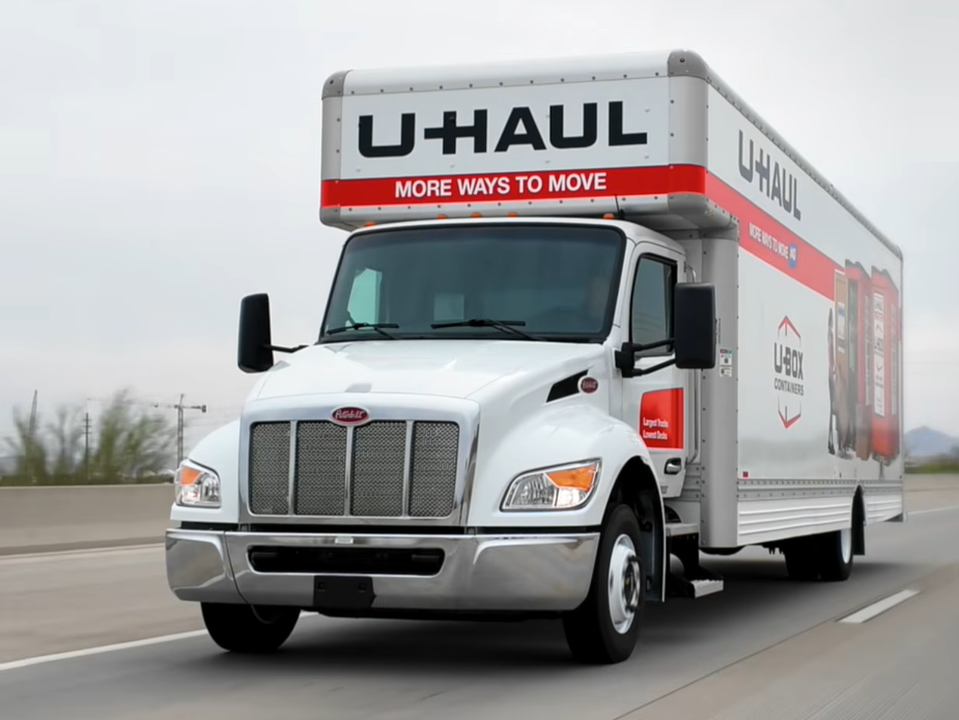
Here’s what U-Haul said in its press release about the new rig:
“We wanted to design a truck that fits everybody,” explained Jeremy Donohue, U-Haul Truck Product Director. “If you’ve never driven a truck, our goal was to remove the adversity, so nothing is difficult. Everything is intuitive. Everything is accessible. Controls are easily laid out. The EM’s features are like every other vehicle our customers drive.”
So, the EM is certainly one of the cooler new U-Hauls we’ve seen in a while. U-Haul says the EM is the company’s first new truck since the 20-foot TT model was introduced in 2011. It also means that U-Haul now has two big trucks in its fleet again after the 24-foot GH had been discontinued for years.
Of course, while it will be legal for just about anyone to drive one of these, please take care. This 36 feet of medium-duty truck isn’t going to handle like any passenger vehicle you can buy. You will need to take wide turns, you will need to slow down for curves, and you will need to give yourself ample braking distance. You will also need to make sure that whatever bridge you go under will fit a 12-foot-tall truck. Also, speed is not your friend in a rig this big. But you can do it if you do a little research first and be responsible.
U-Haul says the EM “Easy Mover” will roll out about now to the Los Angeles and Philadelphia rental markets. Then, the rest of the nation will get them. Rates start at $49.95 plus mileage for in-town rentals. I can’t wait to try one out just for the funsies.
Topshot: UHaul




rent one and do what Jack-ass guys did, have a party in a driving truck
as someone who wasn’t born in Canada or US it always blows my mind how you can rent this “weapon of mass destruction” without truck driver’s licence. I rented a 26-footer once and the entire trip I was worrying about the dimensions and wide turns I had to take and people around me not being hit. I consider mysel a good driver and drove all kind of shit but just handing the keys to this and saying: see ya later” is just so American. I alway try to stay away as far as possible from thiose big rental trucks as i know they are probably driving it first.last time in their life
I drove the 26 footer a few weeks ago for a local move and I was just glad I only had to do a few miles each way.
I had to take mine about 60kms away through the freaking 401 in Toronto Area and back….good thing it was fall and dry. if it was winter..no way
Drove a 26 footer for a friend through three states. Felt like racing. Just keep your line.
I’ve done cross country in the 26 foot Penske towing a car behind. I know it was well over 50 feet long and loaded well over 26k. Air brakes the whole deal. Blew past every weight station, not a care in the world. I was basically driving something the size and weight as a semi on a normal passenger license for 1500 miles. What could go wrong?
I drove an old International 26 foot truck with the old DT-series diesel and a manual transmission.
I found it to be easier to drive than expected. I just took it easy and didn’t try to do anything fast.
If you’re not in a hurry and already know how to drive a manual, these old trucks are not hard to drive.
You just have to me mindful of taking your turns wider and be mindful of low bridges and low hanging objects. And when backing up, have someone spot for you.
And the new trucks with their automatics are easier to drive. But the last one I rented that had the old/stupid Ford gasoline V10 was a mega-gas guzzler. Would have rather hand the old manual/diesel truck.
Sure it that gasoline V10 made more power.. but when I’m moving stuff, the extra power is mostly irrelevant since I’m not going fast anyway.
I kept having two thoughts repeatedly while reading this:
I was thinking the same thing, or rather I was trying to think of something really big that I need to move as an excuse to rent one. Can’t think of anything, might just rent one anyway.
The same rules should apply to folks driving a huge RV going slowly in the left lane .
Wait, are you suggesting the laws of physics don’t change when a vehicle is titled and registered as an RV???
That’s crazy talk.
I disagree on your second thought. The data shows that uhaul renters are not significantly more dangerous than regular drivers. I can think of a few reasons why:
1) people drive carefully because they don’t want to break their stuff.
2) young and old people are more likely to crash but uhaul renters are more likely to be middle age (old’s don’t move themselves, youngs don’t have enough stuff)
3) people driving a uhaul are more likely to be sober,
4)people are aware that driving big things require more caution so they focus more.
Can you provide a link to the data? I’m not disputing your claim, but I would like to see the data for myself.
As for your point, I think your logic is flawed. It is not valid to compare all Uhaul drivers to all drivers.
You specifically mentioned that Uhaul drivers are more likely to be sober and not elderly or very young than the general population. I couldn’t care less that a Uhaul driver is a safer driver than an intoxicated person, an elderly individual, or a teenager.
You also ignore that Uhaul trucks include some relatively small vehicles (vans, pickups, and a 10 foot box truck with a GVWR of 8600 lbs.). I specifically mentioned trucks with a GVWR over 10,000 lbs., with particular concern for the largest trucks. A pickup or 18 foot overall length/8600 GVWR box truck is obviously less challenging to drive than a 40 foot, 13 ton behemoth like the one mentioned in this article.
It would be far more useful to compare like to like (i.e. look at the data for age-matched, unimpaired drivers without a CDL , as well as removing data from drivers of small Uhaul vehicles) – if that shows drivers of large Uhaul trucks aren’t substantially more dangerous, I would have no objection to untrained individuals driving them.
I agree we should make laws based on data and not intuition and opinions, but we need to make sure we are interpreting and using available data correctly.
10K GVWR is too low, that’s a 3/4 ton truck.
I’d hear arguments for making it 14K (F450 and above), but I’m sympathetic to the argument that statistically these rentals are safer.
I would be okay with 14k, depending on what the data shows (again, I think laws should be based on facts and not personal opinions/feelings). You have to draw the line somewhere – I’m just skeptical 26k is the right place to draw that line.
Again, though, I want to see exactly what the statistics show. My concern is that these are statistics published by the rental companies specifically selected to show their businesses in the best light. I know from personal experience that data can be cherry picked to favor a certain outcome and that the same data set can have multiple interpretations.
Also, I am open to other solutions than requiring a CDL – something like an endorsement on a regular license might be a reasonable compromise.
A standard driver’s license in Europe only allows the holder to drive a vehicle up to 3,500 kg (7716 lbs). Seems to work fine for them.
That’s fine, and probably makes sense for a market without HD trucks.
Over here, I would be vehemently opposed.
Europe has the equivalent of US HD trucks – they just aren’t used as daily drivers. Yes, people would be opposed – that doesn’t mean we shouldn’t do it. People opposed CDL’s when they were new too.
Europe also doesn’t just have two classes. They have:
B: Up to 3500 kg vehicle + 750 kg trailer
B1: Up to 3500 kg vehicle + 3500 kg trailer
C: 3500 – 7500 vehicle + 750 kg trailer
C1: Combined up to 12000 kg of vehicle + trailer
CE: Any combination
Pretty logical. The heavier the vehicle / trailer the more training is required.
Let me rephrase then:
I’d need an extremely high burden of proof that the extra training and regulation has enough of a societal benefit to be worth it. Europe does a lot of things that wouldn’t fly here and I don’t think the fact that something is accepted there makes it a good idea everywhere.
I’d say their road fatality statistics support the concept that more training has a benefit to society. Our deaths per vehicle-mile are about 50% higher than Europe on average. Double the rates in Scandinavia.
It’s a pdf so I cannot link but look up:
“THE RENTAL TRUCK SAFETY STUDY REPORT TO CONGRESS
Pursuant to Section 32206 of the
Moving Ahead for Progress in the 21st Century Act (P.L. 112-141)
July 2014”
Scroll down a little bit and you will see that for 10,000-26,000 GVWR vehicles “Rentals” drivers are 11% safer than CDL drivers
Basicly a study targeting exactly the data you asked for.
My personal opinion would be that hypothetically even if rentals were more dangerous there should be higher burden on banning/restricting it. we can’t go and ban everything because it’s slightly more dangerous. 2 million people a year rent Uhauls and more from other companies. People need this service and the burden on people’s lives of having to hire movers instead of doing it themselves would be greater than a few extra car crashes.
Thank you. That is useful information.
It isn’t exactly what I am looking for, though. Again, I’m mostly concerned with the larger rental trucks (i.e. those closer to 26k GVWR). I would like to see this broken down further into small trucks (10k to 18k GVWR) and large trucks (18k to 26k GVWR). While unlikely based on the study you referenced, it is still possible larger rental trucks may be substantially more hazardous than smaller trucks. If larger rental trucks still have a similar or better safety record to CDL drivers, I would no longer have concerns.
(Also, I’m sorry if I am moving the goalposts a bit in my responses. Looking back at my comments, I didn’t do a good job of making it clear my concern is primarily with the biggest rental trucks.)
My personal opinion would be that … if rentals were more dangerous there should be higher burden on banning/restricting it. we can’t go and ban everything because it’s slightly more dangerous.
Just to be clear, I completely agree with you that some additional risk is acceptable. I just want to have a better idea of what that risk is. I think the data that is readily available does not answer some important questions.
Yep.
i can’t wait to watch these hit the 11’8″(+8″) bridge in Durham. It’s going to be fantastic.
This is not new. Uhaul and others have been renting 26 foot box trucks to anyone with a standard driver’s license for decades.
I rented one for the first time back in 2002. Never left town or got over 45 mph on this move.
Drove one cross country pulling a car trailer back in 2014. That one was an International with a 26 foot box that was limited to 65 mph but with a low RPM governor not speed governor. This made for VERY slow climbs up grades.
It isn’t new – I have had concerns about the 26 foot box trucks as well.
The study referenced by Space is good evidence in favor of allowing people to rent these without a CDL, but I still want to see safety data for the largest rental trucks and not just rental trucks in general.
I don’t doubt that 26 foot trucks can be driven safely by someone without a CDL, but there are definitely drivers who can’t handle vehicles this big. It is possible that people are good about knowing their own limits and renting trucks accordingly, though.
This new U-Haul is just a 26 foot box truck from Peterbilt instead of Ford. PACCAR won the bid this time, Ford last time, Chevy before that. Dimensionally they are very similar to U-Hauls of the past.
Given that California and New York hand out CDLs to illegal aliens that can’t speak, read or write English, like Cracker Jack goodies, I feel that the CDL is not a good predictor of competence behind the wheel of a big truck. Recent results indicate that familiarity with traffic laws might matter more than knowing maintenance and inspection of an air brake system.
On my flight back from Amsterdam, an engineer for Cummins sat next to me and he told me about the new gas engine. Pretty crazy I’m reading about it now.
Was he excited or weary of the new engine?
I’d be weary and wary. Development of that engine has been a fiasco.
I imagine it would be, a diesel piston combustion bowl is significantly different than gasoline piston design. So I feel like they’re leaving efficiency on the table by using the same short block, pistons and all.
We haven’t cracked open a Octane engine yet but I really doubt the pistons are the same.
That’s cummins’ claim, per the article.
I’m aware the article says that. That was the original goal.
I’m excited for the first person to do a teardown of one, or at least a head off.
It will be. I believe we send our test engines back to Cummin instead of doing teardowns ourselves.
He seemed really excited about it. I imagine an engine that doesn’t need DEF or more stringent emissions controls made his life easier.
If it works, most definitely. pre and post catalytics are a MUCH simpler solution.
This is great news!
What I really want with the B6.7 Octane is a HD Ram with the Mega Cab though.
With all the unreliable emissions crap diesels need to pass emissions nowadays I’d rather just have a gas engine, but I want it turboed for the high elevation I live at and the Cummins does that.
Should bolt right up to the transmissions they use for the Diesel 6.7s in the Ram HD Trucks, it’s just a matter of plumbing for gas instead of diesel and the proper software.
The commercial Octane will be WAY down on power vs the consumer spec diesel that they put in the Ram because pickups sell based on spec sheets not total cost per mile. We are talking half the HP and Torque.
On the positive side commercial B6.7 engines have a 250,000 mile powertrain warranty
Yeah but the consumer-spec diesel these days is waaaay overpowered in my view. So half the HP and Torque means we are back to power levels of the early-to-mid 2000s. And those power levels were perfectly adequate.
You and me both. I’d rather have the warranty and reasonable power. However, crazy spec sheets sell trucks.
I can’t see them offering a gas engine that costs about the same amount as the diesel with those specs.
“However, crazy spec sheets sell trucks”
Up until recently anyway. It’s really interesting how I see people in larger SUVs and big trucks driving Very Gently recently… likely in an effort to not burn as much fuel.
It’s one of the things that I like about higher fuel prices… people are inclined to use less of it. I also like that it’s causing a resurgence in BEV sales globally.
The Trump-loving oil industry is laughing right now, but they are screwing themselves in the long run.
And when my daughter needs her own car in about a year, I’m gonna strongly encourage her to either get a plug in hybrid or a BEV as an insurance policy against high fuel prices and a big middle finger to one of Trump’s key support bases.
How is it possible that some idiot like me, without a CDL, can legally operate one of these? Many years I rented a “little” 24′ box truck. All the time I was thinking “why did Budget let me rent this”?
Great ideas but I guess these things last two years before they are sold off due to the average UHaul drivers being unable to actually drive their regular cars let alone a 43 foot box truck. Better off with a sleeper cab and hire a retired semi truck operator.
U-Haul has been offering 26 foot trucks for years and years. The most recent was on a F-650 and before that they had Chevy Kodiaks. Looks like this round of bids PACCAR won.
Good thing the 11’8″ Bridge is now 12’4″.
I asked the Uhaul last time if there was a gas station they recommended nearby that the trucks fit under. They said it would clear all of them, which was good news. I just didn’t want to risk making that mistake.
I’d note that many states still limit single unit cargo vehicle lengths to 40 feet. but U-Haul doesn’t seem to know how long their truck is. Their dimensions give a box length excepting the front extension of 26′ 6″, truck boxes are generally dimensioned by inside length in 1′ increments, so that’s probably actually a 26″ box and the extra 6″ is the front wall and back door. Peterbuilt claims a 107″ bumper to back of cab dimension with the aero hood, add the standard 4″ between cab and box for the bits to flex and this looks to be only 35′ 9″ long plus however long the back bumper projects. That’s way shorter than 43 feet, but it’s U-Haul, so don’t expect exactness!
You are forgetting the grandma Attic over the cab.
Whoa! So yeah, now that you said that, I just ran U-Haul’s numbers against Peterbilt’s numbers. If you’re being generous, it’s 36 feet before the addition of the back bumper. There’s no way it has a 7-foot-long rear bumper. So maybe someone at U-Haul didn’t know how to measure? Maybe a typo?
Oh well, I’m going to correct my story until someone at U-Haul says otherwise.
Edit: Just because I’m paranoid about not being able to trust U-Haul’s numbers, I ran the BBC of the F-650 against the box length of the JH, and U-Haul’s graph is correct for that. Weird.
I suspect someone at U-Haul made a math mistake in adding up the cab, box, etc. lengths into an overall length. The “26 foot” truck’s diagram shows an overall length of 34′ 5″, adding 3 feet should give an overall length of 37 feet and some inches for the “29 foot” truck.
Maybe they measured it with the loading ramp extended? If so, LOL.
Be careful with those abbreviation letters they can mean more than one thing.
A long, long, long time ago, we moved from Cedar Rapids, IA to Savannah, GA. I rented a truck, loaded it with all our wordly goods, and hit the road.
At a cloverleaf in the Quad Cities, I saw an identical rental truck laying on its side in the grass. They had apparently attempted to negotiate the curve at speed. The truck laid over, the roof of the box ripped open, and their belongings were yard saled into the median.
That image was seared into my brain, and I drove MUCH more carefully that trip.
I witnessed a professional moving company top their rig over in New Hampshire, trailer split open like a can of beer in a campfire. Turns out the driver enjoyed drinking straight vodka. Who would have thought that could go wrong?
If they had just not exceeded the speed listed on those ‘ramp speed’ signs, they likely would have been fine.
It’s likely the idiots renting the truck were trying to drive the truck the same way they drove their car.
Reminded me of a time I was driving my Country Squire down to Austin for a car show. Going through Dallas I hit a patch of traffic and slow rolled past a Buick Roadmaster wagon that had been badly rear ended. Felt like an omen.
So when are you renting one for the day to review?
And take to the track!!
And get stuck!!!
Pretty much the moment they start showing up in Illinois!
We all know about your prior history with Uhaul trucks. This is a chance to redeem yourself.
“Just when I thought you couldn’t get any dumber, you go and do something like this…and totally redeem yourself!”
Also have to add:
“I can get 70 miles to the gallon on this hog!”
I have a feeling 379 and 389 drivers will not be happy about this.
I know household furniture is “light” and it would be hard to max out that 25,999lb GVWR.
But lets say you are moving something like stage rigging, stage lighting, speakers, band gear, etc. Something a bit heavier and a real world use for a rental box truck. With the added space but same weight rating, Id imagine you could easily go past that 25,999 lb GVWR
Are you actually going to overload the truck and make it unsafe to drive?? Or is that 25,999lb GVWR just a compliance thing to avoid a CDL. Id imagine there is a fudge factor and the real weight rating on that truck is A LOT higher
If it is anything like a Ford Ranger you can exceed the GVWR by alot before anything mechanical breaks.
I think the GVWR is more of a legal/liability thing. Like towing for crossovers in EU vs US.
FFR has an UNLIMITED GVWR! 🙂
It’s this.
And when driving on the highway and you have to go through those truck weigh stations, it’s a very good idea to weigh in UNDER that 26,000lb limit unless you have a CDL.
Nit-picky bit: The Paccar PX-7 isn’t derived from the Cummins B6.7, it is a Cummins B6.7. They’re painted dark grey and have a different logo but are otherwise identical.
I’m a bit surprised how much press this U-Haul is getting considering you can rent a F-650 from U-Haul today or an International or Freightliner from Penske via Home Depot.
“U-Haul says to expect 8 mpg”
I would plan on 4-5 mpg at anything close to max GVWR.
I mentioned the F-650! Though I was a bigger fan of the TopKicks. To me, it’s newsworthy because it’s an even bigger truck than U-Haul’s F-650. 9 more feet isn’t nothing!.
Have you used your measurement tape to confirm? Those guys in the marketing department are not to be trusted and I bet the grandma Attic is included in one of the trucks length
It is news worthy and a good fit for Autopian. I’ve also seen it on 3 other sites in the last 2 days – sites that never talk about RVs or moving trucks.
This is bigger than a F-650 U-Haul but the box is only 3 feet longer (29 vs 26 feet including the attic) The box without the attic is only 7 inches longer than the 26′ box moving trucks you can rent from Penske. Penske doesn’t give overall length but I suspect they are very similar.
Dang it, I’ve been bamboozled by not double-checking U-Haul’s spec sheet. U-Haul appears to be lying about it being 43 feet long. It’s more like 36 feet, or only a foot longer than the F-650 version. (The F-650 has a shorter BBC than the Pete).
U-Haul overcompensating again?
Ha ha
I’m afraid buying a Cummins because it runs on gas is a bit like buying a Mac because it runs Windows.
I mean, they’ve been doing CNG and LPG for decades, this is just another shift.
I cant wait for some kid to slap one of these into a bmw drift car in 10 years.
At 1350 pounds for the engine, it will definitely keep the front wheels planted!
There was a comedian a while ago who professed the U-Haul was an ancient Hawaiian word that means “I’ve never driven a truck before”.
On one hand yes, on the other hand you have dipshits in their regular cars that treat U-Hauls like they can stop on a dime.
I was gathering facebook marketplace furniture with my wife scouting out the small stuff in her car and while driving a 20ft truck in the slow lane I see a harley rider on the side of the road standing by his bike.
A beat to shit 90s chevy full size pickup accelerated in front of me from the fast lane then merged less than one car length in front of me while slamming on the brakes to get to his friend on the bike, his tailgate disappears in front of my hood and I hear a large bang. He proceeds to get out of his car, give me the finger, and walk to his friend.
I, frankly stunned, go out and inspect the front of the U-Haul. No damage, not a single scuff, the bang I heard was the sturdy wood king size bed frame in the back slamming into the front of the U-Haul box.
For every dipshit who drives a U-Haul wrong there has to be at least 10 assholes in regular automobiles like the guy I encountered that day.
I’m looking forward to the upcoming article about “I rented U-Haul’s big new truck to pick up two new kei cars I imported from Japan and in the process forgot to close the door and strap down the cars and am now searching for them in this big corn field…”
Handing this thing’s keys to Joe Random with no CDL is nuts to me.
They did it with RVs
That’s dumb and wrong, too.
It is nuts. But we live in a world of nuts. I’m reminded of this every holiday weekend when suburban dads are flying down the interstate at maximum sustainable velocity in F350s and 35-foot travel trailers, trying to eek out another hour of ATV and pallet bonfire time at the campsite before the Monday grind begins again.
If you need special training as well as a written and practical test to be able to legally operate a motorcycle with more any power than a push mower, I’m really baffled how Joe Random is allowed to drive ginormous Class A motorhomes, these bigass rental trucks, or tow fifth-wheels that are practically the length of a tractor trailer. I’m not sure how it being for “personal” vs “commercial” usage affects the laws of physics or the skill needed to safety operate or maintain it.
Perfectly encapsulates America. You need a license and legislative approval to kill yourself (motorcycle, assisted suicide), but no such restrictions to eliminate an entire bloodline with a single whoopsie (no weight restrictions on rentals/large trucks, guns).
Really funny that if you were getting paid to drive one of these around you’d need a CDL but if you’ve never driven anything bigger than a Prius they’ll hand you the keys for a weekend as long as you have a credit card.
All this means is that the redline is low. I do believe 1800 RPM is not correct though, that might be torque peak, but per the link to the Cummins site, the redline is 3200 RPM.
Oh snap, good catch! Sorry about that, I had multiple spec sheets open at the same time and must have pulled the limit for an actual Cummins diesel.
At what point does it become woefully stupid to give big truck keys to unskilled drivers?
I’m not yet sold on giving car keys to unskilled drivers.
Yeah, it’s crazy when you look at it on paper. But I keep an eye on the crash stats in my state, rental trucks somehow do not show up as statistically more dangerous. I know how people drive them, but that’s the numbers. So I grit my teeth and don’t look too close.
I’m not terribly surprised, really. I worked for Uhaul for a little over a year most of the damage was from low tree branches, not running into things. A lot of people renting bring someone along that’s comfortable driving a bigger vehicle because they are scared (I myself have driven many when friends were moving), and then when it’s loaded up with belongings people drive very carefully to avoid breaking their stuff.
Obviously things happen because people aren’t familiar with driving such large vehicles, but for the most part they are much more careful than they would be driving their own cars.
I am the Property Manager for a Storage Company trust me the renters and their help can’t drive the small truck no chance this goes any better. However a great use case would be for independent contractors delivering food products to your local grocery store as the normal box truck is being phased out. Did anyone write a column about the demise of the box truck
That tracks, friends were in the habit of renting U-Haul or similar trucks for moving band equipment for gigs. Once there was an encounter with a too low tree branch, peeled back the top like a can opener.
Luckily for them they had purchased the “covers everything” insurance. And they had to rent another truck, but did so from a different vendor that was actually open on the weekend. And parked the peeled truck out of sight around the corner when picking up the new rental.
Seems to be rather common that unskilled people still able to get driver’s licenses.
States need to update their written tests with questions like “While driving on a two lane road, you receive a notification of a like on your latest insta post. What should you do?”
a) Check it immediately, it might have been from someone with a lot of followers and thus very important.
b) Check it immediately, the dopamine hit will improve your mood resulting in safer driving
c) Film a Reel saying thank you but that you’re driving and will reply later.
d) All of the above
Werner, Swift, and other mega carriers have been doing it for decades. Which is why I hate them
We’re past that point.
Right about 26,001 GVWR I’d say.
26,000 GVWR
Well we are giving the keys to semi tractors with a 53 foot trailer that can’t read a street sign so.whats worse?
Probably a better choice to take a diesel engine and rework it to run gasoline than the other way around, as one manufacturer famously (infamously?) did back in in the day with, shall we say, questionable results.
But 1800 rpm and just 8 gears? The spacing on those ratios must be hella wide to get up to highways speed. Don’t try passing a car on a 2 lane with one of these things unless you can see about 6 miles of clear road ahead.
About a 500 rpm drop between gears, which on a diesel would be within the peak power curve. On this gasser, I figure acel will be similar to a fully loaded semi. So yes, passing on a 2 lane requires caution.
These are not meant to be passing they are meant to be passed.
Rental vehicles do lots of things they were never intended to do.
With a peak of only 300hp I’m not sure it would matter what the gear spacing was.
I thought it was crazy i was able to show up, give them my credit card, and drive off with a 26ft truck. Now they come out with this, absolutely nuts.
The 26ft truck was surprisingly easy to drive, I just always had to be aware of my turns, but handled great on the highway.
Do these larger trucks need to stop at the weight stations?
Non commercial usage, no. Weigh stations only care about commercial vehicles. Rentals for personal moving they could care less about. Much like monster rvs
“Rentals for personal moving they could care less about”
IF they ‘could care less’, that means the must care at least a little bit!
Depends on the state.
For real use advice buy the insurance.
Whenever I rent a truck, absolutely.
In the Province of Ontario in Canada, yes.