

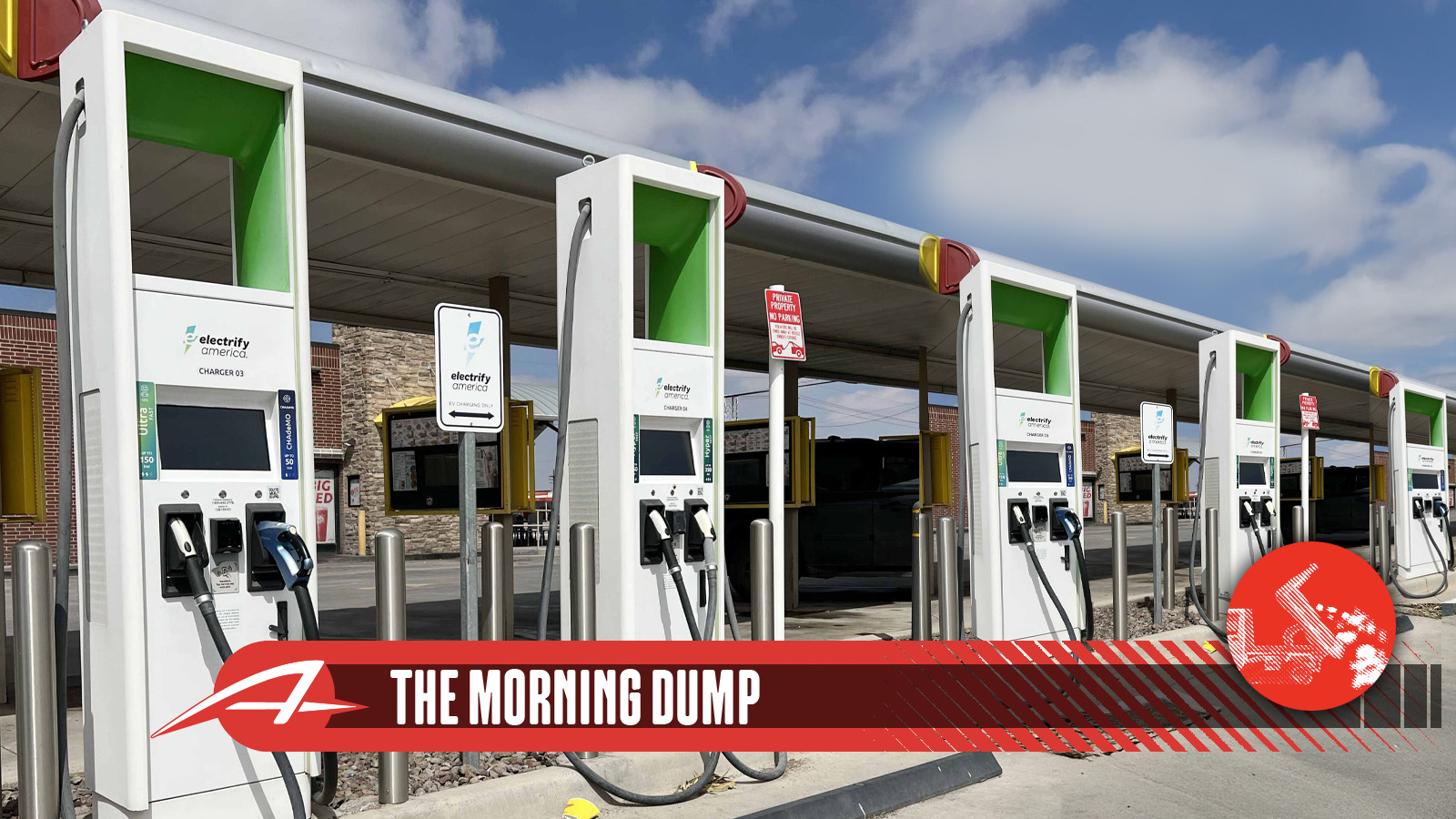
If I could go back in time to college, I probably would stop my ex-girlfriend from serving me that vodka drink she thought up freshman year. I’d also take more economics classes. I love the merger of data and human behavior, as well as the fact that even with data, no one ever seems to agree on anything.
EV fast charger build-out is a great way to understand the EV market and is, in a way, even more powerful as a data point than, say, sales. America keeps adding chargers and keeps needing them, even as pundits (sometimes me) keep reminding us that EVs aren’t as popular as everyone once thought. What’s going on? The Morning Dump is going to dive into it.


Part of EV demand waning has to do with cost, and Lexus has an interesting answer: The EV version of the new ES is cheaper than the hybrid version. That might be a first! What’s not a first is yet another market cycle where drivers are super underwater. When will it end? Maybe soon. Maybe never.
And, finally, Tesla holds onto its management-friendly union for a little bit longer.
Here Comes The Used EV Wave

There’s a great Bloomberg article out this week that points out a fact that may surprise you, which is that not only are more EV fast chargers being built, but demand continues to grow at a quick pace:
US chargers have become more reliable and far faster, which encourages more people to use them, according to Paren, a data platform focused on EV infrastructure. Charging networks added about 11,300 ultra-fast cords across the US last year, up 48% from 2024. And the high-speed buildout is only accelerating: In the fourth quarter, nearly one in four new chargers were capable of pumping at rates of 250 kilowatts or more, which can typically add 100 miles of driving range in less than 10 minutes.
Despite the uptick in the number of chargers and their ability to sling electrons faster, the average US charging station is still fairly busy most of the time.
The number of charging cords in the EVgo network has roughly doubled in the past three years. Yet each cord, on average, has steadily pumped more electrons in a given period.
There are a few obvious reasons for this. The first is that EV charger demand is about the total number of EVs on the road, not new EVs sold. Even if EV sales drop by half this year, that’s still more than 600,000 new vehicles out there driving around. Another reason for more chargers is that there are still federal and state funds flowing into projects, though politicians (primarily from the Republican party) have tried to curb some of that.
The biggest reason why I expect growth both in usage and distribution has less to do with how many EVs there are and more to do with who is buying them. Electric cars remain popular (and often required) for ride-hailing services, and those users tend to rely on fast-charging.
Maybe more important is the used EV market. As I’ve mentioned before, a quirk in the way the Inflation Reduction Act was enforced led to a huge number of cheap EV leases. Those leased EVs are starting to be returned, and now a bunch of consumers are going to have access to affordable, high-quality electric cars.
Those consumers are also probably more likely to live in apartments or other places where they don’t have home charging access. I live in a building, and neither of my parking spaces has charging as an available option. If I were to buy a used EV, I’d be forced to use the local public chargers.
This is one of those outcomes that’s good for the larger EV market, as the increase in demand means an increase in chargers, which helps solve one of the concerns that would-be buyers have about charger access.
The Lexus ES EV Is Cheaper Than The Lexus ES Hybrid
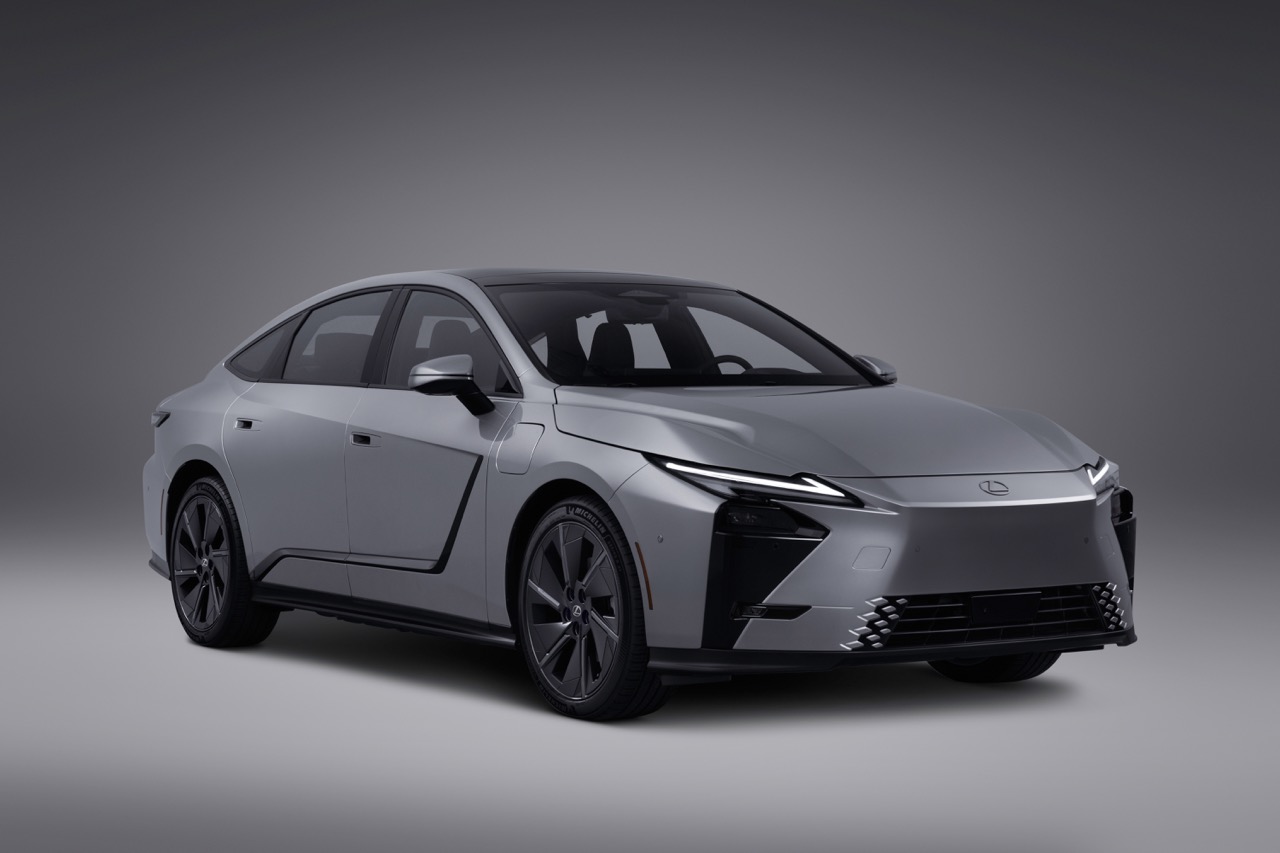
The 2026 Lexus ES is a big departure from the outgoing model, and now only comes as either a hybrid or an electric car. Curiously, the low-end EV version is now the cheapest of all the models.
The ES350h hybrid, which is roughly equivalent to last year’s ES300h (the gas-only ES250 and ES350 models are gone), makes a big jump in price up to $50,995. That base price is $6280 higher than before, which is likely accounted for by the new ES’s larger size and, presumably, additional standard equipment. Lexus hasn’t yet detailed what comes in the base Premium trim, or what you get by paying extra for the ES350h Premium+, starting at $55,795. The other significant change to the hybrid lineup is the option of all-wheel drive; it costs $1400 extra on both trims, and both the ES350h FWD and AWD models have 243 horsepower.
While EVs often cost extra compared to their gas-powered equivalents, the electric ES350e is the least expensive ES of the bunch. Starting at $48,795, it comes with front-wheel drive, 220 horsepower, and a claimed 300 miles of range. It’s offered in the base Premium trim, along with a Luxury trim for $57,195. To get all-wheel drive in the ES EV, you have to opt for the more powerful ES500e, which starts at $51,795 for the Premium and $60,195 for the Luxury. It has dual motors for a total output of 338 horsepower, but claimed driving range is lower, at 250 miles.
The loss of the Inflation Reduction Act probably plays to the benefit of certain automakers as it levels the playing field, and while $49k isn’t cheap, it’s the cheapest, and that’s quite the change.
IG Metall Loses Bid To Take Over Tesla Berlin
Last week, I pointed out that Germany’s biggest auto union, IG Metall, was trying to take over the works council at Tesla’s Berlin factory. It was contentious, but it sounds like workers there are fine with the status quo.
IG Metall, which has been fighting for more influence at Tesla’s gigafactory in Gruenheide, said it secured 13 of the works council’s 37 seats, leaving the committee’s majority in non-unionised hands.
Voting at the plant, the U.S. electric car maker’s only European production site, had started on Monday.
The current council is also dominated by non-union members, with IG Metall, which has for years been fighting for better working conditions, holding 16 of the council’s 39 seats, meaning an actual loss in representation.
Germans may be down on Tesla’s cars, but Tesla employees seem to like things the way they are.
How Long Will People Be Under Water?

Being underwater on a car loan means owing more in financing than the actual value of the car. It’s not great, and this usually happens in the hangover of some sort of financial event. In the case of the current market, a lot of this has to do with inflated prices during the post-pandemic period.
Is it turning around? Automotive News talked to some experts, and the answer is: Maybe, maybe not.
Scott Normandin, sales manager at Normandin Chrysler-Dodge-Jeep-Ram-Fiat in San Jose, Calif., said his dealership has seen “people coming in [$10,000], $20,000 dollars upside down.”
Nationally, a record 27 percent of all underwater new-vehicle buyers carried at least $10,000 in negative equity during the fourth quarter, according to Edmunds.
The problem was most acute on electric vehicles, particularly higher-end ones, Normandin said. He gave the example of an $80,000 EV for which “50 percent of the value is just gone” after two years.
“So I’m hoping it’s going to get better,” he said.
Patrick Manzi, National Automobile Dealers Association chief economist, presented negative equity volume and dollar amount data for new and used deals in a NADA Show speech Feb. 3. Those figures, from J.D. Power, followed a similar path as Edmunds’ statistics.
One possible out for buyers stuck on this cycle of needing new cars, but not being able to afford them, is leasing.
What I’m Listening To While Writing TMD
Who wants some bebop? Here’s Dizzie Gillespie doing “A Night in Tunisia” live.
The Big Question
What is stopping you from buying an electric car?
Top graphic image: Electrify America


EV discussions is the political debates of the car world.
My wife and I bought a prius prime in 2018. We barely used any gas because we could charge at home and when we went out there were often empty chargers because there just weren’t that many EVs/PHEVs at the time. These days the free chargers are almost always occupied and even the paid chargers are usually in use. The prius mostly burns gas these days because we moved from a single-family home to a condo, and while we’re working on having charging added to our off-street parking spot it’s a much longer process than just having a dryer plug installed under the panel of our single family home.
We do charge the prius at public chargers sometimes because it’s more pleasant to drive on EV mode and also using some battery helps it warm up more gently in the cold mornings. What we’ve noticed from that is the cost of electricity at public charging stations works out to the same or greater cost per mile compared to gas (although maybe that’ll change soon given geopolitics). The prius is just too dang efficient. So for us, the prius just makes the most sense until we get home charging again. Once we get charging installed we’ll likely get an EV.
You tease us with a hint of an anecdote about an ex-girlfriend, vodka and freshman year of college and leave us hanging.
Fine. What’s stopping me from buying an EV is
My next car will either be an EV or PHEV. The thing in the way is the incredible reliability and low cost of ownership of my 2013 Prius.
Ditto, but mine is an 07. When I bought it 4.5 years ago I looked at EVs, but the infrastructure situation still wasn’t good enough, and I do road trip this car pretty regularly. However, I’ve kept an eye on the EV charger situation and it’s gotten pretty good in my area. I think I could do an EV now, but the Prius was dirt cheap and has caused so few problems that I have a hard time parting with it.
The high cost of electricity in my neighborhood ($0.30/kw hr) is slowing my desire for an EV – that and my roof is almost maxed out with solar panels already. Also my garage currently only has one car for me that is used as the trip car – so it is not unusual to do 400+ mile trips into areas with few chargers. My Elise did note the new iX3 has 400 miles of range so she sounded interested.
Hahaha, €0.30/kWh is not high cost. You silly.
For the question, two reasons. I just don’t want a large Li-Ion battery in my attached garage while everybody’s asleep. I’m waiting for widespread adoption of a more stable battery chemistry, hopefully solid state.
The other reason is I don’t want to drive an iPad. Make the door handles normal and mechanical, make the interior controls intuitive and tactile with knobs and buttons. Stop un-solving problems.
EV fires happen a lot less than ICE fires.
(No my cars do not charge inside, stop asking).
Both our eNiro and our Cooper SE have normal door handles and tactile buttons for most stuff.
Regarding being underwater… “One possible out for buyers stuck on this cycle of needing new cars, but not being able to afford them, is leasing.”
But do they truly NEED new cars? Or do they merely WANT them?
In my view, the better way out is to keep what they have, focus on paying off the loan and after the warranty is up, learn how to do some wrenching.
“What is stopping you from buying an electric car?”
In 2024, what stopped me from buying the 2014 Tesla Model S 85 I wanted to buy was a crazy high insurance quote of around CAD$4500/year.
By comparison, the 2017 Ford C-Max I bought costs a bit under CAD$1500/year to insure.
I expected to pay a bit more for insurance on the Model S, but not THREE TIMES as much.
I thought about what else I could do with the $3000/year extra and decided not to buy the Model S. Rather use that $3000/year to help my kids with their post-secondary education and other stuff.
Also at the time, the Model S was really the only good used BEV on the market available for a reasonable price used that was big enough for my needs. Availability of the Mach E, Ioniq 5, Kia EV6 and other BEVs were thin on the ground and expensive back in 2024.
But the next time I’m in the market, there will be way more selection at better prices and thus, it’s much more likely I’ll go with a BEV next time.
And remember folks… always get the insurance quote before you pull the trigger on a car purchase to avoid any nasty surprises.
How many people “need” a new car vs how many “want” a new car? So many people I know buy a new car every 2-4 years, long before the depreciation curve has flattened for no reason other than vanity. If you’re always upside down, maybe it’s time to rethink that approach.
I have 5 cars in my family and the newest two are 2015 MY and they run fine. The oldest is 25 years old and also runs fine (but is rusting away – perfect car for my son). If you look after a vehicle, it should last at least 15 years.
I would definitely consider a used EV when it’s time to buy a car, but that might be a while.
“How many people “need” a new car vs how many “want” a new car? “
+1
That was my first thought as well!
New cars genuinely do make sense for people who pile on mileage and who intend to keep the car well beyond the life of the loan. Our family’s cars have been about 50/50 new and used. If you intend to own for a long time, used cars can represent significant risk, depending on the situation.
Now to the people who are buying new cars and trading them in with negative equity? Obviously that’s exceptionally stupid, and you shouldn’t ever do that. People who trade in their cars with multiple years of powertrain warranty still left on them drive me extra nuts. You’re just going to give that away? Lol.
The other thing about buying new is that not every segment depreciates like an EV. I’ve seen used vehicles listed higher than a similar brand new model. Sometimes even when they are cheaper, it’s not by enough to justify the loss of years/mileage from buying used.
It’s hard to make useful generalizations about used vs. new these days, and you should be suspicious of anyone claiming it’s cut and dried.
Yeah I’m often on here making a case for new cars provided you’re going to keep the car long term. There’s value in knowing everything a car has been through. And value in those first few years of minimal maintenance and high probability of reliability, not to mention warranty coverage.
I know a lot of people who stick to “buying new cars is for idiots” then go out and buy a 3 year old RAV4 for 3k less than a brand new one.
Edit: The rules were a lot different when nearly every off-lease car seemed to sell for 40% off it’s original sale price. That’s just not the way it is anymore (except for EVs, apparently).
I am a pretty decent candidate for an EV with short commutes mostly in cities but I live in an apartment, can’t charge at home, and the apartment management won’t install a charger.
Not spending more money, time, and frustration to wait at a charger, plus new EVs suffer from new-car-isms I don’t like (giant wheels, poor visibility, bright ass headlights, awful seats, distracting tech, screens, useless rear bumpers, some have no door handles, most of them are subjectively ugly, too high and heavy, and so on). In short, they aren’t for me specifically and that’s fine since I’m not in the market for one anyway.
“and the apartment management won’t install a charger.”
Is there anywhere on the property that has an existing regular 120V outlet near any parking spots? If so, ask if you can park in those spots and plug into the existing outlet.
Usually there are at least a few outlets around… particularly in underground garages.
Sadly none available outside and I don’t think running a 100ft extension cord is the best idea either 😛
Both of my cars are in good condition and paid for, so unless one gets totalled, I won’t need to replace one any time soon. If I don’t need another car, I don’t need an EV.
Now that that’s out of the way, there are several reasons I don’t want an EV. I think they’re generally ugly. For some reason, it seems like automakers have decided they need to look futuristic or something. Seriously, look at that Lexus. Ugh. Electricity is expensive and getting more expensive where I live. Maybe it’s the data centers, maybe it’s just because they can raise the rates, but it’s up about 20% year over year. I like a good road trip. Range is fine as I like to stop and stretch my legs every couple hundred miles, but I don’t want to stop for more than 5 minutes unless I’m having lunch or arrive at a destination/waypoint, so 20 minutes at a charger would be annoying. Cost – The price of a new EV is generally much higher than the cost of a comparable ICE car. Yeah, you can argue TCO is less, but I’m not convinced. If you keep it forever, it might be, but if you trade it in after five years, depreciation is a killer.
Man, do I hate stats as represented like this. That’s 27% of vehicles that were purchased with an underwater loan balance. These are people who decided to just kick the can further down rather than paying off what they already had, and for whom the right answer was “Keep your previous car that you still owe on.”
Most lenders will not deal with greater than 120 or 125%LTV, so getting to that 10k means taking out a 60k loan on a 50k car. And if I’ve said it before, I’ll say it again – there is no use case for a 50k car that cannot be adequately solved with a new Yaris or a 15k minivan.
>What is stopping you from buying an electric car?
The same thing that’s stopping me from buying any new car. These things were designed for brochures and not humans. I travel for work and have had the pleasure of many a rental car and each one has left me thinking “I don’t think I’m buying anything newer than ~2020 ever again…”
That is except for the Nissan Frontier I had last week, which was a refreshing breeze of familiarity within the stale air of touch screen hell.
What is stopping you from buying an electric car?
I don’t need a new car. Yet.When I do, I’ll sell my car, take on my wife’s car, and she will decide.She does not want an EV.New ones are too expensive (that depreciation is way too steep), and the rest are potential bricks. With an O.G. car. one could still limp it to the repair shop for minor things.I do not want all functions integrated. Separate functions are better, and they worked just fine for the longest time. (But that is all newer cars.)My wife and I do not drive enough per day to reap the savings. My median miles per day is 0. My wife’s median miles per day is 4. Sometimes we take 200-mile trips on weekends. Too close to call for an EV.Car doors, like the SNL pre-tape said.My electricity rates are actually pretty high. All that said, I could see leasing a 4-year-old EV. When does that market start up?
What’s stopping me from buying an electric car? So far nothing I have seen gives the theatrics of my corvette at a price that’s remotely affordable. Sure EVs (and any car made in the last decade) are faster, but that is only so appealing for so long.
German auto parts suppliers are laying off employees. VW is trimming down. Tesla workers must have considered this as part of the decision to vote yes or no for the union. Better to have a stable decent job than to not have a job that has better working conditions or perks. Assuming the current conditions are safe of course.
Narrator voice: They’ll all get fired all the same as soon as convenient.
My answer to the big question:
There are a few, but my number one reason for not considering an EV is charging. I live in an apartment with no charging access. There’s no local charging access. There’s no charging access at work or walking distance to work. I just do not know where I’d charge the thing that didn’t entail a special trip somewhere.
2nd reason, I can’t afford what I’d want. I’d be all over a Rivian, but I’m just not in that tax bracket. I could find a few I’d be happy with as a commuter or runabout, but see refer back to reason 1.
And as far as the charging problem, we don’t do infrastructure anymore, only war.
For apartments with garages, you may be able to charge with a Level 1 (120v).
YMMV, but I think people sometimes think you need Level 2 when Level 1 could work if your driving habits suite it.
I have a 60 mile round trip commute, I put on a decent amount of miles. If I only had to charge a few times a month I’d probably be able to figure it out, if I had the will.
Apartments with garages are pretty rare in my area, anything with one is likely new enough that charging is there or could be added.
I’d have to run an extension cord out my 2nd floor window, down across the sidewalk, to my car in the street. I’d also have to hope nobody parked in my spot.
Level 1 is impractical for those who needs the car daily.
I can get away with it only because I rarely touch the car on weekdays, and can afford to charge it for a couple days straight (as I am doing right now) so the car will be ready for the weekend.
Unfortunately for those without easy access to charging (ideally Level 2, as DCFC isn’t kind to batteries) EV isn’t yet practical.
What’s stopping me? Nothing.
Our fleet is 2 EVs & a Miata. Life’s good.
Edit w/ 2 important factors: Both purchased used from legacy dealers (yay depreciation). Iowa electricity is dirt cheap.
Another possible theory is that as the EV fleet ages and range depletes, the vehicles need to be charged more often.
More and more data regarding EV battery degradation is becoming available. It seems that for EVs newer than the ill-fated first-gen Leaf, EVs retain over 85% of charge even at 200k miles. Many do even better than that.
There you go. 15% increase in charging demand right there. 😉
That doesn’t change the demand, it changes the spacing If you have twice the battery capacity as me, you stop half as often. However, when I stop, I need half the charge that you need to top off my smaller battery.
Now, if everyone drove the same route with the same range cars, the lower range cars would be more of a problem for where to put the chargers. But since not everyone drives the same route and has the same cars, when the EV charging system is fully mature, the difference between a big and small battery will be more on how often you have to stop.
As a data point or two, my bolt EV at 2 years old with 20K miles still had 98% of its original capacity. Whereas a first gen leaf I owned for a little over a year lost about 4% in one year. Partly to blame was the fact that first gen leaf was air cooled for the battery, other part is that because the range was so low you were always charging it to 100%, where my bolt was only charge to 100% about 10 times in 2 years (charged to 80-85% otherwise).
What’s stopping me? The $27,000 roof my house needed a couple of years ago. Once that home equity loan is paid off I’ll be back to shopping for something new, and it’s likely to be a full BEV to replace my 2012 Volt. An Equinox comes to mind given the current deals.
Then again I’ve been going to more IMSA races and first gen Panameras have been starting to pop up remarkably cheap. Also, last night’s article about those bargain-basement four-cylinder Chevy trucks got me interested in CT4s after someone in the comments pointed out they share the same four-cyl.
Telsa in Germany.
I worked for a German company way back when. Large German companies have “central controlling boards” These boards are made up of 1/3 management, 1/3 the money people and 1/3 workers. All major decisions of the company need to get past this board. I think this is the law for many German Companies.
Telsa appears to be very anti-union. German laws are written very pro-union. A clash was almost baked into the decision to make a factory in Germany. I’ve actually never really figured out why Telsa picked Germany for that factory location in the first place.
Isn’t it also common for there to be some local political or state representation on the boards?
I think if you want to solve the EV charging problem, the focus should be on Level 2 chargers, not the faster Level 3 chargers. The solution isn’t even that hard.
First off, for the vast majority of drivers and the vast majority of their drives, they aren’t going on trips, but just doing life. Go to work, go to a store, go home, repeat.
Look at the parking lot where you work. What do you see? Lots of light poles. If the parking lot was there a long time, the light poles had 1-2kW bulbs in them back in the day. So the wiring is all there to support a Level 2 charger (or two) at each light pole.
During the day, when most of the employees are slaving away at their 9-5, these lights are off. Instead of just lights off, there is not a lot of effort to have switches that turn the lights off and EV chargers on.
My math says that for a typical office building, the cost impact of charging a typical commuter every day they are working is about 1% extra for the electricity bill. So, a company can offer free charging for their employee’s EVs without going broke for installation and impact on the cost of operations.
It would take some sort of incentive for companies to do that, but having work based charging allows EVs to be the cheaper option for daily commuting for many workers, which would increase demand on both the new and used market.
Even on trips, half of the time I use L3 chargers I could easily avoid if L2 chargers were fairly ubiquitous.
If you have the range, you could drive say 300 miles, L3 charge, drive another 300 miles and check into a hotel with a L2 charger. 500-600 miles a day is a good pace for a really long drive.
I would like to subscribe to your newsletter. I will warn you, though, that most people need a truck with 1000 mile range that can tow two houseboats at the same time for commuting. They would have to work some pretty long shifts to top those up.
Years ago, I drove corner to corner across the lower 48. I was changing jobs and they would pay for 5 nights on the road. So, I took all of them. I didn’t speed, I watched weather maps to avoid storms and I only drove during the daylight and I stopped to see stuff like Mt. Rushmore.
I learned in my 20s that long distance driving is like long distance running. If I took off and went as hard and fast as I could, I can’t drive far the next day. Keeping a slow steady pace is the best way.
Long story short, nothing worked out well in the PNW for me, and I came home 15 months later. This time, with me paying out of my own pocket…. I told MORE time. I ended up stopping one night and decided that I was tired and there was stuff to see, so I spent another night in the hotel. I had used the same chain for both trips, so I used a free night to just reset a bit.
More and more parking lots have solar panels on top. In sunnier locales the cars basically charge for free.
The problem with that is that I only need public charging when on a road trip and then L2 is way too slow.
Charging at work is great (we have free chargers but only 12 and a few hundred EVs) Current management has no plans to add more – even at the new building that is nearing completion.
How often do you road trip? If I had free L2 charging at work, I would look into a old Leaf or a Bolt to drive for work and save an ICE vehicle for the road trips. Or perhaps get a PHEV until the L3 charger distribution is better in my neck of the woods.
I never road trip with my Bolt. We drive the Acura wagon or the RV if we are going more than 300 miles. I do periodically DC charge but only to add 10 – 15 kWh to get me home. The Bolt charges too slow to road trip
A lot of people did look into old Leafs to take advantage of the free charging at work. I know a guy that buying the Leaf paid back in 18 months on fuel alone. The problem is that too many people did that.
We started with 6 chargers at 6 kw. We had rules that you could only charge for 4 hour and to move your car at lunch to open a spot and let others charge. Also only charge if you need to. 10 years ago I knew everyone with an EV and if you really needed to charge you could call someone and they would move.
Then those 6 chargers became 12 but on the same service so 3 kw. 10 EVs became hundreds and people lost the community. Now the same 12 people charge every day and don’t move their cars. Several are fully charged by the time I arrive at work but they sit there taking a spot all day.
I don’t mind the look of that ES but I sure can’t shake the Camry-meets-Ioniq-6 shadow over it.
As for what’s stopping me for grabbing an electric daily, my money is currently better spent elsewhere or saved and I would miss how tall my 4Runner’s cargo area is (two-row model) as well as trail capability, no spare, the Highlander EV is wide, door handles vary, there’s a lot to worry about. The F-150 is closest though.
I’d love a beater EV but parking space is limited.
I’m waiting to test drive the slate. And if I don’t like it, maybe the rivian r3.
very different cars, but ok.
Wow. That Lexus is not attractive.
This just in. Water is wet.
It reminds me of one of the less-attractive generations of a Hyundai Elantra, just heavier and even weirder.
“What is stopping you from buying an electric car?”
A few things:
PG&E residential rates: Even charging overnight it only just breaks even with gasoline. At partial, on peak or public rates? Fugetaboutit! And of course that doesn’t include charging losses which can be substantial.
Insurance: I expect the rates on a newer EV would be higher than my current 16 yo Mazda.
Functionality: I have no interest in yesterdays cool new tech that turned out to be awful and can brick the car on failure. Electric door handles, touchscreen everything? No thanks
Cost: I have yet to master the mathematical gymnastics needed to justify ownership. Even with free power the higher insurance, tire costs and sales tax alone might cancel any energy cost savings.
“16 yo Mazda”
Says “77 SR5 LIftback”
Nothing but love.
Right back at ya.
The insurance thing is no joke, and I know it’s been covered, but it’s worth repeating – it’s a big driver of the cost.
I have three cars – one is a 560 hp+ sports car, one is a 620 HP+ wagon and one is a Tesla Model 3. The Tesla is the most expensive to insure and not by a small amount.
And on a EV rate, PG&E Off Peak is $0.31/ kW-h. That really cuts into the savings as well, although Premium here is about $5.20 a gallon as of today.
This is going to be very dependent on an individual’s situation. When I owned a Model Y, the insurance on it was only about $6 more per month than my wife’s CR-V for the same coverage.
Absolutely a great point. I’m older, no kids in the house and no accidents or tickets on the current record, so that might have skewed things on the fast cars in a positive direction.
But that’s a great deal for you! Can I ask what company you were using?
I also forgot: Maintainance. They might not have an ICE or transmission but EVs have plenty of other things that can break. Suspension bits and electronics notably.
I had a rear suspension bushing that gave out at 30 k miles. Shredded a $250 tire and I had to buy the entire part with the bushing (they did not sell the bushing separately). I ended up getting some aftermarket adjustable links, but it was a $2k job.
And others have mentioned tires. Ugh.
Yikes!
I’m in the process of shooting my Mazda’s suspension with the parts cannon now, trying to fix an annoying clunk. Thankfully parts are shared with the Ford and even BMW so they are dirt cheap. Ball joints? $25/pair. Shocks and struts? $120 all around. Sway bar bushings? $10. Links? $20. Engine mounts? $20.
Similar for my 20 yo Honda. A few years ago when I thought I might have to replace the entire A/C system I priced the parts. A whole new A/C system would have cost under $500 plus my labor. As it turned out the fix was a $5 valve that literally took a minute to replace and $25 of Freon. That was years ago and it’s still blowing cold. Sometimes it really does “just need a recharge”.
EVs don’t notably have MORE “suspension bits and electronics” than an equivalent era non-EV. Repairs are not maintenance either. If you hit a curb with either you’re going to do damage. Shocks eventually wear out on anything. And so on. But you knew all this already. But if you want to contrast like this how about mentioning brakes, i.e. something that in many EVs you basically never need to replace since they aren’t generally used to any significant degree compared to a regular car/truck.
Parts are dirt cheap on your 16 year Mazda because it’s…a 16 year old Mazda. Price out the same parts for a 2025 Mazda CX-90.
Didn’t say they had more.
EVs tend to be much heavier than comparable ICE only vehicles which may accelerate wear and increase the probability of damage to said components.
“But if you want to contrast like this how about mentioning brakes, i.e. something that in many EVs you basically never need to replace since they aren’t generally used to any significant degree compared to a regular car/truck.”
Sure. Pads run about $50 all around and can last 10 years or better. They take very little time or effort to replace. The rotors, calipers etc are all original and doing fine thank you. Amortized costs are less than a rounding error.
“Price out the same parts for a 2025 Mazda CX-90.”
Because I HAVE a 16 yo Mazda, not a 1 yo Mazda. I’m not buying a
2025 Mazda CX-90 either.
Holy crap, your 16 year old Mazda rotors are original??? The average 16 year old Mazda around here is… well, disintegrated and in similar condition to Project Postal. Are Mazda rotors what they should have made the entire car out of?
As are my 20 yo Accord rotors. All eight rotors of both cars look, well not *new* but if the cars were wrecked tomorrow the rotors might well be the nicest in the junkyard.
Ah, I was reading your commentary as a screed against buying a new EV vs a new non-EV instead of comparing the running costs of a new (anything really, not just an EV) against those of a 16 year old presumably paid for Mazda.
No worries 🙂 It dawned on me afterward that might be the case.
“Premium here is about $5.20 a gallon as of today”
Here in the notoriously expensive SFBA Gas buddy says the range is $4.45-$5.63 so shop around a bit and you may be able to do better.
Well if current event continues, the math can easily flip towards favoring EV even where electricity is expensive.
We’ll see. I expect if gas prices go up electricity will soon follow.