


I had a bit of a whiplash moment this morning. Two well-respected analysts came out with reports about vehicle pricing and affordability, and neither report quite agreed with the other exactly as to the culprit. It’s a fun exercise to read both back-to-back as the problems are clearly identified and yet, while there’s some overlap, I don’t see fingers pointing quite in the same direction.
The Morning Dump will take a bit of a different approach this morning as I’m going to take the news of the day and analyze these two reports in the context of what they wrote, with the hope of coming to some sort of answer as to why no one has a clear answer. Obviously, I’ve written about this a lot this year, so I’ll try not to repeat myself too much.


This morning’s first analysis comes from Jessica Caldwell and her team at Edmunds. The other report is from Erin Keating at Cox Automotive. Edmunds, being B-to-C-focused, tends to have a consumer perspective, whereas Cox Automotive is a bit more B-to-B, but both are historically the best resources when it comes to tracking these issues.
The Manufacturer Is To Blame

This is the easy finger to point. Cars have gotten too fancy and too expensive and automakers have abandoned the lower-end of the market by getting rid of the sub-$25,000 car in almost every context. This is also the Trimflation argument, which is that automakers have prioritized higher margin vehicles and trim levels, meaning that even if a cheaper MSRP vehicle theoretically exists, few of them ever end up being built and sold.
This factor is called out by Edmunds, which reported today that a record number of people are taking out loans that are 84 months or longer.
“Unfortunately, this is the new normal for new-car buyers. Until we see a major shake-up in automaker incentives, a meaningful drop in interest rates, or a shift toward a more affordable mix of vehicles — none of which appear to be on the horizon — consumers will have to keep walking this financial tightrope.”
It’s the mix! This is definitely true, to some extent, although this chart from Cox is interesting:
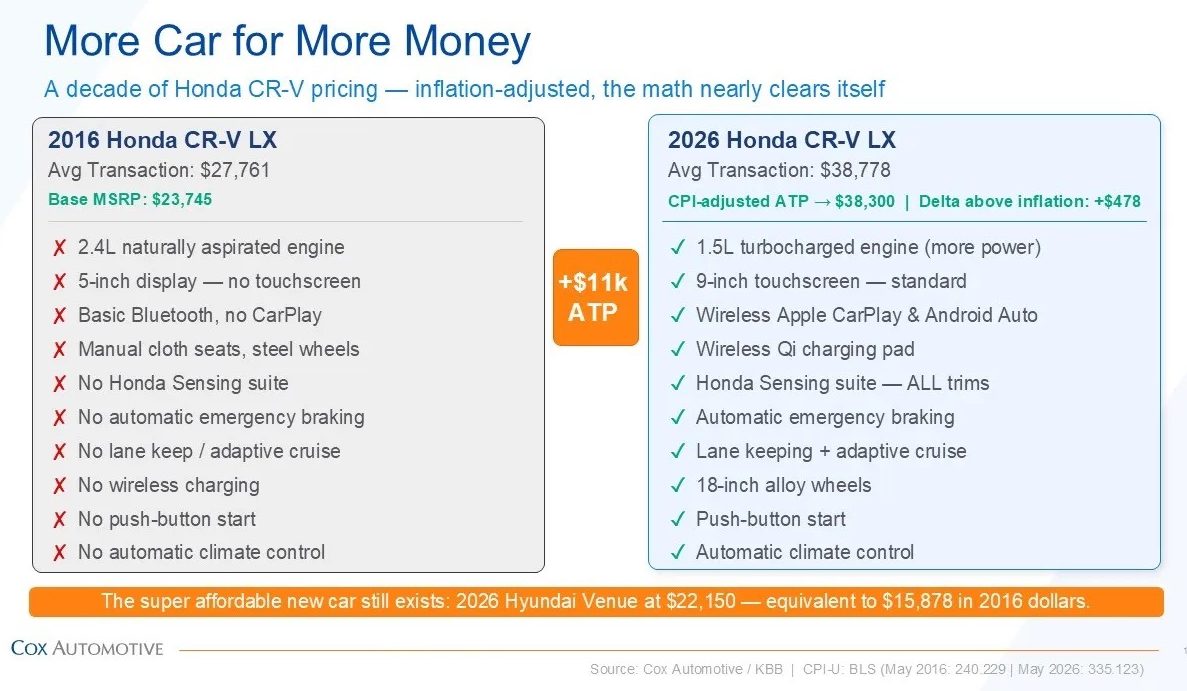
A 2026 CR-V, when adjusted for inflation, is only about $500 more expensive, yet offers way way way more stuff, and more stuff that people want. Specifically, the report from Cox is called “The Car Is Not the Villain” because, even though ATP is up $11,000, it’s more complicated than people just buying good cars.
Today’s CR-V includes turbocharged performance, advanced infotainment, wireless smartphone integration, and driver-assistance technologies that were optional or unavailable a decade ago. It is a better, more capable vehicle by almost any measure. Once adjusted for inflation and income growth, the price has barely moved.
The increasing price of the car is real, but is that the manufacturer or the consumer driving this trend?
The Consumer Is To Blame

As the Edmunds report points out, consumers are hitting record lengths and amounts for loans, with potentially dangerous outcomes:
“Car shoppers are caught in a dangerous practice of focusing heavily on their monthly payment while ignoring the potential long-term damage to their wallets,” said Ivan Drury, Edmunds’ director of insights. “Pushing loan terms past six or seven years might make an average monthly payment more digestible today, but it’s a mathematical trap. When you pair a 7.0% APR with an 84-month loan and a smaller down payment, you’re signing up to hand over nearly $10,000 on average in interest alone. Unfortunately, stretching out the term to be able to swallow a higher-priced vehicle guarantees you’ll be building equity at a snail’s pace, leaving you highly vulnerable to falling underwater when it’s time to trade in.”
Are car shoppers being irrational here? Cox would argue that getting a slightly higher trim vehicle isn’t necessarily bad:
There is also a common-sense piece to this. When the price gap between a base vehicle and a better-equipped model is relatively small, many buyers choose the vehicle with more features, better fuel efficiency, or stronger long-term usability.
That behavior is rational. Consumers are thinking about total value, not just the lowest entry price. Over time, those choices shift the sales mix and lift the industry average. The headline number moves, but the underlying story is consumer choice.
It’s true that consumers are not as interested in cheaper vehicles. Given how long people keep cars these days, I do wonder how much of an impact option for the cold weather package or whatever matters 13 years down the road. If you sell your vehicles at a more normal rate, then the options you have can command a higher price.
Politics Are To Blame

Tariffs have added costs to new cars, as have safety regulations and environmental regulation. This is nowhere clearer than on the lower end of the market, as the United States has long relied on imports for many of its cheapest cars. Nissan, which often offers the most affordable cars on the market, does so by relying largely on Mexico for production.
With the USMCA under review, the prospect of bringing more cars from Mexico is a sketchy one, with Nissan’s CEO Ivan Espinosa pointing out to Bloomberg that the company is suddenly paying 25% more to import its cars:
The duties are “making part of the lineup that we are bringing in from Mexico difficult to sell,” Espinosa said Wednesday on Bloomberg Surveillance. “Looking at the pressure that the US market has today in terms of affordability, we see that potentially some of the buyers could be moving into this type of vehicle, so we are working very strongly on making them more competitive.”
[…]
While the company has shifted some vehicle production to reduce its tariff exposure, it’s kept entry-level models like the Nissan Sentra compact and Kicks crossover in Mexico to take advantage of lower labor costs. The manufacturer has said tariffs on the Kicks and Sentra cost around $2,500 to $3,000 per vehicle.
$3,000 on a Sentra is insane and, even if the goal is to bring more manufacturing to the United States, the medium-term impacts are extremely real. Nissan is trying to find ways to make the cars cheaper in Mexico as opposed to just bringing production here.
Politics is definitely playing a role, although it varies a lot by car, and politics aren’t making people buy $50,000+ three-row SUVs.
It’s The Economy

Consumer preference, regulation, politics, manufacturing choices, et cetera are all part of the picture. The sad reality is that many things are conspiring to impact the car market, and there’s very little consumers can do about it because of the underlying economy. This is something that all the analysts seem to agree on, and though it isn’t necessarily the main culprit, it’s the one factor that is insurmountable for a consumer and difficult for automakers to impact.
First, from Cox:
The bigger issue is the economic environment around the vehicle. Purchasing power has been stretched, household budgets are under pressure, and consumers are absorbing higher costs across nearly every part of daily life.
Vehicle insurance has risen sharply. Auto loan rates are higher, so borrowing costs more. Maintenance and repair costs are up. Gasoline is higher, too. So are housing, groceries, healthcare, and subscription services.
In that environment, it is no surprise that a new vehicle feels out of reach for many Americans. But the issue isn’t the car itself — it’s because life got more expensive.
And from Edmunds:
“The Q2 data perfectly illustrates the stark reality of today’s new-vehicle market: Affordability is such a massive hurdle that buyers are forced to stretch their budgets to the absolute limit just to get into a new vehicle,” said Jessica Caldwell, Edmunds’ head of insights. “When you see loan terms extending to record lengths, down payments shrinking, and monthly payments hitting all-time highs, you’re looking at a clear recipe for long-term financial strain.”
Some consumers are too stretched by all the various negative economic factors, whereas other consumers are driving the K-shaped market by shrugging off those concerns and demanding bigger, better, nicer. Automakers are also facing these concerns as money is more expensive to borrow and they, too, will reach a limit of what they can offer affordably to consumers.
In the end, the fingers are pointing in various directions because there are legit that many directions to point in these days.
What I’m Listening To While Writing TMD
It’s “Cats” by Mitski, because my cat was up this morning yelling at me to feed him even though I’m wiped after the track day.
The Big Question
What would you bring to an Autopian track day?
Top graphic images: stock.adobe.com; DepositPhotos.com


My .02 is that everything has gone up other than wages.
A 1996 Corolla had a base price of about 13K. Today that would be 27,700.
The base price of a 2026 Corolla is $23,125. A 2026 Corolla is pretty much an S-Class compared to a ’96, so in fact you get more for less, relatively speaking.
It’s the cost of everything else that is (pardon my French), fucking people.
(Funny story, I once said that in a group of actual French people, and they looked puzzled, and asked why Americans say that).
Just look at the cost of housing alone- it’s skyrocketed since 2020. Even for the people that had the good fortune of buying pre-2020, they’re still paying more via property taxes. That home that was purchased for 200K is now worth 450k and taxed accordingly. And for those who weren’t able to buy then, good luck saving now that the rent has likely doubled.
Theres a segment of people experiencing unprecedented wealth growth, while the rest of us stagnate and fall further behind. The current wealth gap is larger than during the Guided Age, it’s time to start sharpening the pitchforks.
Your comment on the housing is correct. I bought well, but my town is increasingly gentrified. Families don’t stay so the turnover is high, and transaction prices are escalating. Seen many houses here double in just a couple years.
It’s wild in my area. Not too long ago, a local realtor posted a slide show of homes purchased 10-15 years ago with the selling prices of then vs now. It was supposed to show what a great investment local real estate is, but it just pissed people off. It was mostly average looking 400-500K-ish family homes selling in the millions now. .
Sounds familiar. We just moved, and it all seemed like monopoly money with the transaction amounts. Pretty much anyone who hasn’t been a homeowner for the past decade+ is hosed. I would have preferred if the prices were halved, even if it would have meant “losing” money on selling our old place, as it would have been logistically much easier, and we would have a much smaller mortgage now.
Having housing prices triple in a decade highly benefits a small group of people, but overall certainly seems to be quite negative for society as a whole.
This would imply everyone’s assessments have gone up, which would mean no one’s taxes have actually gone up. The way your taxes would increase is if the budget dramatically increases, or if your assessment in relation to everyone else’s assessment in the tax levy, has gone up.
My taxes went up based on assessments. Costs for my town went up, so there is that
Budgets haven’t dramatically increased but the budget to income ratio has.
The federal government cut off massive amounts of money that used to be sent to the states. The states then had to cut off money they used to send to their counties, and the counties have had to make up for the shortfall by increasing local tax revenue.
Your statement would be correct if greedy politicians didn’t see the huge increase in values and decide now is when they can finally get their pet project through, since so much money is available even keeping the tax rate the same. Also commercial property hasn’t increased in value as much as residential, so some of the tax burden has shifted more towards residential owners.
In my tiny city in eastern NC house values skyrocketed since 2020, I was lucky to buy right before they shot up. My tax value was 70k when I purchased at 99k, and after a reappraisal last year the tax value (after a successful appeal by me) is 210k, tripling it’s tax value.
The county managed to keep a revenue neutral rate, but my city taxes doubled. The council, when they did last year budget, noted they finally had the money to do all the little things they wanted to. They all got voted out this year. However, the new budget this year is only down by 4%, in spite of promises to reduce it (one councilman quit when he realized how things were happening.)
When I bought my house it was on the market for 1 weekend. From 2022-2024 houses were selling within a month of going on market. Note it’s a retirement community so deaths mean houses go on the market pretty often. Since the new tax rates, combined with higher interest rates, houses are sitting on the market much longer, 3-6 months for the ‘reasonably’ priced ones like my house, and longer for the old mansions with outrageous valuations that need lots of work to bring them up to standards modern buyers want. That’s how I was successful in my appeal – I noted my house hasn’t been updated since the 80s, while the comps they were using had all been redone this decade.
Housing is a whole other thing. 100 years ago we would use some land and materials to build a two-flat of (2) 1200 square foot homes. Now we use twice the land and more materials to build (1) 4000 square foot home.
Unless you are in AZ. Then it is 1/4 of the lot with as large a home that can be squeezed onto the lot. So close you can hear your neighbors flush there toilet on a quit day.
Not a joke on the toilet thing. My brother had this issue in Ahwatukee house.
God dam there vs their
damn
Same with Nevada, there is so little non-federal land they put the houses exactly 10′ apart (the legal minimum). The cost of land has gone way up.
New building codes have sneakily increased cost too. New houses in this county have to be built with fire sprinkler systems which sounds great except they add $10,000 to the cost and are more likely to leak and cause water/mold than they are to stop a fire.
Yeah, it doesn’t matter if the cost of something has only risen because of inflation if people’s wages haven’t also risen because of inflation.
In California Prop 13 locks in the taxable value of your home at whatever you paid for it (or your parents paid if you bought it from them or inherited it). There are large numbers of million dollar+ properties in CA that pay taxes as if they are still worth <$100K.
Prop 13 doesn’t lock taxable value, it limits annual increases in assessed property value to 2%.
Assessed property value is pretty much interchangeable with taxable value in California, Taxable value is assessed value minus any eligible exemptions (mainly a $7,000 Homeowners’ Exemption). Yes, it increases by a maximum of 2% a year, but when houses double or triple in value over the course of a decade, the taxable or assessed values have no relation to the current market value.
For example, the actor Jeff Bridges (the Dude) and his siblings inherited a beachfront Malibu mansion from his dad, Lloyd Bridges (Sea Hunt). Before it burned down it was assessed at about $500k for a annual property tax bill of about $5,700. They used it as a vacation rental, charging $25K per month in the summer. The vacant lot is on the market for almost $5 million.
I learnt that expression relatively recently from British person. I thought it was very funny.
Let them eat cake, god damn it…
Spot on with one addition: that home that was worth 250k is now worth 390k but assessed by the county at 450k, because local governments are running out of money too which tends to happen when the federal government takes tax dollars that used to be allocated to the states and instead uses them to bomb Iran and funnel money to the Trump crime family.
The bottom line is that we’ve been charging headlong toward unsustainable, no-rules capitalism and so-called “trickle-down” tax policy since 1980 and we’re finally reaping the rewards: the rich get most of the money and the rest get fucked. It just happened faster than planned because no one thought anyone could do what the Republicans are doing today, right out in the open, and get away with it.
Fuck pitchforks, it’s time to roll out the guillotines.
I’d bring my TR6 to a track day!
Shareholders looking for higher returns. The people with money want to make more. Consumers-“Look, I bought a new car! Look at how nice it is! I got all the options so when I sell/trade I’ll do better!” Which as was noted above means you’ve negated that with interest. Never mind that some of those features broke a lot.
I would drive a base model with a great drivetrain.
Oh yeah, and while the cars are better adjusted for inflation, my income has not
Up until my last car, I did. Spent everything on engine / mechanical upgrades. Nothing on extras.
Unfortunately, not a lot of that with US offerings. Can’t get a wagon never mind an inexpensive new one
Just checked out of curiosity. The cheapest estate car here is the Seat Leon Sportstourer. You can have it with a 115bhp 1.5 litre turbo engine a six speed manual for €23,200 (around $26,400).
Heaven to me
I blame capitalism and corporate money mining. Landlords, C-suites and shareholders. They want to make us into a society of subscribers, endlessly paying for everything.
I get that profit is the goal. They’re in the business of making money, which they do by selling cars. That’s fine; if you aren’t paying the bills you’re going broke. But to what degree is anything owed to the shareholders? Are executives actually worth millions of dollars when line staff are making one-twentieth as much?
Please note I say this with only a single 100-level Economics class and a bit of Business Ethics, and the argument of what shareholders are owed was vigorous, beginning in no small part with whether anything was owed at all. One thing we all agreed on was that shareholders’ engagement of business-related gambling was voluntary, which absolves business of a modest portion of liability.
Modest.
Obviously the whole point is to make money. How much money they get to make, well, there’s no promise there. And if they’re going to price the damned things like they’ve got a megayacht payment to make, we’re not going to buy. We don’t owe anyone that yacht, we don’t even owe anyone the opportunity to shop for a yacht.
I make decent money – not great by any means, up until last year we very nearly came close to breaking the six-figures mark but that has since changed. But the house is paid off and we live modestly. We could afford some stuff. But with the average new car price at $49,000, I don’t think we could afford a new car. And with the price of new cars going up so quickly, now there are previously-inconceivable 84-month car loans. Because people still need cars, and the banks don’t lend the money for free because they have shareholders too, all of them trying to get rich. How long before we see a ten-year car loan?
I say all this knowing that, as a holder of a shares in several mutual funds, I am among those people. But I’m not trying to get rich per se, I just don’t want to starve after I retire.
Still. Automaker executives. Shareholders.
They keep telling us that AI will make a lot of labor obsolete, and I agree. I’m fairly certain the CEOs and top-tier executives are a first choice for replacement with AI, provided the existing layer of middle managers protecting the rest of the company from the executives is retained, for obvious reasons.
But the cost of housing has rocketed up at a pace that far outstrips that of either inflation or wage growth. A house that cost just $100k in 2000 can, depending on the market, now cost 4x as much. I know that my house’s price has gone up by a factor of three; I couldn’t afford to buy my own house if I were shopping right now. Corporate landlords snapping up all the available housing and treating it as a money mill is poisoning the housing market, forcing hundreds of thousands of people into difficult decisions where they have to ask, which one can they cut back on: someplace to live, or something to drive? Some make the decision one way and become Van Lifers, and others become tenants, shopping deep into the classifieds for the reliable wrecks, driving up the prices on ten-year old Corollas.
What would I bring: I can’t afford anything special to bring, so I will bring my 1987 Toyota Truck. It isn’t fast, but I can help carry your wreckage home for you.
Are you under the impression that in some previous decade where cars were more affordable, that capitalism wasn’t in place? Or that cars were affordable in the USSR?
Excellent response.
So much hate on these boards for capitalism…
Lots of hate for capitalism. Cars were more affordable as people had more buying power. Enjoy your dividends
I don’t have dividends.
And I’m not that smart, but have enough neurons to see capitalism may suck, but it sucks less than any other system that has been tried
Good luck to you
I’m inclined to disagree, though I do confess that one of the funniest true things I ever read was that communism* was the most difficult and painful path from capitalism to capitalism.
Capitalism doesn’t have to suck, but unregulated capitalism will and does suck.
*The communism in question was that as practiced by the Soviet Union, which as communism goes was one of the most corrupt forms of government ever. On paper it could’ve been great; in practice it was just an orphan grinding machine.
Winston Churchill quote,
“Capitalism is the worst economic system… except for all the others,”
And that is the crux of the argument that is most often missed…
Very true. There’s also the factor that capitalist system is very much risk vs. reward — but as time goes on, the wealthier individuals and corporations get, and then they want all the rewards with none of the risk. So they find ways to put the risk on anyone else but them, while reaping more and more of the rewards for themselves alone. Workers see layoffs and stagnant wages justified by “economic headwinds” while the board and stockholders reap ever-bigger returns and still spend more on mergers and acquisitions to make more money — while none of it reaches the labor force.
So along comes democratic socialism, which promises to not eradicate the capitalist economy, but rather to regulate it so that individuals and smaller companies have more opportunity to compete, and surplus wealth is to be re-directed into bolstering the rest of society with essential things like healthcare and education. Unfortunately, everybody — and particularly wealthy political donors — have varying ideas on what constitutes “surplus” wealth, and so it’s blocked at nearly every turn in the US, where capitalism is only lightly regulated on a good day.
I’m not entirely pessimistic; there is more support for democratic-socialist political candidates in the US than there has been in a long time. But it’s still a terrible uphill slog to get the greater public to understand what democratic-socialism really is, and to un-learn decades of “Red Scare” propaganda.
Pretty much agree with you on all points. My only issue is in the actual nomenclature of “democratic socialism”. I’d really like to see it called something else because anything called “socialism” is pretty-much DOA because the average American is irrationally tied to labels that they can’t even define. We won’t even get into the gulf between American “capitalism” and actual capitalism. That’s a whole other depressing discussion…
Yes, the average American’s understanding of these labels is… tenuous. It would kind of suck to have to once again invent American-only terms for these things; after all, Europeans don’t seem to have any problems understanding them.
But then, Europeans have functional education systems…
“But then, Europeans have functional education systems”
But no A/C’s. Not very smart. lol
Limited use of A/C is due in part to a growing holistic view that A/C can aggravate urban environment heating due to units releasing concentrated amounts of heat plumes. In large numbers, it really is a thing. We still haven’t figured out a scalable way to deal with it. Heck, it’s still not a widely-discussed issue in all parts of the world, but the physics of the problem is undeniable.
The other, much bigger part, is the “We’ve always done it this way” mentality particularly in areas where A/C wasn’t overwhelmingly needed. There’s a strong contingent that still thinks it’s just an expensive luxury. Add to that the rising cost of electricity, and then adoption is further slowed.
Not all of Europe is anti-A/C. It was standard in modern buildings in Spain in the 80s, and retrofitting accelerated with portable units and mini-splits over the decades. Central A/C for homes and flats is still uncommon, but may be catching up. Spain’s climate makes A/C more of a need than a want; they’ve been dealing with the issues of mass usage by focusing on efficiency and use of renewables to meet the grid demands. The dryer climate also helps, since A/C efficiency declines in high humidity.
But the funny thing is that the will to wield capitalism all but dissappeared as soon as the specter of communism was out of the picture. It used to be that the ruling class had to convince the middle and lower classes that capitalism was better for them by actually materializing a better life for them. As soon as the poors had no other option, the rich started extracting us for every red cent. In a way communism was the only force keeping capitalism palatable.
We’re seeing a bit of a groundswell for democratic socialism, so perhaps we aren’t entirely out of alternatives.
Lots of hate for capitalism.
Not enough, but I’m here for what I can observe.
If it’s not a free market then it isn’t capitalism. The American government has had its hands on the market for decades and its whole purpose seems to be to benefit those who already have much more then they need. The job of the government in a truly free market would be to regulate markets and protect the people from predator corporations but this government and many around the world have been taken over by those who do not want to be regulated. These governments certainly have overstepped at times (OSHA is a problem but shouldn’t be) but what we have in America now is much more a kleptocracy and that happened long before DT came along and supercharged corruption to the point of no return (hopefully not but here we are debating who is to blame for unaffordability). It’s been a race to the bottom for basically my entire life (45 years) and the end goal of the rich is to take as much as they can while we fight over scraps. I say this as the owner of a tier 2 (maybe 3?) automotive supplier in Detroit. Cars are unaffordable because of corporate greed, full stop. Unfortunately the government (and Wall Street [unregulated by design]) fuels all of it. Blaming the consumer is weak. Yes people make dumb decisions and are eventually held accountable financially but banks letting them make stupid decisions to profit off of is a problem that a truly free market society would/should not put up with.
It’s much better here than Reddit, even more hate but anyone who speaks differently is banned.
The problem is that today’s crony capitalism is not the capitalism that helps everyone. Adam Smith said that there needed to be a 90% or higher inheritance tax to prevent capitalism from becoming a faux feudalism. Image how much better our country would be if that was the case.
The outcome of chasing the dragon of infinite growth. Gotta keep the stock price going up to keep the shareholders happy, but once the market matures, no choice but to start squeezing customers.
The car market has been “mature” in the United States longer than the vast majority of Americans have been alive.
But, line must go UP!
/s
Previous decades didn’t have capitalism beamed into the palm of every hand at all hours with contextualized, personalized advertising. Or variable pricing based on income, need, and desperation. Or monopolistic private equity companies buying up entire industries to fix prices and convert owned property to subscription models.
In this decade it’s evolved into a truer form with less oversight and a higher demand for immediate profit at any cost, while a geriatric governing body fails to assess how tech firms are perverting the market, or using it to get rich themselves.
The end stage of unprotected capitalism we’re marching toward is wealth concentrated in so few hands that society reverts to economic feudalism and an economic policy completely out of the control of regulators.
I do think that constantly seeing fancy lifestyles on one’s phone contributes to this, because people stretch to buy what they see. I don’t think that’s somehow more capitalist in any meaningful sense.
The real end stage is what happened in France in 1789…
No, and no.
I am under the impression that capitalistic practice is intensifying and finding new ways, or enhancing existing ways of squeezing money out of products, processes and people. And really those three things are all the same thing: products and processes are only enticements to part people from their money. It appears to me that the pace of the economy is accelerating and islands of peace and, for lack of a better word, freedom are getting smaller and farther between.
Are you under the impression that capitalism pre-Reagan worked the same as capitalism post-Reagan?
Wrong question because neither was free market capitalism. The big corporations have the government in their pocket to tilt the scales before, during and after Regan.
Very true, but it’s become orders of magnitude worse since the 80s.
I’m not a Reagan fan by any means. But are you saying cars are equally affordable now as they were in 1995?
No, I’m challenging your implication that the impacts of capitalism remain stagnant – i.e., that because cars were more affordable in years past under capitalism, it must not be capitalism’s fault that they’re unaffordable now.
That’s an incorrect assumption with no basis in fact.
I think you’re begging the question. I’m asking how capitalism got worse, for cars specifically, since 1995 or whatever date you want to place when cars were affordable. That also requires a definition of capitalism that isn’t “things about the economy I don’t like”.
Capitalism got worse in part because of the cumulative effects of supply-side tax policy, which lowers tax rates disproportionally on the wealthy. As their taxes go down, they keep more of their money. As time passes, the rich accumulate even more money while the rest of us don’t, and they use that money, not to hire more people as promised, but to influence lawmakers to pass legislation that lets them keep even more of their money.
It began in the early 80s, and had not yet had time to come to full fruition by the 90s.
Now it has.
Meanwhile those rich people, who frequently owned large businesses, also lobbied for more business-friendly policies such as allowing corporations to donate money to (read: bribe) politicians who then passed even more laws designed to tilt capitalism farther in favor of the elite few.
So, yes, we operated under capitalism in the past, and now that the effects of the rich putting their thumb on the scale for themselves have had time to mature, we live under worse capitalism now.
Cars are less affordable because life is less affordable.
People used to be able to buy a house on an average salary. Now, I so.e places, starter homes are 7-figures.
A family of four used to be supportable by the sole income of a blue collar worker who may or may not have graduated high school. Now, Ph.Ds are on food stamps.
A new car in 1980 was around 35% of the average income. Now, it’s closer to 60% even though cars cost about the same, adjusted for inflation, as they did in the 80s. But adjusted for inflation, incomes have remained stagnant and purchasing power has dropped significantly as the price of nearly everything else has skyrocketed.
As I said, cars are unaffordable because life is unaffordable.
We don’t have capitalism now. We have CRONY capitalism. Bribe the ruling party, and you get what you want. How do you think we ended up in a situation where the Billionaire class pays a smaller percentage of income as tax than a working person making $75k per year? We need to return to the Federal income tax structure of the 1950’s. You know – when Eisenhower was president.
The bottom line is that wages have gotten so far behind the rest of economy in terms of increasing along with it, that we are all a lot poorer, even while working more and more.
That’s only true if you deliberately play around with time frames to make it look that way.
Real (inflation-adjusted) wages are up over the last 10 years.
What would you bring to an Autopian track day?
I’d bring my 2021 F250 diesel. Of the five vehicles in my fleet, it is somehow the fastest and best handling. I need to buy the Mustang from today’s shitbox showdown just so I have something semi appropriate to take to a track in case the opportunity ever arises.
As for the cost of cars, trying to argue any single factor is the primary driver is kind of silly. Realistically, it is a combination of consumer expectations, cheap/easy credit (even with interest rates that have gone up the last few years), the cost of labor (which paradoxically can increase as efficiency/worker productivity increases), geopolitical issues (tariffs, etc.), the cost of raw materials required to build complex modern vehicles, and probably twenty other factors I could name if I cared enough to think about this for 10 minutes.
What about the banks? They’re the ones approving those ridiculous loan terms.
They are setting the loan terms, not just approving
Yeah, that too! The math to make an 84 month loan on a depreciating asset as collateral worthwhile is interesting to say the least.
I am afraid I won’t be able to afford used soon as there will be less cars and they won’t be as easy to repair
I imagine that they’re betting that most people with good enough credit to actually get said loans won’t leave them holding the bag. Your credit score affects your ability to do basically anything major with your finances, so anyone who can help it is going to maintain it as best they can. 7 years of guaranteed interest from 90+% of customers sounds pretty good to me.
And even if 5% said screw it and stopped paying after 5 years and had the car re-poed, they’ve already paid most of the principle & interest, and the bank can easily make up the rest selling the used car, even with depreciation and legal expenses.
Yeah, that or they figure most people won’t hold onto the car that long and it’ll get paid off by the next dealer and the negative equity rolled into another 84 month loan.
Also true.
84 month loans are only the fault of people buying the cars. In the end, the buyer is the one making the payment. If you need a 84 month loan you need to lower your car standards.
Or, you have the money to afford it and the interest rate is low. Then you’re just smart.
But but but I deserve a better car! And I haven’t learned any personal responsibility.
And maybe ‘the government’ will pardon my stupid car loan, the way they keep talking about pardoning borderline mentally challenged college loans
I don’t think people expect the government to bail out their car loan, they just aren’t thinking long term.
(Also, forgiving predatory college loans was a good thing.)
Great analysis. You’re forgetting also how capital wants higher and higher returns, so I’d add your 401k as a villain.
Now, can we clarify some misleading crap in that 2016-2026 comparison:
– a push button should be cheaper to make so that should be a downgrade for numbers sake (ironic that consumers think it’s an upgrade but see cause #2)
– same goes for the 1.4 engine. Should be cheaper to make, where’s our credit? (Please don’t mix R&D here since we have to assume 2016 Rav also had that going compared to 1996 models)
– Apple car play and other tech add-ons put money in the pockets of tech monopolies and away from shoppers. That’s a usability upgrade but can’t compare it to “we didn’t use to have CarPlay in 1996”. No one is comparing 2010 Sirius service to CarPlay and they should because maybe we don’t want it. Oh, you mean to tell me that it’s fully integrated into the car’s telematics and we don’t have a choice? I see I see.
Having nearly 100% of the population on a 401k retirement plan has resulted in pressure on companies to show short term growth over everything else.
More that putting everyone on 401(k) retirement plans was a result of the pressure on companies to show short-term growth over everything else.
Companies desperately wanted to get rid of pensions and as soon as the 401(k) came along, that was their offramp.
Because a 401(k) is not invested in a single asset or asset class, individual corporate performance has less of an impact on it than it does the *actual* shareholders – i.e., the ones who vote. And they’re the ones the corps care about. They don’t give a damn about anyone else, and quite honestly if you have a 401(k) you probably don’t have enough money for them to ever care.
1000% this.
I can’t begin to explain how much it pisses me off to hear about 30-somethings watching their portfolios daily as if retirement is right around the corner. Who gives a fuck what happens today if you aren’t retiring within the decade.
I can assure you that nearly 100% of the population isn’t on a 401k plan. In fact, it’s 35% of working age people.
How is a turbo and intercooled engine cheaper?
Not specifically turbo vs aspirated but a smaller engine in 2026 will (should) surely cost less than its larger 2 prior gen predecessor. I use surely as “probably” of course. I am no engine engineer with 30 years of data. My argument assumes that if it wasn’t cheaper or more efficient, they would not do it.
Not sure if I understood you correctly, but smaller engines are not necessarily cheaper to make, especially if there is a technological difference (turbos, direct injection, etc).
That is the crux of the problem, a 10 year old car should be cheaper to make and therefore well below inflation, but we are not comparing a car with the same car built 10 years later we are comparing a car with a completely different car, hiding behind the same name.
Seriously? Its literally the automakers, they chose to discontinue cars, especially smaller cars, in favor of SUVs and pickups. They chose to discontinue base trim levels and sell everything well equipped, they chose to repeatedly raise prices on the same old models that have been in production for ages, when amortization of tooling and R&D should be making them cheaper to build per unit
While that’s absolutely true when talking about Ford and Stellantis, but what about the other 15ish companies? GM, Honda, Hyundai, Mazda, and several others all have ~30K cars that I would actually want to own.
Right, but they used to sell even smaller, cheaper cars. Those are gone.
🙂
yeah that’s true, but the only one of those I’d personally want to own was a Honda Fit…
edit – My mom’s Kia Rio of the last year they made it really surprised me by how much I liked driving it, even with the CVT. I much preferred it over the 2010 Camry she had even though you might be able to argue the Camry was a “better” car.
A friend of mine commuted in a purple manual Rio for years! He loved that silly thing.
The cars that remain are much cheaper.
For example:
A 2024 Camry was cheaper than a 1995 Corolla.
That is simply not true, and I have a close example. A cousin of mine had a Fiat 500 which she replaced with a Toyota Yaris Cross. Nobody forced her into the crossover as Toyota still sells the regular Yaris hatchback. She chose the crossover on her own.
Not here they don’t
They discontinue those models because there’s no market for them. Nobody wants a decontented penalty box in 2026 and automakers are responding accordingly. That’s just rational.
If there was a market for those cars, it would be filled by an enterprising automaker looking to capitalize on their rivals’ decisions.
Nope, any existing automaker would only steal sales from their own, existing, higher margin models, and tariffs and FMVSS make it almost impossible for anyone new to come in (which is what would naturally happen under these circumstances in a truly free market, but government intervention prevents those forces from working)
TBQ: My 03 Honda Civic LX and my 13 Honda Civic Si of course.
I could finally get lap time comparisons, and while I know the Si is faster, how much faster is it really?
Also, which is really more fun to drive full out? I don’t know that my skills will keep up with the Si at full tilt, while the Lx is so slow as to be frustrating on big straights. My instructor at my last Open Track Day commended me on the Lx “Get good divining this and you’ll be a monster in something capable” sadly that was two summers ago, and I haven’t been able to go back.
Inflationary adjustments are not an accurate comparison of “cost”. The best measure is hours worked. Take your pool of buyers of given product, find their average wage, then find how many hours it takes them to purchase that product. Do that for both time periods. If hours went up, cost is up. If hours went down, then cost is down.
Great. So for the CR-V above. Median wage (according to bureau of labor statistics) unadjusted was 37,040 which works out to 17.80 per hour. The 2016 costs 1600 hours of work. 2025 (26 data not yet available) is 62,088, or 29.85 per hour. The 2026 car costs 1300 hours of work.
Happy to accept other sources of data if you prefer them.
So 300 hours less. Now whats the hours difference for median healthcare, education, and housing expenses?
That’s not really about the car anymore, is it?
If all your labor hours “saved” buying a new car spent somewhere else and then some, that car isn’t exactly more “affordable”. You can’t talk about affordability in a vacuum.
But then you’re no longer measuring the affordability of just the car, you’re measuring how attainable everything in the amorphous bucket called “lifestyle” is. I’m not saying what you’re pointing out isn’t a problem, just that the evidence isn’t there that cars are a significant part of the problem.
How exactly does affordability of a car works, if you don’t take into account available money to spend on a car?
Because words have meaning. Cars are more affordable by the similar car/hours worked metric. Housing is less affordable by the same metric. So claiming that cars are less affordable because housing is more expensive, even when cheap cars are still cheap but fewer people are buying them, doesn’t make sense. Certainly GM isn’t responsible for housing being more expensive!
Yes. Words do have meaning. What do you think “affordable” means? Person A who has three kids might find a car unaffordable that Person B who has no kids finds affordable, even if they have the same income.
You’re playing a game of semantics and are losing.
We’re talking about median wages and hours worked, so there is no person A or B in this scenario, all the people exist in the amorphous blob called ‘data set’ of which the median is derived, representative of persons A, B, C, all the way down to cell XFD, 1,048,576
And in the above data set, the affordability, by your very own definition, of a car in 2026 is better than 2016. Please stop trying to be clever, it doesn’t suit you.
Cool. Now follow the comment trail and see what Goose said,
“So 300 hours less. Now whats the hours difference for median healthcare, education, and housing expenses?”
I used people because it made an easily understandable example of affordability. I’m not being semantic. Affordable isn’t about semantics. It’s price and money availability.
If the median person is stuck spending more on housing, they might have less money to spend on cars. Which could mean the car is in fact, less affordable. Now replacing housing with groceries, or gas, or whatever else that is impacting the median person…
This isn’t rocket science.
Here a big one – insurance. I know some co-workers where their insurance is more than that car payment. One just gave up last week, his $800/month insurance on a Nissan Sentra was breaking him. He bought an old Chevy Impala that he could put liability only on.
His problem was he moved back in with his mother and sister, and a new push by insurance to base it on everyone who could possibly drive the car in his house tripled his insurance over his last residence. His mother had a speeding ticket, and his sister an accident.
Words in context of sentences and paragraphs communicate ideas. The context here is the population level, not difference between individual households.
Yes, and this whole thing started off with Goose saying, “So 300 hours less. Now whats the hours difference for median healthcare, education, and housing expenses?”
Do those things not affect affordability?
What’s this article about, Ferdinand?
Not affordability. It’s about price and consumer buying habits/tendencies.
You would be correct if we were talking about countries where the majority of people can feasibly choose to live without a car. But we aren’t; you need a car to be employable, to get groceries, to do everything in the US. So the demand for personal transportation has become in-elastic in this country.
I would argue that affordability is exactly what you state here. A measure of fitting a purchase into a life. That is why my initial argument is about COST which is static and mathematic. It doesn’t care how wealthy you are, the cost stays the same. But affordability is VERY concerned with how wealthy you are. Being more wealthy makes larger costs more affordable. And I would very much be cautious that one CRV math done by one person is a demonstrable proof cars aren’t part of the problem. There are multiple ways to argue his data pool isn’t apt to the discussion (should it be zoomed in on new car and potential new car buyers? Should it be zoomed in on only CRV buyers? Only Honda Buyers? Only NEW Honda Buyers?) and no one actually fact checked anything. That is a strong position to take from one random internet comment.
I haven’t done every vehicle but there is a strong pattern.
Year
Model
Base MSRP
Median Household Income
Weeks for median household to buy the vehicle.
1995 Nissan Sentra….. $ 11,389…. $34,080…..17.4
2024 Nissan Sentra….. $ 20,630…. $83,730…..12.8
1990 VW Jetta Sedan.. $10295…… $ 29,940….17.9
2024 VW Jetta Sedan.. $21435…… $ 83,730… 13.3
1995 Ford Explorer…. $19,485….$ 34,080……. 29.7
2024 Ford Explorer…. $38,455….$ 83,730……. 23.9
1995 Wrangler 2D…… $12,313…. $ 34,080….. 18.8
2024 Wranger 2D …… $31,995…. $ 83,73……..13.3
1997 Honda CR-V….. $19,695…. $ 34,080…… 30.1
2024 Honda CR-V……$29,500…. $ 83,730…… 23.9
1995 Corolla Sedan…. $13,782….. 34,080…… 21.0
2024 Corolla Sedan…. $22,050….. $83,730…. 13.7
1995 Camry Coupe ….. $16,128…..$ 34,080… 24.6
2024 Camry Sedan …… $26,420….$ 83,730… 16.4
2001 Highlander 2wd…. $ 23,515… $ 42,230… 29.0
2024 Highlander 2wd…. $ 39,270… $ 83,730… 24.4
1996 Toyota RAV4……$17,758……. $ 35,490 .. 26.0
2024 Toyota RAV4….. $28,675……. $83,730 ….17.8
1995 Tacoma Xtra…… $15,248…… $34,080…. 23.3
2024 Tacoma Xtra…… $31,500…… $83,730…. 19.6
1990 Ford F150…….. $12,584 …… $29,940 …. 21.9
2024 Ford F150…….. $38,000 …… $83,730 …. 24.5
(XL Regular Cab, Short Bed, RWD)
To some extent I see your point. Affordable is very much term of “weighing”. What is affordable to some is not affordable to others. But to be fair, you also changed the topic. My initial statement, which I stand by, is to measure COST, not affordability. And the direct cost to a person seems to have gone down. But whether a reduced cost has maintained its position as “Affordable” does have to be taken in context of other necessary costs, and compared to the net value the purchase brings compared to the costs in the market for other similar things.
Uhhh, why is wage any more about the car than take home pay or discretionary income? Expanding beyond wage/cost gets into general affordability, which is exactly what this article is about. Cost is kind of pointless without additional context. Lower cost =/= more affordable, wage =/= discretionary income, or that wage directly correlates to affordability. If those additional wages over the past 10 years get eaten up before the wage even hits your bank account (i.e. income tax changes or health insurance premiums increases could mean your take home pay decreased even if your wage went up) you might actually have to work more hours for the same car; something that looking at only wages wouldn’t show. It could also be the opposite, I’m not sure what the actual case is over the past 10 years.
At the same time, you might have inelastic expenses that drastically change what other costs are actually affordable or not. If you’re spending all your money on X, it doesn’t matter how cheap Y is, it’s still unaffordable.
Well said.
Can we all just agree that everything costs too damn much these days?
Please remember that “median” wage is a lie. As long as the top earners are on a steep enough line going up, median will go up despite the average person’s wage going down.
If Musk makes one billion and you make 20k, but in 10 years Musk makes 2 billion and you make 15k median wage will still be about 1 billion more over those 10 years.
Ok. What’s a good measure? Median “wage” is the median of reported earned income, so salaries and wages, not capital gains. Median of that seems to me like a pretty good measure of overall trends in income. But I’d love to hear what you think is a more accurate measure.
“Mode” would be the salary most people make.
https://www.purplemath.com/modules/meanmode.htm
For the most part, you cant beat Mark Twain “There are three kinds of lies: lies, damned lies and statistics.”
:/
I’m sorry… but what? Please tell me you’re not serious.
I for one appreciate your quick calculation proving them wrong and your follow up replies. Thank you.
While thats not the data pool I think accurately reflects the “buying audience” (which I personally think is a more interesting measure. It measures how people who actually want it and might buy it have been impacted), it demonstrates my point perfectly. Hours worked tells a very different story than just baseline inflation. I do not know if the data measure I would prefer tells just as drastic a story or not. That is why I find data so interesting. I often have no idea what it wants to tell me.
A car of the same size and level of luxury costs the same as it did a couple of decades ago.
Cars are more expensive because small, cheap cars went away. That happened because customers stopped buying them. That happened because CAFE stopped the subsidy towards Focuses and Cruzes and the upper-middle-class Democrats who had bought those cars went electric instead.
In 1995 the cheapest car sold in the USA was a Geo Metro. It started at $8,395 and cost the median household 12.8 weeks of income.
In 2024 a Chevy Trax started at $20,490 and cost the median household 12.7 weeks of income.
The buyer in 2024 is paying the same but getting a much nicer car.
The flaw in you reasoning is not realizing that other expenses are gobbling up any savings by cars being cheaper in terms of weeks of work to purchase. Things like insurance (car, health and home), groceries, housing, car expenses (tires, maintenance, etc.)
Median household income has exceeded inflation for decades.
Some things have gone up (healthcare) and others have gone down (vehicles). On average more things are cheaper than more expensive.
The exception is debt. Debt is not included in CPI inflation calculations. A big part of the squeeze some families are feeling is interest rates across all types of debt returning to historical norms after more than a decade of abnormally low rates. People got used to being able to finance their lifestyle for almost nothing and are shocked by a return to the norm.
In car terms – the guy that used to drive a Camry but could “afford” a Highlander with 0% financing is finding that at 6% he either needs to drop back down to the Camry or stretch the loan on the Highlander from 60 months to 72 or 84 months to keep the same payment.
MSRP has certainly increased for many models but they aren’t always getting it. Ram and GM trucks might be be the best example. 10 years ago you might have been able to get a base work truck for $23k to $25k now you can for $25k to $28k. BEV MSRP over all have gone down while getting more. MSRP is the problem because they thought they could get often did and don’t want to reduce it now the things are regular and free money is gone.
I’m not sure how we calculate inflation works anymore half the time some greedy greasy little man corners the market on something making consumer costs going up. Stamped lumber for instance. Everyone was getting payed the same except the tree owners were getting less. Retail lowered their profits and yet prices were at least 500% over what they had been just months to a year before. Now they are more or less back to what they were. The egg supply issue caused a lot of consumer goods to increase now eggs are back to where they were. We had chicken issues a few years ago that is now back to about normal. Now we have beef issues that won’t stabilize for a few years. Gas prices are rapidly falling after over doubling in many places. We are also in a massive housing market correction. Florida and Texas appear to be leading the charge.
Usually inflation is calculated with a basket of consumer goods (food/household stuff , typically this excludes things like houses, insurance, college and eating at restaurants.
Yes but the consumer good index has been inflated from various supply chain issues. Just today egg producers were slapped with fine for conspiring to increasing egg cost further from simple supply and demand.
Absolutely, it’s not perfect in fact there is a general consensus that inflation has been under counted for decades. Staying on the gold standard would have made this easier.
The CPI includes housing, insurance, college, and eating in restaurants.
“The Big Question What would you bring to an Autopian track day?”
I’d gather all of the readers who owned a Chevrolet Trax so you could call it the Autopian Trax Day. 🙂
The single largest gathering of Trax and grandather clock toting 2CVs in history!
Personally I think the affordability issue, at least in the US, is the decades long societal prioritization of personal wealth and corporate profits. Seem to me as time goes on, I see more and more emphasis on the stock market = the entire economy, and numbers where it looks like the top 10% of people is now 50% of spending and rising. The automakers and dealers cater to the top end, as that is most profitable, and they are probably buying the majority of new vehicles. Many (not all) consumers seek to stretch themselves to the limit to make payments on the biggest, fanciest thing they can make the monthly payment on. Everything is driven towards big, fancy, and expensive from all directions.
“Look how nice my new vehicle is”
wow.
”I worked with the dealer to get the payment down”
I had this conversation three times. None of them kept the vehicle more than 3 years. Have a scuba tank
hmmm, that scuba tank of rolling over negative equity will allow them to stay underwater for quite a while, but eventually the air must run out, right?
10 years later? – “so how’s that $1500/month payment for a hail damaged, used nissan rogue treating you?”
This is the way. /s
Maybe my own French car if I can find a small enough grandfather clock:
https://live.staticflickr.com/65535/52763070823_2cfb092975_c.jpg
https://live.staticflickr.com/5302/5600648065_1cce953440_c.jpg
How about a cuckoo clock?
How bout a grandmother clock? They are shorter. I didn’t even know they existed til recently when I saw one on storage wars
The average American has been proven to be a financial idiot unfortunately. People seem to not be able to see beyond a week to make decisions.
I’ve always been fortunate enough to pay outright for used cars within my budget, the idea of a loan on a car makes my stomach turn
What about a loan at 0%?
Loan at 0% or 1% makes sense if the cash flow is there. Pay in future dollars that are inflated compared to today’s dollars. Plus keeping other investments available to make more money makes sense to me. If you want a new car, there are much worse ways to go about purchasing one than the manufacturer eating the interest.
I bought my first BMW motorcycle at 0% interest!
This would be the exception if you need a new car. But again, if I can keep one more recurring bill out of the budget, more peace of mind
Yeah I just bought my 2025 integra type s with cash and the dealer was like wow. I told him I had been driving the same car since I was 16 so I have money saved haha.
Considering how finances are not taught in public school (or at least while I was there), that doesn’t seem like a coincidence.
But they will sure learn em some bible info.
The average American has been proven to be a financial idiot unfortunately.
I suspect it would be equally accurate to say “The average person has been proven to be a financial idiot.”
The biggest difference is that, in America, we don’t have nearly as many consumer protections to save us from ourselves. I’m not going to argue whether this is a good or bad thing (the lack of protections is probably good for some and bad for others), but I wouldn’t assume consumers in other countries would make better decisions if given the same opportunities.
Never mind the current admin is trying to sabotage the agency trying to help
Yeah I just gave an opinion from my American point of view but I agree with you.
All this points to complex factors. As evidenced by our comment section where intelligent people are citing quality sources about inflation, cost of living, purchasing power, or whatever other measure of consumer costs/income seems to model one’s personal beliefs and intuition.
I think two things are clear though:
Perception is that costs are wildly out of control and most people can’t afford what they want. Everyone expects a catastrophic recession soon. The CA LAO has been calling for it every year, and every year CA ends up with billions more revenue than projected. There’s a huge perception gap even among experts. And of course, applied economics is a lot about vibes.
Two+ decades of zero rates at the fed has conditioned folks to think that amortization of large purchases are free. People are looking at the sticker… but as we all know that’s not how a majority of people shop. The increased costs might not be about cars at all…
TBQ: my custom porteur bike with all the fancy luggage.
Loan rates are a big reason the vibes don’t match the economic data. Inflation calculations do not include interest from debt payments. As you said, rates were artificially low for a period of time and people just expected that they could buy everything on credit and pay almost no interest. Now that interest rates have returned closer to the long term average people that are heavily leveraged are seeing their payments go up and their aren’t happy about it.
The guy that moved from a Camry to a Highlander because zero percent financing made it “affordable” is switching from a 60 month loan to 72 month loan to stay in a Highlander when it comes time to trade instead of going back to a Camry.
TBQ: if motorcycles are allowed, I’d bring one of mine! Otherwise my Bronco.
Politics are broadly to blame, period.
Politics impact every aspect of the vehicle purchase price. Politics impact what can and cannot go into a car (expensive EU compliant emissions equipment, GPF, etc). Politics impacts how much it costs to bring a car into the country (wildly inflated due to ridiculously stupid tariffs). Politics impact the state of the economy (not so great right now due to the *everything* going on).
Politics impacts the economy from the Fed Reserve side in that high inflation leads to higher interest rates. Politics impacts the perception of Americans when it comes to CPI, Cost of Living, etc. Politics impacts how automakers structure product portfolios, knowing that if cost of selling cars is high, trims must get inflated or prices must go up to account for this. Politics impacts the cost of repair bills and parts, of gasoline, of everything.
The argument against EVs and Hybrids I hate the most is that “the government can’t tell me what I can and can’t drive so I wont drive an EV.” Well listen pal, the government has done exactly that since before WWII. Politics have grown increasingly fast paced and short sighted in the US, and that acceleration of the full cycle from policy to impact lays bare just how definitively that politics drives this above every single other factor.
I appreciate the commentary, and to me it still points to expected shareholder profits
All business expect a profit – that is the only reason to risk one’s money to make the investment.
Over the last decade GM has only averaged a 4.95% net profit margin.
TBQ: My FR-S is the only car that runs. I mean I could road trip the Bug once it runs. But it doesn’t.
Let’s not forget to put some blame on dealers too. They know exactly what they are doing to affordability when every car on the lot has some combination paint coating, window tint, nitrogen filled tires, and fabric protection jacking the price up hundreds to thousands of dollars.
The “VIN Etching” that they wouldn’t remove from my bill of sale because they “already did it”. I still don’t know that they etched. I’ve never seen it.
I’m pretty surprised there was no finger-pointing at greedy gouging dealers and their bullshit fees, not to mention their scummy high pressure sales tactics. A glaring omission, if you ask me.
Re: consumers – I vehemently disagree with this take. Consumers are forced to look at the monthly payment because the overall cost has risen so much, so quickly. If the damn things were actually affordable for most people, we’d be able to look at that instead of the monthly payment.
Consumers are not forced to focus on the monthly payment when buying a car – new or used. They could (and smart consumers do) look at the actual price of the vehicle.
Dealers love to just talk payments because they are easy to manipulate with longer loan term and it also makes it easier to shift people to a higher trim level or more expensive car.
Also, let’s not forget that dealers are ordering vehicles on spec, so they’re checking the option boxes that’ll appeal to the vast majority of buyers . They don’t want a lot full of low-spec strippers that will have limited appeal to go along with their limited margins. Nowadays, if you want that base model with no options, you’ve got to find a dealer and manufacturer who are willing to work with you to special order for your unicorn – and at that point, you’re more likely to pay as much or more than you would if you simply accepted something from their existing inventory.
Literally the worst. We recently bought a CPO Volvo, and I had high hopes. It’s Volvo, surely the dealer will be friendly and not evil?
They had about $2k of bullcrap protection things for interior and exterior. Claimed they do it for all of the cars, and they send it somewhere to do it.
I refused and eventually (after 2 rounds of talking to the sales manager) removed the charge. There’s no way in hell they did any protection coating on the like-new Napa leather….
You still bought the car. Yes I know they removed the cost for you but you didn’t walk away so there is NO incentive for the dealer to stop that practice going forward. If someone complains they can remove the cost. If someone pays it, great. Zero downside… Now imagine the next 50 buyers in a row coming in and saying F that, I don’t appreciate the BS and I am taking my business elsewhere, buh-bye. They’d likely figure out some other con or, preferably, just be honest about it and set the price and profit level where they want it and let the consumer decide what they are willing to pay.
TBQ: Our new Mazda CX-90. Sure it’s way too big to be a proper track car, but I’d like to learn what it’s actually capable of in a safe environment. I have no interest in driving performance cars at half of their limits because of my lack of skill. I am much more interested in pushing my everyday car to the edge to see exactly where that is.
Car pricing: most of my career has been involved in the engineering and manufacturing of complex systems for transportation and energy. The idea that physical goods somehow keep on getting cheaper every year is an anomaly of like the past 30 years of economic development, mostly due to shoving externalities off to Asian (read: Chinese) manufacturing. Modern cars are amazing chunks of engineering, vastly safer, more efficient, and capable than their predecessors, and as the Honda comparison shows, not actually that much more expensive when adjusted for inflation.
They also last a hell of a lot longer than they used to. We talk about 72 and 84 month auto loans as if it’s a terrible calamity, but I think this is misplaced. If you take a 7 year loan for a car thats going to be dead after 5, that’s stupid. But most modern cars will last 20 years plus, they are actually durable goods in the economic sense. So it might actually be a wise decision to finance long term, especially given how prevalent subvented financing is (Mazda was happy to do 0% for 72 months on our car, and while we could buy it outright that is actually a hell of a lot of free money on offer if you invest it instead).
Please stop using “adjusted for inflation” in arguments. I don’t know a single middle class person where their pay has ever kept up with inflation.
TBQ: if you ever come close enough to me, I’ll bring my MGB 🙂
This exactly. Especially in the last 6 years since covid, my wages, while up, have nowhere near kept up with even a conservative view of overall inflation.
If wages had grown with productivity since the Reagan years, the federal minimum wage would be around $24 an hour by now. You’re very right in that “adjusting for inflation” is not as helpful a statistic as it could be unless it’s coupled with something that also describes the “average” person’s actual buying power as well. Going back to the 1960s, not only was a dollar “worth” more relative to later years due to inflation, but wages relative to dollar value in the market were higher, too!
A thing that raises my hackles is when I see current economists trying to argue that “well, inflation isn’t actually that bad because wages are growing, too,” neglecting that “inflation” does not apply to all goods equally and the index prices for things such as food, rent, and other necessities have eclipsed any growth in wages for the lowest earners.
I know I’m a pinko-commie socialist cuck-lord or whatever the term is now (soy? Something with soy?), but I am starting to think an economic system where we keep funneling money to trillionaires to play astronaut in low-earth orbit while everyone else just gets poorer and hungrier isn’t a very good system!
Man, I’d love to make $24 an hour. That would address a ton of day to day anxiety.
Depending on where you live, that’s still not even enough to get by.
Hmm the French figured that out sans internet in 1789. They came here to avoid the same mistakes and -wait…
In this country “pinko-commie socialist cuck-lord” is anyone who thinks people should afford to live on a single job, an illness or surgery shouldn’t bankrupt a family, education should be affordable and have some standards, and the rich should pay their fair share of taxes.
Half a century of brain-washing the masses ended up with people rather voting for convicted criminals, pedophiles and grifters, rather than a qualified person who would try to make their voters’ lives better.
I am not an economist, but I took a statistics class once and I know “average” is a terrible metric.
People don’t get pay raises for staying in a job, only when the switch jobs. And the “average” person doesn’t have the ability to change jobs.
For example, managers at a big company move up every 3-5 years and are way ahead of inflation. The engineers stay in the same job or pay band for a decade getting maybe 1-2% increases per year. But hey, the pay increases for that one manager averages with the 50 engineers, so pay is keeping up with inflation!
What do you suggest doing then? Objectively, dollars then are not the same as dollars now, so some adjustment is needed to compare. What’s your preferred model?
Uhhh…. why? It’s objectively true that a dollar in 1900 had a far greater purchasing power than a dollar today, that delta is inflation. Now if you want to debate about which inflation metric to use or how to adjust for the glaring deficiencies in certain metrics (like CPI), those are certainly discussions worth having. But inflation is a natural result of a productive economy and absolutely should be factored in.
Helping this take with some easy data: minimum federal wage went up roughly 200% since 1985, while prices hiked 300%. So at the very least we’re poorer by a third here in the US. There.
But almost nobody makes minimum wage, so that’s really not useful data.
I…don’t believe you.
It’s a heck of a lot better than the people that DON’T account for inflation and act like the prices from 1956 are somehow realistic today.
“Inflation adjusted” isn’t perfect (and measures of inflation vary), but it’s a hell of a lot more accurate than the anecdotal vibes you provide.
The article starts with a false premise. Cars are not more expensive today so there is no reason to try to assign blame.
Price is just one half of “affordability”.
If the other half is wages – median household income has exceeded inflation.
The median household has 17% more to spend than in 2000. 38% more than 40 years ago
That and how discretionary/mandatory spending breaks down.
People who keep saying it is no more complex that median income and vehicle MSRPs are oversimplifying a rather complex economic situation.
The issue is everything else is more expensive, people cannot afford homes, etc.
And if that’s the issue, then the premise of the article is false, as Jason says. Examining whether Stellantis is to blame for housing prices is, obviously, absurd.
No, it’s not, and he’s arguing a strawman. The article doesn’t simply say they’re expensive, it says they’re unaffordable, which is not the same thing. Something can become unaffordable even if it never changes price. Jason has a valid counter-argument to some of the specific points in the article but not the article as a whole, which does take into account larger macroeconomic factors that have affected affordability of everything.
Basically, two things can be true. Cars can be no more expensive than they were 10 years ago, and yet they can be unaffordable. The complexity inherent in that statement is why even the experts don’t agree about exactly what is going on.
Cars are cheaper than in the past, it doesn’t matter if you compare prices based on inflation or weeks of median household income.
Median household wages have also exceeded inflation.
People are taking out longer loans and the average transaction price is increasing faster than inflation because new car buyers are not only moving up to a higher class of vehicle but also moving up trim levels. (As noted in the Cox Automotive article)
Then there is financing. People got used to free or almost free money. Now that loan rates have returned to normal levels budgets get squeezed. A 5 year $50,000 car loan at 6% has a $944 payment but at 0% it is 833. A buyer coming out of a 0% loan to a 6% loan needs to cut their purchase price by $7,000 to keep the same payment.
The cost of debt is not included in inflation calculations – nor should it be.
Yes, everything is more expensive – that is inflation.
However, median household wages have exceeded inflation.