


I had a bit of a whiplash moment this morning. Two well-respected analysts came out with reports about vehicle pricing and affordability, and neither report quite agreed with the other exactly as to the culprit. It’s a fun exercise to read both back-to-back as the problems are clearly identified and yet, while there’s some overlap, I don’t see fingers pointing quite in the same direction.
The Morning Dump will take a bit of a different approach this morning as I’m going to take the news of the day and analyze these two reports in the context of what they wrote, with the hope of coming to some sort of answer as to why no one has a clear answer. Obviously, I’ve written about this a lot this year, so I’ll try not to repeat myself too much.


This morning’s first analysis comes from Jessica Caldwell and her team at Edmunds. The other report is from Erin Keating at Cox Automotive. Edmunds, being B-to-C-focused, tends to have a consumer perspective, whereas Cox Automotive is a bit more B-to-B, but both are historically the best resources when it comes to tracking these issues.
The Manufacturer Is To Blame

This is the easy finger to point. Cars have gotten too fancy and too expensive and automakers have abandoned the lower-end of the market by getting rid of the sub-$25,000 car in almost every context. This is also the Trimflation argument, which is that automakers have prioritized higher margin vehicles and trim levels, meaning that even if a cheaper MSRP vehicle theoretically exists, few of them ever end up being built and sold.
This factor is called out by Edmunds, which reported today that a record number of people are taking out loans that are 84 months or longer.
“Unfortunately, this is the new normal for new-car buyers. Until we see a major shake-up in automaker incentives, a meaningful drop in interest rates, or a shift toward a more affordable mix of vehicles — none of which appear to be on the horizon — consumers will have to keep walking this financial tightrope.”
It’s the mix! This is definitely true, to some extent, although this chart from Cox is interesting:
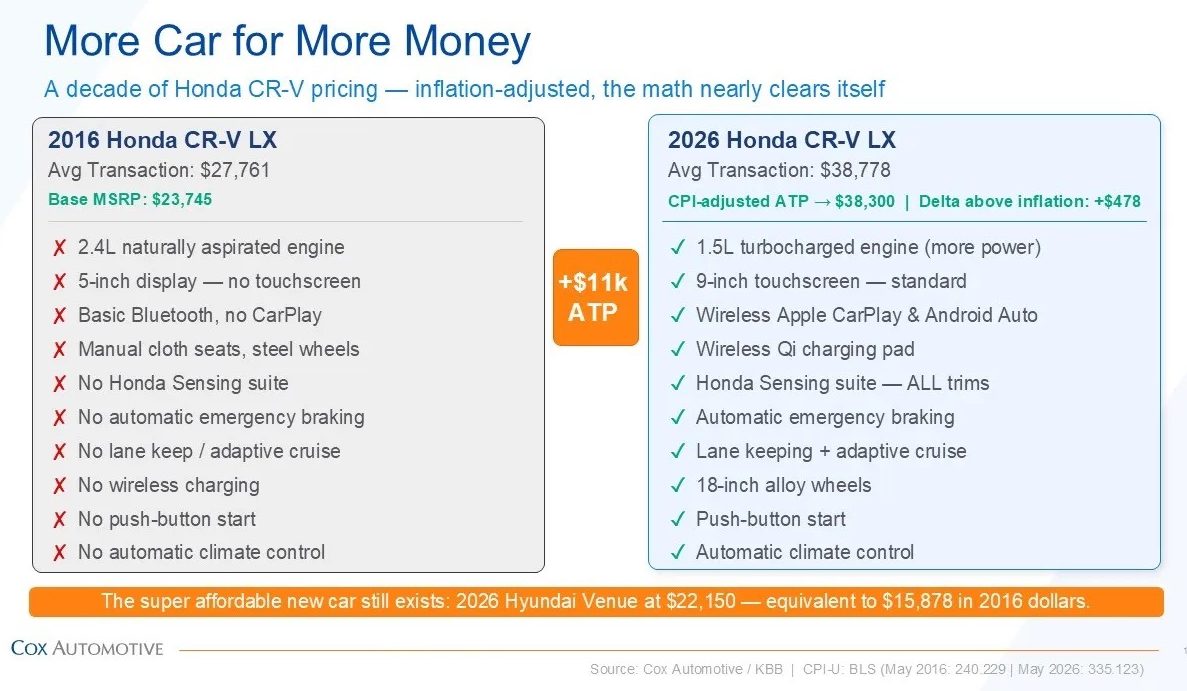
A 2026 CR-V, when adjusted for inflation, is only about $500 more expensive, yet offers way way way more stuff, and more stuff that people want. Specifically, the report from Cox is called “The Car Is Not the Villain” because, even though ATP is up $11,000, it’s more complicated than people just buying good cars.
Today’s CR-V includes turbocharged performance, advanced infotainment, wireless smartphone integration, and driver-assistance technologies that were optional or unavailable a decade ago. It is a better, more capable vehicle by almost any measure. Once adjusted for inflation and income growth, the price has barely moved.
The increasing price of the car is real, but is that the manufacturer or the consumer driving this trend?
The Consumer Is To Blame

As the Edmunds report points out, consumers are hitting record lengths and amounts for loans, with potentially dangerous outcomes:
“Car shoppers are caught in a dangerous practice of focusing heavily on their monthly payment while ignoring the potential long-term damage to their wallets,” said Ivan Drury, Edmunds’ director of insights. “Pushing loan terms past six or seven years might make an average monthly payment more digestible today, but it’s a mathematical trap. When you pair a 7.0% APR with an 84-month loan and a smaller down payment, you’re signing up to hand over nearly $10,000 on average in interest alone. Unfortunately, stretching out the term to be able to swallow a higher-priced vehicle guarantees you’ll be building equity at a snail’s pace, leaving you highly vulnerable to falling underwater when it’s time to trade in.”
Are car shoppers being irrational here? Cox would argue that getting a slightly higher trim vehicle isn’t necessarily bad:
There is also a common-sense piece to this. When the price gap between a base vehicle and a better-equipped model is relatively small, many buyers choose the vehicle with more features, better fuel efficiency, or stronger long-term usability.
That behavior is rational. Consumers are thinking about total value, not just the lowest entry price. Over time, those choices shift the sales mix and lift the industry average. The headline number moves, but the underlying story is consumer choice.
It’s true that consumers are not as interested in cheaper vehicles. Given how long people keep cars these days, I do wonder how much of an impact option for the cold weather package or whatever matters 13 years down the road. If you sell your vehicles at a more normal rate, then the options you have can command a higher price.
Politics Are To Blame

Tariffs have added costs to new cars, as have safety regulations and environmental regulation. This is nowhere clearer than on the lower end of the market, as the United States has long relied on imports for many of its cheapest cars. Nissan, which often offers the most affordable cars on the market, does so by relying largely on Mexico for production.
With the USMCA under review, the prospect of bringing more cars from Mexico is a sketchy one, with Nissan’s CEO Ivan Espinosa pointing out to Bloomberg that the company is suddenly paying 25% more to import its cars:
The duties are “making part of the lineup that we are bringing in from Mexico difficult to sell,” Espinosa said Wednesday on Bloomberg Surveillance. “Looking at the pressure that the US market has today in terms of affordability, we see that potentially some of the buyers could be moving into this type of vehicle, so we are working very strongly on making them more competitive.”
[…]
While the company has shifted some vehicle production to reduce its tariff exposure, it’s kept entry-level models like the Nissan Sentra compact and Kicks crossover in Mexico to take advantage of lower labor costs. The manufacturer has said tariffs on the Kicks and Sentra cost around $2,500 to $3,000 per vehicle.
$3,000 on a Sentra is insane and, even if the goal is to bring more manufacturing to the United States, the medium-term impacts are extremely real. Nissan is trying to find ways to make the cars cheaper in Mexico as opposed to just bringing production here.
Politics is definitely playing a role, although it varies a lot by car, and politics aren’t making people buy $50,000+ three-row SUVs.
It’s The Economy

Consumer preference, regulation, politics, manufacturing choices, et cetera are all part of the picture. The sad reality is that many things are conspiring to impact the car market, and there’s very little consumers can do about it because of the underlying economy. This is something that all the analysts seem to agree on, and though it isn’t necessarily the main culprit, it’s the one factor that is insurmountable for a consumer and difficult for automakers to impact.
First, from Cox:
The bigger issue is the economic environment around the vehicle. Purchasing power has been stretched, household budgets are under pressure, and consumers are absorbing higher costs across nearly every part of daily life.
Vehicle insurance has risen sharply. Auto loan rates are higher, so borrowing costs more. Maintenance and repair costs are up. Gasoline is higher, too. So are housing, groceries, healthcare, and subscription services.
In that environment, it is no surprise that a new vehicle feels out of reach for many Americans. But the issue isn’t the car itself — it’s because life got more expensive.
And from Edmunds:
“The Q2 data perfectly illustrates the stark reality of today’s new-vehicle market: Affordability is such a massive hurdle that buyers are forced to stretch their budgets to the absolute limit just to get into a new vehicle,” said Jessica Caldwell, Edmunds’ head of insights. “When you see loan terms extending to record lengths, down payments shrinking, and monthly payments hitting all-time highs, you’re looking at a clear recipe for long-term financial strain.”
Some consumers are too stretched by all the various negative economic factors, whereas other consumers are driving the K-shaped market by shrugging off those concerns and demanding bigger, better, nicer. Automakers are also facing these concerns as money is more expensive to borrow and they, too, will reach a limit of what they can offer affordably to consumers.
In the end, the fingers are pointing in various directions because there are legit that many directions to point in these days.
What I’m Listening To While Writing TMD
It’s “Cats” by Mitski, because my cat was up this morning yelling at me to feed him even though I’m wiped after the track day.
The Big Question
What would you bring to an Autopian track day?
Top graphic images: stock.adobe.com; DepositPhotos.com




I’d prefer Honda’s NA 2.4 liter to their 1.5 Turbo engine 100 times out of 100. Going from a much more reliable and long-lived larger displacement engine to a highly stressed, tiny displacement turbocharged engine with known oil consumption issues is a massive downgrade, not an improvement.
To be sure, the safety stuff that new cars have is good, but who the eFF cares about ‘push button start?” That’s supposed to justify how much better new cars are than old ones?
Give me a break!
Why is the photo at the top of the article clearly of an Australian dealership? Did you get it from Lawrence? The white suv is clearly a Ford Territory, and the roadwork sign isn’t a US one at all.
Everyone I know, including myself, who has a Kia Soul absolutely loves the thing and has usually bought or leased more than one.
What’s Kia do? Quit making the Soul.
I guess they think we’ll move up to the Steltos or whatever. They are incorrect. I think it’s a symptom of the problem you are trying to analyze here.
TBQ: Gold gilded chariot pulled by a team of Boston Robotics Mules or John Deere walking tractor Timberjacks.
TBQ: After a quick oil change, bringing out the Boxster.
with big complicated issues, its a fools errand to try to pin the blame on one thing. they usually have multiple causes, so ur ignoring most of the issues. it is fair and correct to say that consumers, corporations, government, dealers, and lenders are all to blame. and its absolutely pointless to bicker about who has more blame, were all suffering for it all the same. hopefully it all crashes and corrects, i wouldnt bet on it tho.
Inflation, retarded politics, useless features forced into every new car, spoiled consumers, greedy car makers and out-of-touch dealers.
That pretty much cover it?
“Politics Are To Blame”
That’s the #1 reason by far. Not just due to the Trump Tariffs, but other long-standing stupid shit like the Chicken Tax.
“What would you bring to an Autopian track day?”
The vehicle I already have… my Ford C-Max Energi.
Ayy, fellow C-Max driver
Blame the consumer.
If consumers are only purchasing requirements include:
Well…then…it is gonna cost ya…because the manufacturers pay attention.
That said…they make a boat load more profit on these vehicles than the could with say …a 77 Toyota Corolla Liftback…which is the perfect car…if not for the fact they have all rusted out.
TBQ: my Crosley Speedster. But probably only if you’re at Road America.
—
I think the entire economic environment is the big challenge, and cars are only one piece of the puzzle. Unfortunately, Americans collectively are making choices (definitely including voting for certain politicians) that are only making things worse. And it will take a long time to turn something this big around.
According to the Cox chart, cars are not more expensive. That means politics and manufacturers are out. So consumers or the economy or both are the cause. Best thing we can do is what’s best for us and our families let other people make good or bad decisions on their own.
What would I bring to an Autopian track day? Right now I only have the Mazda3 so that, but in few years I hope to have a Copen *and* the rotary-swapped Alto. If I have a car hauler I could throw both kei cars on, I’d bring both of those.
Also making cars so unaffordable is dumb because everyone upside down on their 7 year loans when they are bored and want to change 3 years in so you are just losing your repeat customers who get the dirty taste of an insulting trade in value and won’t come back even at the back end of the decade.
They will be back.
They will take that insulting trade-in offer.
They will add the balance to the new loan.
They are idiots. Predictable idiots.
Omg that edmunds CRV comparo
Engine – prefer the reliable 2.4
Touchscreen, carplay, bluetooth, charging pad, sensing suite – don’t care, never used when I have had it in cars I’ve owned or rented
Cloth seats fair enough leather is nice but if its fake leather prefer cloth
Aeb – nice to have but not necessary
Lane keep adaptive cruise – yeah don’t care I have mainly fun roads around here
Push button start – prefer not, key slot is a great place to store your car key imo
Auto climate control – prefer manual anyway, have had 18 cars with a mix of both, manual is fine. I will concede though the new CRV does look better than the 2016 model but seriously on every other metric seems worse when you put it side by side like that. (I also like the weidrburger ZR-V in the dark maroon with the cool black leather seats better than the CRV)
I’m with you there on liking everything on the old one all that new stuff is just more things to break, I would take cloth seats over leather though. Leather gets too hot in the summer.
That’s why you spring for the top model that gets the cooled seats. Problem solved for only a few more bucks a month.
For a second I thought you were talking about a paid subsciption
These days, could go either way.
I love my screenless BMWs. But 95% of the buying public loves and wants this bullshit, and as a bonus, the screens are cheaper to make today. Look at the SCREAMS on here when GM ditched Carplay. On a car nut forum…
I’m with you, but that’s not really the point. What they’re demonstrating is that even though by all rights the current CR-V should be much more expensive to make, Honda is practically selling it for the same price that they sold it for 10 years ago. Which means one of three things: Moore’s Law applies to cars, Honda is cheaping out somewhere we can’t see, or Honda is cutting external costs to offset decreased margins.
Someone here did the math and found the 2026 Honda is 300 working hours cheaper for the avg American. I bet they are saving in labor costs and tooling costs.
If it takes the average American less time to make the money needed to buy the current CR-V, wouldn’t that mean Honda’s labor costs should be higher? Both the 2016 and 2026 models were assembled in Ohio, so they’re using domestic labor.
My guess is they replaced people with automation and/or workers like designers and engineers became more productive.
There is probably a bit of currency hedging, creative supplier relationship management and all sorts of other stuff going on. Or maybe they could have made it cheaper years ago but are forced to now because there are so many more players in the game to compete with. Honda is making less money now than they were.
Moore’s Law (or equivalent) applies to most manufacturing. There is CONSTANT pressure to squeeze suppliers and make production more efficient. A penny here, a penny there, and you can hold the line on inflation-adjusted cost for a long, long time. Or really forever, because adjusted for what you get for the money, cars are *wildly* cheaper than they have ever been, especially relatively cheap cars).
I blame consumers who have decided that when it comes to vehicles, their “wants” are the same as their “needs” which among other things is to ensure they have a vehicle with capabilities well beyond their normal use cases with the appearance they are more affluent than their realities. The same consumer who would’ve happily bought a CR-V in 2016 and could easily afford a 2026 model would rather stretch their budget on a Pilot to cover those rare instances where they might have to stuff someone in its third row.
With this being the prevalent consumer mindset, why shouldn’t automakers and dealers take advantage it and offer the models they desire at the inflated prices they are willing to happily pay with minimal haggling, even if it’s to the detriment to the overall automobile market?
I’d suspect this is also a big part of it, even if it’s hard to quantify. I know several people who bought bigger (so more expensive) vehicles than they need because “well, I might have to carry someone in the third row when we have company twice a year.” On a semi related note, I also worked with or know several younger ladies(under 27 years old) who bought either new or lightly used SUVs “so they’ll already have their mom car when they have kids and I like the space”
But if I don’t have AWD I am going to *die* in the winter.
Well whenever you have the autopians down under track day, I’ll have my RX7 there.
And if I manage to win Lotto then I’ll fly in and buy the most American car I can off of marketplace specifically for the occasion, so let’s a a 62 caddy
You’re all TOAST when I get ny 411 up here!!!
Whats the 411 on the 411 Stef??
Still in Texas. Still need to ship it up somehow.
*my
(goshdarnit, I can’t type)
TBQ: Meyers Manx
High Auto Costs: Resurrect child labor, anyone? Seriously, complete automation.
Large corporations: Everyone, have you seen the inflation rate? We have to raise our prices, it’s the only way to survive!
Employees: That means you’re going to raise our wages by the inflation rate at the minimum, right? Right?!
The lies in the Cox report are not in the numbers, but in the omissions. Higher selling price means higher insurance cost, more interest paid. The engine may make more power, but if it does not have better gas mileage, then it is more expensive to run. And does it need more power? Highway speeds have not increased. Cars today are more expensive to repair. I had a buddy have a fender bender (rear quarter) and it totaled the car! Safety, reliability and drive-ability are progress in cars not screen sizes or connectivity. Don’t even get me started on bigger rims with more expensive tires on them.
More expensive cars do have higher insurance rates. However what matter matters is the insurance rate increase vs wage increase. Median wages have exceeded inflations for decades.
Paying interest on a car loan is optional.
The average car vehicle is much more fuel efficient that in the past. 20 years ago the average new vehicle got 20.1 mpg. In 2025 that was up to 28.1
Complete agreement with you on oversized wheels and tires.
TBQ:
A grandfather clockA horse – the only one with a 1HP conveyance.
What about a horse with 2HP?
What is this witchcraft double-horse you speak of?
Stagecoach. Some of those had up to 6HP!
All of the options are significant contributing factors, although I feel “dealership greed” should have been included. That said (and not to sound like a curmudgeon), I’d have to say customer buying habits is probably the one true root cause. It’s the one thing that would put very significant downward pressure on new car prices if it were to change.
-Manufacturers: It would force manufacturers to build and actually offer lower cost platforms with fewer cost-inflating options. Maybe we would have actually economical sedans or small hatches again.
-Politics: Regulations could mandate whatever they want, if customers would not accept higher costs the manufacturers would be forced to make other concessions (see Manufacturers). The same could be said for trade policies, there’s a reason prices have gone up but not as much as the math the tariffs would seem to dictate (NOTE; this is not to say I support current tariff policy, it’s just an observation of the numbers). There was profit margin wiggle room there that the customer has been paying.
-Economics: People don’t need a new car every 3-4 years. As others have mentioned, cars average lifespan is higher than it’s ever been. While it’s far from typical and is entirely anecdotal; I work with a couple who have bought more new cars (not leased) than I’ve owned in my lifetime in the time since I last bought tires… If most customers chose to maybe skip an upgrade cycle since their current vehicle is 100% mechanically sound, I’d guarantee prices would go down or would have at least increased less than they have… This isn’t to discount the very real effect of increased costs and falling wages; it’s just that I see a lot of really bad decisions when it comes to car purchases that don’t seem to reflect that reality.
-Dealership greed (my addition): COVID and the era of ADMs taught the dealers that some people are willing to just pay whatever to have the new shiny. If people were to just decide to walk out of the F&I Manager’s office over nitrogen fills, window etching, doc fees (sorry, that’s part of operating a dealership. Build it into the price.), Truecoat, etc., I guarantee they’d be a thing of the past.
Understand that a lot of these are paraphrased and heavily condensed to avoid it being an even bigger wall of text. I mainly wanted to give examples of how changing customer habits are the one factor that would have significantly lessened all of the other contributing factors.
And BTW. I’d probably have to bring my second gen Scion Xb since it would be slightly more fun at a track than my first gen Tacoma…
Hopefully I’ll have some spare PTO when future Autopian track days take place, and if so I’ll bring the 986.
Even if I have a second car by then, I’m sure it will be devoid of air conditioning, sound deadening and horsepower, the kinds of thing that make a cross-country trip bearable.
TBQ: I’d steal a neighbor’s Porsche.
Worth it?
Said neighbor runs a karate studio and is fitter than I ever was, so I imagine justice would be doled out in creative ways if I got caught. So, I dunno.
My neighbor has a ZL1 1LE, I might consider following your example but I suspect he practices the martial art of clic-pao.
You would have a Porsche to get away in though, so there’s that
Still deciding on whether or not to pull the trigger on a Slate, I’ve never bought something new without driving it first.
Not sure what I’m bringing but definitely something, unlike this year.