

While gas prices have risen a lot since the beginning of the year, they haven’t reached the apocalyptic heights many were originally predicting. That’s the way the market has been lately. At the end of last year, some analysts were worried oil prices would fall to $50 a barrel. That didn’t happen, either. What’s going on?
The answer to why the cost of a barrel of oil has stayed within a reasonable bound is China. For reasons only known to itself, the country has been quietly keeping the price of oil stable. This is at the same time that the country is exporting cars and trying to keep control of precious metals.


Another mystery involving China is why Volvo is allowed to build more cars here while Polestar is getting the boot. I’ve got a theory I’ve espoused in The Morning Dump before, and there’s now a little more evidence in that direction. There’s no conspiracy theory needed to explain Toyota’s success as it continues to benefit from a weak yen.
Car Week is nigh, and Lamborghini is celebrating the Miura in a big way. Or, well, celebrating in a way.
China As The Stabilizer Of Global Oil Prices
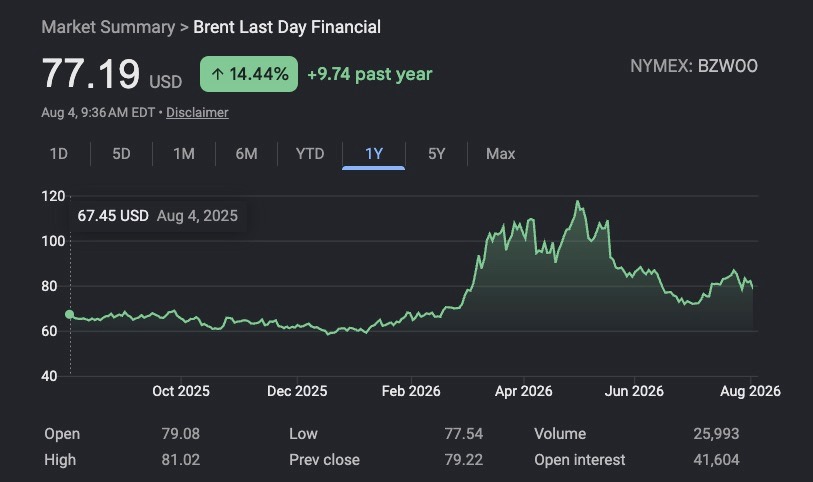
Above is a chart of Brent Crude Oil Last Day Financial Futures, which is a good enough measure for where prices are for global oil. Also, when I say the “you” in this post, I’m referring to a global “you” and not a specifically American one because this is a global story (a chart of WTI Crude shows a similar pattern, if you’re curious). An American is a little more sheltered whereas, say, an Australian is way more at risk from fluctuations in global oil prices.
I’m not an expert in the economics of petroleum, but I was born in the shadow of refineries and grew up in Houston, which is close enough for this discussion. Like many people, I assumed fuel prices were going to get a lot worse than they did after the coordinated US-Israeli strike on Iran and the subsequent closing of the Strait of Hormuz. This was after a long period where it seemed like fuel prices could only go down.
Early on, I listened to a podcast wherein commodity market expert Rory Johnston talked about how the price of oil could surge above $200 a barrel. That didn’t happen, and he came back later to describe where everyone went wrong in making that assumption (link here if the video doesn’t load for you):
Here’s what he said:
We always knew that China had huge stockpiles of oil, but we didn’t know how they were going to react to this crisis. And what we’ve seen through this crisis is that Chinese oil imports, crude oil imports into China, the world’s largest crude oil importer, fell by upwards of five million barrels a day between the three month average prior to the war through to June. Now we’re not quite done this month, but that’s roughly where we’re trending for June so far. That five million barrels a day was upwards of half of the total spot market supply hit to Asia, and that allowed a lot of those other Asian importers to basically not have the competition that they would have had for the barrels they were importing.
When prices of oil dropped in 2025, China did oil-producing countries a solid by stockpiling millions and millions of barrels of oil. When prices shot up, China basically stopped competing for oil on the open market and allowed more desperate countries with smaller stockpiles to catch up at a more reasonable prices.
This is weird! China is super competitive in so many ways, so what’s going on? I’m not an oil expert, but Philip Verleger is, so let’s ask him:
China likely reacted to maintain higher prices in 2025, preserve its export markets to oil-exporting countries, and maintain competition in the oil market. The latter countries purchased $320 billion in goods and services from China in 2023, the most recent data available. Chinese officials likely worried that their Middle East export market would suffer if oil prices declined precipitously. Buying oil for its strategic reserves helped keep prices up.
In 2026, China has cut its oil consumption sharply and drawn from its reserves to hold prices lower. The Chinese government understands that the country’s exports could fall if oil prices shot up and global activity decreased, as the IMF predicted in April 2026.
Many will challenge the idea of China acting as buffer stock manager in the oil market to further its economic interests. However, the evidence shows that China is consistently aggressive when it comes to boosting its economy, particularly regarding commodity markets.
It’s good to be friends with China, and hard to be competitor. As Verleger points out, China was happy to dump products on the rare earth market to make it harder for others to compete, especially the United States. China, though, seems to want its partners in the Middle East to stay in business and its consumers in the rest of the world to have the funds to import what it exports.
The minerals thing is interesting, as the Trump Administration hoped to stockpile about $300 million in lithium carbonate reserves for strategic defense reasons. After extending the deadline multiple times the Department of Defense canceled the contract. That’s kind of weird, right?
Volvo Will Make More XC60s In South Carolina

The United States effectively banned Polestar, the Chinese-owned automaker, from selling any cars after MY 2026. What it didn’t do, though, was ban Volvo, even though Volvo has essentially the same ownership structure and sells many of the same vehicles.
In fact, the new Volvo EX60 looks a lot like a Polestar 3, and there are similarities between various Geely, Polestar, Zeekr, and Polestar products. These cars do have some differences when it comes to telematics, infotainment, et cetera, and it seems like Volvo may have convinced regulators that the company’s American offerings were safe enough from the kind of surveillance and interference at the center of this whole issue.
So why couldn’t Polestar do the same? I had a theory, and it went like this:
Polestar makes a fraction of the cars that Volvo does. Given the difficulties Polestar has had in the market and other changes, it feels entirely possible that Geely could have made a deal at the top to fully utilize the South Carolina facility (thus pleasing the President and Republican politicians), resulting in a game of musical chairs where Polestar was left without a seat.
Oh, hey, here’s an update from Automotive News:
Production of the XC60, slated to begin in January, initially will boost output by more than two-thirds at the troubled Ridgeville assembly plant near Charleston.
“We are producing around 30,000 cars and [XC60] will bring at least another 20,000 to start with,” Volvo Cars Americas President Luis Rezende told Automotive News.
“It’s going to be at least a full shift, and it’s a fantastic preparation for what is coming next. Charleston will be very, very busy.”
The one thing that the Charleston plant has never been is very, very busy. It has been, per the article, operating at about 15% or so lately as it builds the Polestar 3 and Volvo Ex90. Making a bunch of XC60s there is sensible, as the model is a popular offering and has seen sales rise so far this year in the United States. Having more production in South Carolina will likely allow the company to take the XC60 and be more competitive on price.
However, the timing does feel like it supports my conspiracy theory that this is all a plan to save Volvo by bringing more jobs to South Carolina.
Toyota Is Banking On That Cheap Yen

In my article on currency last week, I said you could look at The Fast and the Furious as a movie about the strength of the US Dollar or, inversely, as a movie about the weakness of the Japanese yen.
Guess what? The yen is weak again, and this is good news for Toyota, as Nikkei Asia reports:
Toyota also raised its net revenue forecast by 3 trillion yen and its operating profit outlook by 400 billion yen. It now expects net revenue of 54 trillion yen, up 6.5% from the previous fiscal year, and operating profit of 3.4 trillion yen, down 9.7%.
[…]
Toyota cited revised foreign exchange assumptions in the current fiscal year as among factors contributing to the upward revision of 480 billion yen ($3 billion) to its operating profit forecast.
It amended its expectation for the Japanese currency in relation to the dollar to a rate of 160 yen per greenback from the previous 150 yen made at the start of the fiscal year. Regarding the euro, it now assumes a rate of 181 yen to the single currency from the previous 180 yen. For Toyota, a one-yen depreciation against the dollar lifts operating profit by 50 billion yen, while a similar weakening against the euro leads to an increase of 10 billion yen.
Not that everything is perfect at Toyota. There are still large fundamental issues with Chinese demand and supply issues related to the Middle East it has to work out. At the same time, the company is still recovering from a massive earthquake in Japan. Japan’s currency, though, is at least one factor breaking Toyota’s way.
What Do We Think Of The Lamborghini Revuelto Miura 60° Homage?

I truly adore the Lamborghini Miura and the 60th anniversary of the model’s debut is Lamborghini’s excuse to bring a bunch of them to Car Week next week. That’ll be incredible. I can’t wait.
While I haven’t driven the new Lamborghini Revuelto I’m sure it’s great, and people I know who have had the chance say great things about it. Lamborghini is taking the Revuelto and giving it a Miura-like tribute, which includes:
The exterior configuration of the Revuelto Miura 60° Homage features two dedicated liveries, inspired by classic styling characteristics found on many historic Miuras: lower body sections finished in a contrasting color to the main bodywork. Customers can choose between the Oro Elios livery paired with Altanero Shiny Gold wheels, or the Grigio Nimbus livery combined with Altanero Matt Titanium Diamond wheels. Both configurations celebrate color combinations that helped establish the Miura as an automotive icon.
The exterior design is completed by the dedicated Miura 60 logo, positioned above the Revuelto script on the side sill near the rear wheel arch, together with a gloss black Lamborghini rear logo, recalling one of the distinctive styling details of the original Miura. Complementing this color scheme, the Revuelto Miura 60° Homage features gloss black brake calipers and matte black exhaust tailpipes.
Neat, I guess? Is that enough to count as a tribute? Is there anything else the company could have done? I guess I’ll have to wait until I see it.
What I’m Listening To While Writing TMD
I’ve been listening to The Lonely Island and Seth Meyers Podcast, and they made an interesting point in an episode recently about the “I’m on a Boat” song. They made the point that the joke works as a song, but once you see the video it’s just that much funnier. It’s true. You gotta see the shorts.
The Big Question
What’s the best tribute car? What’s the worst?
Top graphic images: DepositPhotos.com




That Miura image is really illustrative. That was never a ‘small’ sports car but a comfortable GT. Seeing the gargantuan modern tribute next to it really hits home as to how much we’ve fattened up over the years.
“China Is The Reason Why You’re Not Paying More For Gasoline”
Tell me you live in America, without telling me that you live in America.
Greetings from Germany with gas prices being at the highest constant level since Covid and well…second highest level since…ever? Without a chance of going down…
“China As The Stabilizer Of Global Oil Prices”
This is yet another way that the USA, under Crooked Trump, has lost its leadership position.
Regarding Polestars… we still get them here in Canada.
Looks like we have something America needs. LOL
*pedophile
Aren’t all Jeep CJs/Wranglers since the mid 1940’s a tribute to the WWII Willys MB?
Is that the best or worst?
Yes
THe current Ferrari Dodici Cilindri is a great tribute the the 365 GTB/4 and to the basket handle concept cars of the 1970s.
https://images.carexpert.com.au/resize/3000/-/app/uploads/2024/05/ferrari-12cilindri-bianco-artico-v12-7.jpg
https://media.autoexpress.co.uk/image/private/s–X-WVjvBW–/f_auto,t_content-image-full-desktop@1/v1727700721/evo/2024/9/Ferrari%2012%20Cilindri%20review%20evo-5.jpg
The image of the Miura and the Revuelto: ah, I had an amusing metaphor here, but in the interests of comment positivity let’s just say there is a world of difference.
It’s like the Muira spent the last decades gorging on junk food. Very pointy junk food.
RE: China/oil thing:
How much closer are we to Mad Max/wearing chaps with nada underneath/Bartertown? That’s always the question when it comes to oil/gas.
Prior to the start of the war, I was planning to sell my second P38 Range Rover, but at the moment it’s worth more to me as an extra 25 gallon supply of premium unleaded.
Who says we need a gas crisis to become a post apocalyptic chaps fashion society?
Having been to Walmart recently I really hope people wear something underneath those chaps.
I’m no market analyst, but it seems to me like China did what most Americans do the week before a holiday weekend, where they increase their “strategic gasoline reserves” before the price goes up.