

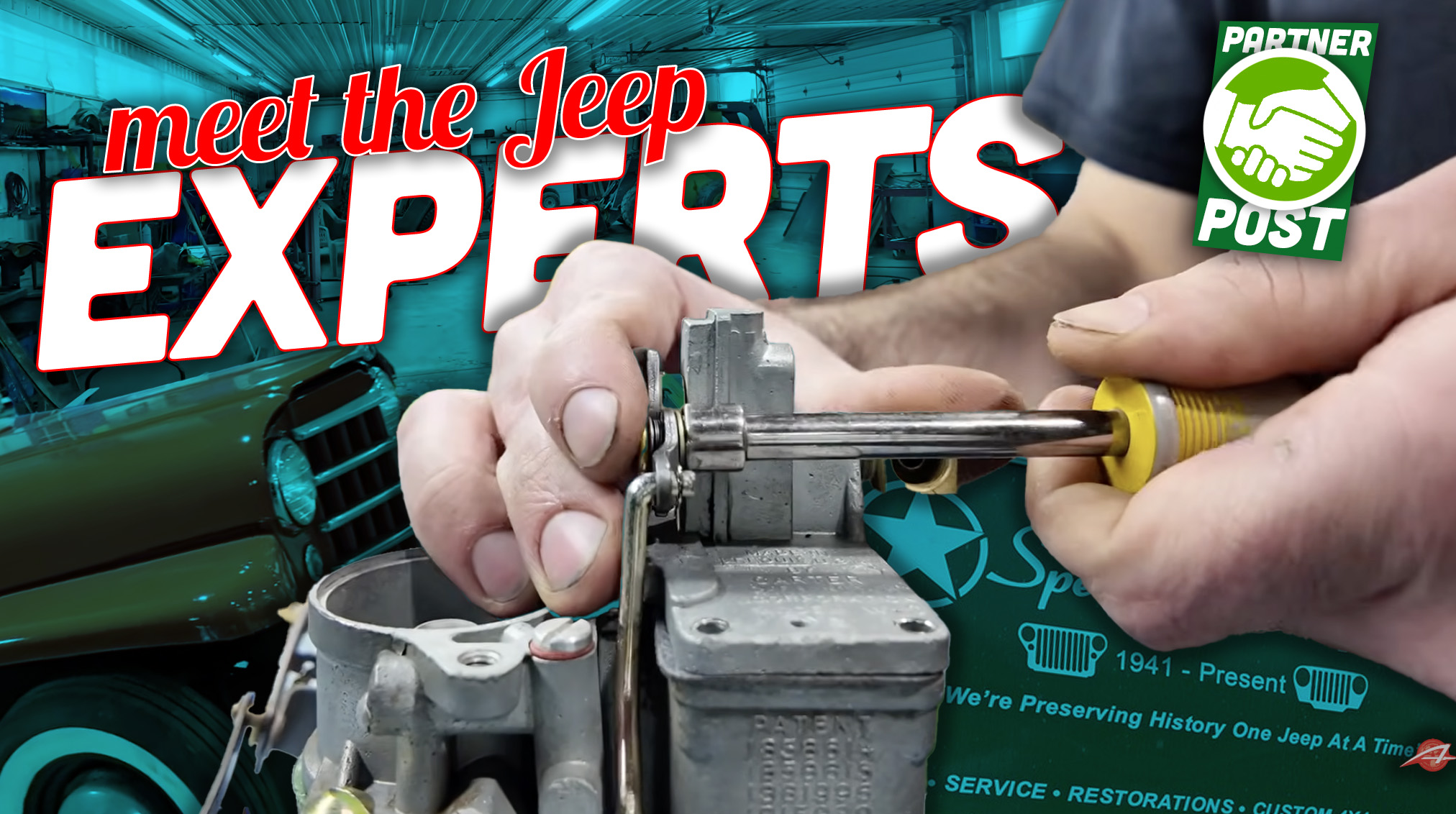
In the thick of my eBay World War II build, eBay offered to fly me to Cleveland. “David, do you have time for this?” my wife asked. “Absolutely not,” I replied, staring blankly towards the WWII Jeep-shaped statue that was nowhere near completion despite me having only three weeks before a 900 mile road trip. “But if someone — especially our fantastic brand partner, eBay — offers to fly me to the home state of Jeep to look at a bunch of vintage off-roaders, I’d be a fool to turn that down!” She understood.
And so to Ohio I flew, with a Carter WO carburetor in tow. I wasn’t sure how I was going to get that through security, but my thinking was this: I had gotten my engine to pop off, but it was running terribly. Despite me getting it to rev long enough to break the new motor in, my test drive was a bit of a failure. I say “a bit,” because my 2000 ft ride did yield some insights. The axles seemed quiet enough. The suspension seemed fine. The steering felt tight. The brakes worked. I learned some valuable things, but I also learned that my engine made basically no power, hence why that test drive ultimately left me stranded.


Maybe the issue was the carburetor, and though I’ve rebuilt old Willys carbs many times, I was on a tight time crunch, and I was hoping to do something with the folks at Specialty Jeeps there in Coshocton, in case we had some time to kill. So along came my carb. Here I am checking on it after I made it through security at LAX:

The whole purpose was to highlight an eBay seller, especially a small business in small-town USA, but for me personally, the trip would serve an even more important function — one that would make the two days of lost wrenching well worthwhile.
Flying To Specialty Jeeps

There I was, months deep into the most intense wrenching project of my life, and though I only had three weeks left, I could tell I was slowing down. My friend Laurence flying over from Australia was a shot of adrenaline that got me wrenching with enthusiasm for weeks after he left. But after getting absolutely clobbered by my Jeep’s suspension/brakes/steering, I felt like I was losing a bit of motivation.
It was just me and my tools in my dark driveway, covered in grease, missing my baby and wife who were so close to me and yet so far away. Problem after problem arose — and not the problems that could be fixed with new parts, but problems that required creativity with a grinder, drill, file, welder, die grinder, hammer, pry bar, hydraulic press and on and on. I understood: “Dave, you’re too close to the deadline. These are the parts you have — you’re going to have to just make this work somehow.”
It was insanely mentally taxing, especially given the stakes, which were higher than I’ve communicated so far (on the Finale of this build, to be posted on July 4, I will describe exactly what those stakes were). It was because of my demoralized state of mind at the time that this trip to Coshocton would be so important.

Getting to Specialty Jeeps wasn’t particularly easy. eBay flew me into Cleveland, and then their team drove me in a sweet Scion FR-S south through Akron (former home of the NBA’s GOAT) to a rural area roughly two hours away.

I arrived at a large metal garage.
This Was My Kind Of Place

“We’re preserving history one Jeep at a time,” the sign out front reads. Just behind that, to the left of the building’s front garage door, was a miniature parts-yard consisting of a Willys pickup, a Willys FJ, a Jeep Commander, a Jeep YJ tub, a Jeep TJ tub, and a whole lot more.

I could tell this was going to be my kind of spot.

Greeting me at the door were Bruce and Bruce Jr., the father-son pair that founded Specialty Jeeps over a decade ago, and that has been wrenching on Jeeps for much longer than that.
“I was 13 years old, and I worked at a sawmill,” Bruce Sr. told me about how he got started down this path. “I couldn’t saw or anything, but I picked up sawdust and cleaned up.”
“Where we lived out in the country, a guy had one of these Jeeps…and I just fell in love; I wanted to buy it and fix it up…by the time I got 16 I’d have something to drive,” he said, joking that he thought his dad was going to kill him for buying a $50 Jeep whose floors were all rusted out.
“But it was my money,” he said, saying he brought in some additional cash by shoveling snow and mowing yards. Bruce gives credit to his older brother’s best friend (and that friend’s uncle) for teaching him how to wrench, saying: “He taught me how to…work on cars and weld and paint…when I was…probably 11 to 12 years old.”
Bruce went on to run a multimedia and marketing business, and after his son Bruce Jr. was born the duo fixed Jeeps out of their two-car garage for fun. “[My son] wanted to do it full time, so I gave him the money to start this.”
“We had a yard full of Jeeps,” Bruce Jr. said about their operations in the two-car garage. “I said ‘We’re busy enough, we can do this full time…We found a shop by the airport and we’ve been gung-ho every since.'”

Bruce Jr., the main wrenching powerhouse behind Specialty Jeeps, showed me around, first pointing out a 4.0-liter Willys Wagon sitting on a 1994 Jeep Wrangler YJ frame.


“[We built this] pretty much from scratch,” Bruce Jr. told me. Pointing to the cowl, he said, “From about right here to behind the seats on the floor was all rotted out and gone, and the sides were gone.” Pointing to the beltline, he said, “It was pretty much only good from about here up,” with Bruce Sr. saying his team had to fabricate the firewall to accommodate the new motor.

Just beyond that Willys Wagon was a Willys Jeepster that a customer had purchased online sight unseen. “We’re just finishing it up tomorrow and it’s ready to go out the door,” Bruce told me, saying his team had rebuilt the motor.


I was a big fan of the Jeep CJ-8 Scrambler Specialty Jeeps was “semi-restoring,” as these are particularly rare and particularly desirable pickup trucks. “We took the body off, sandblasted it, fixed all the rust — it was pretty rotted out,” Bruce Jr. told me. I asked who does all the bodywork, and Bruce chimed in to say that his team has its own metal fabrication shop next door, and that they do all the bodywork in-house.
Let’s take a break from this front shop and check out the metal fab shop.
Specialty Jeeps’ Metal Fabrication Shop Is Impressive

Bruce later showed me into a neighboring garage, where a magician was at work.

That magician’s name is Timmy, and he’s a true master with the welder, grinder, and plasma cutter.

Here you can see where Timmy has started welding a new gusset to a Jeep frame, with a new front bumper soon to be melted into place:

The shiny spots of the Jeep frame below show where Timmy grafted in some patch panels:

Sometimes you can buy a pre-made frame section, Timmy told me, but oftentimes he likes to use a piece of paper to create a pattern of the hole that needs to be patched, then he lays that over some fresh steel, cuts out the shape and welds it in.
And it’s not just older Jeeps whose frames Timmy fixes up, it’s more modern models like the TJ (1997-2006) and YJ (1987-1995), too. “There’s nobody around that will do it,” Bruce said. “We do a lot of TJ and YJ frame repairs…we buy the frame sections and cut them out because around here they’re all rusted out.”


Those frame sections, Bruce said, come from a company called Rust Buster out of nearby(ish) North Lima, Ohio. I checked out Rust Buster’s website (above), and was impressed by just how much of my Jeep YJ’s backbone I could repair with the company’s frame sections (which, by the way, are sold by numerous retailers on eBay).
Perhaps the most impressive thing Bruce showed me in the fab shop was a stack of tall bent sheetmetal leaning up against the wall.

“These are all panels that we’re getting ready to make pickup beds out of,” Bruce told me. “These are the sides, and the bars go on top of it,” he continued, pointing to some round tubes.
If you look at this Willys pickup brochure, you can see how the tops of the bedsides are round:

The fact that Timmy is not just welding on new frame sections and patching rust holes, but actually fabricating entire vintage Jeep beds from scratch is just amazing to me.
OK, Now Back To The Front Shop

The green truck above is a vintage Willys FC, but instead of having a Continental flathead six motor, there’s the unstoppable AMC 258 inline-six. Bruce says this thing was thoroughly rusted before its restoration, and the FC cab just behind it was, too, with Bruce saying Timmy replaced the entire back panel and doghouse:


Bruce Sr. took a moment when showing me a copper-colored 1969 Jeep CJ-5, saying: “[To] a lot of the customers… the Jeep is sentimental to the family. This was one where the grandfather had it, and he wanted to restore it to exactly the way it was when he had it. It’s done; he came in and looked at it last week, and he just cried. He couldn’t believe it; it was his dream to get that done.”

To the right of the CJ-5 is a 1947 Willys CJ-2A, and up above is a CJ-5.


On our way out of the front shop, the Bruces showed me their paint shop (which had an AMC Gremlin in it) and their parts stash, which featured boxes and boxes of rare components that had been purchased through eBay Motors:


But as amazing as that front shop was, and as amazing as the fabrication shop was, my favorite part of the visit was heading out back to the boneyard.
The Boneyard Is Amazing 
After walking through the backdoor of the main shop, I saw a large collection of Jeeps and Jeep parts sitting in the grass right up against a gigantic farmer’s field. It was a miniature salvage yard, and it was glorious.
Just look at all these Willys Jeep tubs, the original Bantam trailer, and the leaf springs and timing covers and radiator fan shrouds and wheels and starter motors:

Speaking of starter motors, there were plenty out there (along with generators) ready to be picked, stripped down, and rebuilt:

There were all sorts of vehicles in the boneyard, from Willys pickups to CJ-2As to M38s to CJ-5s to YJs.
There were even M151 MUTTS. Built by Ford, the M151 MUTT is one of my favorite wartime vehicles because of how bizarre it is. It looks somewhat like an old Jeep, but its grille looks rotated 90 degrees, its body is a single piece (unibody), and the suspension is fully independent. In many ways, the thing was state-of-the-art, but in many other ways it was not (for example, it became known for rather tippy, dangerous handling).

Here are a few more photos from Specialty Jeep’s amazing little boneyard:


There’s A Warehouse, And It’s Also Amazing

There was another giant building on Specialty Jeeps’ property, and though Bruce seemed a bit self conscious about its state of organization, he needn’t have been, because it’s awesome. It’s a giant indoor parts storage warehouse, for the stuff too nice or valuable to leave in the boneyard. Here are some transmission and transfer case parts:

Here’s are some crankshafts:

Behold all these motors:


Here’s a Willys Go-Devil motor used as a generator; Bruce tells me that these generator motors tend to oval-out their cylinder bores for some reason:
Here’s a Cummins motor — the perfect match for an old Jeep that loves low-end torque for off-roading:

Check out this CJ-2A body with a steel cab:

Here are a few other angles of the warehouse:


As you can see, it’s a wild collection of both mechanical components and bodies/body panels. There even appears to be a sandblasting area in the back: 
That warehouse was Disneyland to me — filled with beautiful Jeeps and amazing mechanical components that one rarely sees in this kind of volume all in one place.


The whole Specialty Jeeps facility was magical, though when I reflected upon the visit, it became clear that it was my discussions with Bruce Jr. that made the trip so valuable.
Sometimes, You Just Need To Talk With Someone Who Understands Your Troubles

I have to admit that I was a bit concerned about this trip to Ohio to visit Specialty Jeeps. It took me away from my World War II Jeep project for multiple days, and I was already way behind. But upon my return to LA, I realized that the trip had actually reinvigorated me.
I didn’t realize it at the time, but one of the reasons I had been losing steam was that I felt alone. I was battling this thing day in and day out, and neither my wife (who was focused on keeping our toddler from throwing food all over the house) nor my colleagues (who were focused on keeping the website running) could really relate to what I was dealing with. Sure, I had my friends Brandon and Etienne — two world experts on WWII Jeeps — to chat with over Facebook Messenger, and I could text my buddy Fred Williams and DM Laurence out in Australia, but there’s nothing like talking face-to-face with someone who gets it.
This is a well-established human trait: When we’re dealing with something challenging, having someone to talk to who understands is massively therapeutic, and that’s why my one-on-one time with Bruce Jr. easily made up for the two days of wrenching time I lost. He had seen it all. Every major issue I had dealt with, he had already tackled, and the ones I was still working through — the ones that seemed impossible — he had advice for. This made my project feel like less of an impossible, daunting chore and more like a series of achievable undertakings. Whereas before this trip the end felt nowhere in sight, Bruce gave me the proper context to realize that I was 80 percent done, and the remaining 20 percent was actually not impossible.
In the photo above he’s showing me how the transfer case brake attaches to the output yoke — something I was having a little bit of trouble with. Bruce Jr. told me that the bolts holding the brake would spin when I tried tightening the driveshaft nuts, and he showed me how he’d place a wrench just right to stop them from moving so he could tighten the fasteners.


Bruce Jr. and I didn’t rebuild the carburetor I had brought on the flight because he had already rebuilt one for me to take back home (I left him mine as a core). Bruce showed me how to adjust the metering rod — something that would come in handy later during my 900 mile trip.
He also showed me some specialty tools he had created; I think this might be a distributor removal tool (?):

And this I think is a transfer case yoke puller:

Bruce Jr. walked me through the Go-Devil’s accelerator pedal linkage, which I hadn’t yet installed:

And, as I had yet to bolt my body to my frame (something that would prove to be rather challenging), Bruce Jr. showed me the ropes, and pointed out that, on these aftermarket tubs, things weren’t going to be perfect.

I kept Bruce Jr.’s number, and even sent him a few texts as I desperately wrenched on my eBay WWII Jeep, trying to get it ready for the Easter Jeep Safari that was coming up in just a couple of weeks.

I wasn’t sure if I was going to pull it off, but thanks to my visit to Specialty Jeeps and particularly to my conversations with Bruce Jr., I now had the key ingredient to make it happen: Hope.


That place looks awesome! It’s hard to find shops like that now. The amount of experience they have is priceless.
And I love that Jeepster!! The flat grilles (’48 and ’49) will always be my favorites, but the pointed grilles are really attractive in person.
You might as well flew into Columbus!
Sounds like a great trip!
Question: why leave parts outside exposed to rain and snow and wind and dust etc? Won’t those seize up, or rust, or generally become useless? You weren’t able to use some of the parts at your old place in Michigan.
I think it’s a prerequisite for becoming a Jeep genius. One must sacrifice some parts to the outdoors gods, and one must haphazardly stack other parts in a pile that make sense to nobody but yourself.
It’s a Jeep thing, I guess.
Wow, this is so awesome DT! What an amazing adventure. That place sounds like heaven. Great wrenching work you did.
“Willys Wagon sitting on a 1994 Jeep Wrangler YJ frame.”
Everything there looked so awesome, but that beautiful blue beast really got me. What an amazing creation
Awesome story – intersecting your project, a site sponsor, a real cool shop, interesting and skilled people, Jeeps, patina galore, and wrenching was amazing
David is gonna arrive at the pearly gates one day and St. Peter is gonna be like “Mr. Tracy, you have led a good and honest life. We are happy to accept you into Heaven…but before you go in, God has this broken, rusty 1989 XJ….”
I love this!
I have an uncle that has a very old shop* on the main street in a tiny WI village. Inside is literal tons of scrap steel, a.giant industrial metal break, a 1 inch thick metal welding table that is easily 4 ft by 8 ft. Some late 40s GM convertible (the make/model is not coming to mind), a small metal tracked tractor, a small pot belly wood stove, at least 2 or 3 acetiline torches, several welders and lots of other bits and bobs. The main floor is probably only maybe 30 x 40 ft with 10 ft ceilings. Off in a back corner is a kinda sketchy spiral staircase leading to an upper floor with more stuff.
Every time I visit the area I stop by to see ‘Uncle Bob’ bc as long as it is during the day time and not Sunday morning (church), theres a pretty good chance he’ll be at the shop.
Pretty easy to talk 1-2 hrs straight about old cars, farm equipment and vsrious other metal contraptions.
*the shop.started as a blacksmith shop sometime I think around 1870
This is a perfect example of why knowledge is more important than parts it takes me back to when I lived in Arizona and was restoring a Jensen Healey. Without going into too much detail I had it done but couldn’t get the dual Stromberg carbs aligned. I went to repair shops, then specialty repair shops no one had the ability. Finally one shop said they were too busy and sent me to the guy who they farmed put the work to. A guy who was old at the time now I’m that age so not old, he said he prefers working with shops because people are morons. But since I had a setup and car he liked and respected him he showed me how to tune dual Stromberg carbs with my ears and a screwdriver. I regret having to sell that car it is the best 2 seater convertible from the 70s.
If this helps: I believe in a place called hope.
Looks like it is about 2hrs south of Specialty Jeeps.
No in reality the birth place of Jeep is in Butler Pa but cudos for a great company who doesn’t refuse to repair rust. No one does it anymore
I can not believe these guys are 50 miles from my house and I’ve never once heard of them! What an awesome place.
It’s something special when true believers meet!
I was watching a You Tube video of the cars entering the grounds of the San Marino Motor Classic this month (near Pasadena CA.). About 5 to 6 minutes in, a young guy with a straw hat is happily driving an old rusty red colored Jeep across the grounds. Wasn’t sure if it was David.
https://youtu.be/bTfoSNGQkT8?is=Kn039kT3izJiuUDw
https://youtu.be/bTfoSNGQkT8?si=G417_cbWlREY_zzK&t=460
Yep, that is David.
As my interest in Jeeps stops with the CJ-7, this is all vicariously exciting.
Though I was disappointed that no photos of the giant farmer were posted.
Yeah, and I would have loved it to have this caption:
“This gigantic farmer is…outstanding in his field”
Speaking of automotive stuff on airplanes: The plastic Y-shaped rear headliner trim pieces (both left and right side) from a 1979 El Camino will fit in the overhead compartments of a 757 as well as a Saab 340B+ turboprop. In addition, a bubble-wrapped radiator for a 1991 5-speed Geo Metro will also fit in a DC-9 along with the Saab 340 overhead compartments.
You do get some funny looks bringing car parts through airport security, though. 🙂
David has a history of air travel carrying all sorts of car-related paraphernalia and I don’t understand how he manages it.
Our David Tracy from the past was definitely smiling, especially with all that rust.
Sounds great, definitely the kind of thing that can boost your mood and thus productivity.
Looking forward to the final chapters in this saga.
Citation needed.
LBJ: (in 23 seasons):
MJ (in only 15 seasons):
4 Chips and 10 Conference Championships is as impressive to me as 6 chips and 6 Conference Championships. I could go on and on about ‘bron’s great defensive skills and his efficiency and his assists and the caliber of players in the league during his era and on and on, but these debates tend to go nowhere. And also, it’s fine for us to disagree! Everyone has their own favorite.
Haha all good! I have no horse in this race, as I haven’t watched the NBA since the Goin’ to Work Stones 🙂
I only went to one Pistons game, and it was at the now-gone Palace. What a strange place that arena was.
6 conferences and 6 chips IN A ROW, with a year off playing baseball and no basketball, is not even in the same galaxy of impressive as 4 chips and 10 conferences with gaps and team changes.
“It takes a village”
We’re a communal species by nature, and rugged individualism never gets the results we want, despite what capitalism told us.
No man is an island, and your Jeep is not buoyant, so you wouldn’t want it on an island anyways.
These stories serve to remind us that the people behind the cars are really what it’s about. the car is just the vessel that makes the connections for us.
Maybe just taking things to the extreme is the problem, someone who never asks for help would end up in trouble. Someone who can do nothing without being told to do it will also end up in trouble.
Does ENHRN call you David all the time, or just when you’re making questionable decisions?
obviously, She calls him “Mulholland (Not His Real Name)”
Having just walked through the entire Super Scout Specialists shop in Enon, Ohio two weeks ago, I can relate to both your feeling of burnout and inspiration, David. I’ve been battling brake and wheel issues on my Travelall for a couple of months, but drove my Scout out to the yearly show, and between that, talking with tons of friends while I was there, seeing all the other trucks, and finding some key parts, I’m motivated again.
The amount of aid the Mini community has been giving me to see my car get on the road has definitely been a factor in my progress so far.
I’m glad that your visit to this place gave you the inspiration boost you needed. I can empathize about getting burnt out and feeling alone on a project. It’s the reason I retired from being a Lemons team captain. When my friends and I first started our team 20 years ago, we were all in our 20s with no responsibilities. Now everyone is busy with jobs and kids and adulting and I’m the only one spending my evenings and weekends wrenching to get the car finished before a deadline, with my wife wondering when we can hang out again.
Can relate. Silver lining – it’s really awesome that you have a wife that is understanding enough to let you wrench over weekends. Sounds like a keeper!
Yes, she is unbelievably tolerant and enthusiastic. Last weekend she helped me fill holes in the fiberglass bed of my current project car with epoxy filler. I am a lucky man.
Wow. This place looks awesome and they are doing amazing work. Great article.
The location map is hilarious. I see a place of worship for Jehovoah’s witnesses, Methodists, whatever the fellowship one is (sorry!), and a place of worship for Jeep nuts (myself included) all on short stretch of road!
I wonder if Specialty Jeeps could get a tax break by rebranding to “First Church of Jeep”.
how does no taxes sound?
cutting out rust and welding in replacement steel can be a sacrament.
daily ablutions with motor oil and grease.
growing the fellowship by spreading the good news! (and rubber duckies, unfortunately)
Yup, that fits since a lot of Jeeps in the rust belt are “holy” due to rust
Looks like an amazing trip. I’m always fascinated, and a more than a bit envious of, these sort of businesses that started out as the owner’s hobby or passion.
I’m also envious of anyone who can use the phrase “my buddy Fred Williams”.
Cool story. I was wondering about this when watching the latest youtube video. Besides wearing their t-shirt it almost looked like it was no big deal to you but that couldn’t really be true.
After years of reading this site, I now find myself regularly interchanging the words rust, rot and Jeep. For instance, I was helping a friend lift out their BBQ from winter storage a few months ago and I caught myself saying, wow that’s pretty jeeped out.
I just made spaghetti and meatballs the other day but have yet to mention shower spaghetti to the wife…that’s probably a very good thing!