


The diesel engine is the powerplant that moves the world, and impressively powerful diesels can be found in everything from ships and trains to semi-tractors and farming implements. Modern life would not be possible without these engines of industry. But there was a time when the diesel engine was seen as too unreliable, too weak, and too heavy. During the middle of the 20th century, truck manufacturers across the world found themselves drawn to the call of the turbine engine. In Britain, Leyland saw turbine power as the ultimate solution to acceleration, fuel economy, reliability, and maintenance costs. The British put forth one of the greatest efforts to take gas turbine power mainstream, only to eventually fail to beat diesel.
Throughout history, carmakers and truck manufacturers alike have often tried to find the powerplant of the future, and for a reason that doesn’t sound crazy when you think about it. The reciprocating engines that have powered cars, motorcycles, planes, trucks, trains, ships, and so many more vehicles for longer than a century have proven themselves to be more than capable of doing the jobs they’re asked to. But these engines can be complex. A typical piston engine may have well over 100 moving parts and hundreds more of other bits and pieces. None of these parts last forever, and they add countless potential points of failure.


The chase to find the most reliable form of power has been motivation enough for some companies, but then there’s the fact that piston engines can be rather complex and, if they’re diesels, bulky and heavy. Piston engines are only so efficient, too. Depending on who you ask, the thermal efficiency of a typical diesel engine was about 30 percent to 35 percent in the 1960s and the 1970s, with gasoline engines achieving lower numbers.
No internal combustion engine could ever be 100 percent thermally efficient due to the second law of thermodynamics, but there are engine designs that are theoretically more efficient than others.
For truck manufacturers, the potential engine to rule them all was the gas turbine. First gaining a secure footing in aviation in World War II, engineers soon realized that gas turbines could do more than just fly planes. Like the Wankel, gas turbine engines have fewer moving parts than piston engines, and can do the same work as a diesel at a fraction of the weight and size. In theory, a gas turbine could also run on practically any fuel that burns and potentially even get the same fuel economy as a diesel.
One of the greatest annoyances of the trucking industry through most of the 20th century was the fact that trucks were highly limited in both length and weight. Turbine engines had so much promise, as manufacturers found that a truck with a gas turbine often weighed over 1,000 pounds less than one with a diesel. That’s weight that a trucker could put into carrying more cargo, thus making more money.

Thus, for a glorious period of a few decades that began in the 1950s, most of the world’s largest truck manufacturers all tried to make the ultimate turbine truck. Each manufacturer had a different way to achieve the same result, and some designs proved to be much better than others, yet every one of these companies ultimately failed to unseat the diesel as the king of trucking.
My series on all of the various turbine truck efforts has largely focused on prototype tractors by domestic manufacturers like Boeing, Kenworth, Freightliner, General Motors, Mack, and International Harvester. Today, we’re finally crossing the Atlantic to see how the British adapted turbine power to semi-tractors.
Through the 1960s and the 1970s, Leyland would build several prototype trucks and seemingly got close to perfecting the technology. But there were just a few obstacles that the turbines could not overcome.
The British Were Pioneers In Turbines
The story of how the British got into building gas turbine trucks starts with the world’s earliest-known turbine-powered car. In 1932, British engineer Sir Frank Whittle filed for a patent for what many historians call the invention of the turbojet engine. From Historic UK:
At the age of 15, determined to be a pilot, Whittle applied to join the Royal Air Force’s apprentice school at RAF Cranwell. Frank made such an impression on the powers that be, that he was one of only a handful to be selected for the officer training college next door. And it was here that he would go on to prove himself as both an excellent pilot and engineer. When not flying, Frank was busy writing a thesis that proposed that if aircraft were to fly faster, they could only achieve this if they were able to operate at much higher altitudes where the air was thinner. He concluded that the conventional propellor driven by a piston engine was not the answer and that a new sort of engine would be required. His thesis received top marks – even though the professor who marked it even admitted that he did not fully understand it. His ‘Eureka’ moment came out of the blue when he proposed using a gas turbine to blow air out of a high-powered exhaust pipe at the rear as a means of propulsion for the aircraft. Frank had effectively dreamed up the turbo-jet – the early jet engine.
But when the young RAF officer took his brainchild to the Air Ministry in 1929, their boffins scrutinised it but ultimately rejected it and continued to order conventional aircraft with propellors. Undeterred, Frank applied for and was subsequently granted a patent to protect his turbojet. The patent was duly published and received much interest from some German diplomats in London. When the patent expired in 1935, Frank was not even able to afford the £5 renewal fee. Not that that would have made very much difference, as his plans were now being widely circulated amongst many German aviation engineers. The invention that may well have influenced or even stopped the war was now common knowledge.
Back in England however, Frank did receive some backing from the RAF as they supported him through Cambridge University where, needless to say, he graduated with a First Class honours degree in Mechanical Sciences. During his time at Cambridge Frank continued the design work on his new jet engine. Finally, Frank, along with two of his friends, secured sufficient funding to found the company Power Jets Ltd and in April 1937, demonstrated his experimental jet engine for the first time.

[Editor’s Note: That is the most incredibly steampunk-looking engine I’ve seen since breakfast! – JT]
As Historic UK notes, in 1941, 12 years after the Air Ministry rejected Whittle, a Gloster E28 took flight for the first time under turbojet power. But by now, Britain was too late. Nazi Germany and engineer Hans von Ohain built and flew its first jet aircraft in 1939. By 1942, the Messerschmitt Me 262 went into service as the world’s first operational jet fighter. Having fallen behind the curve, the British didn’t get their first jet fighter; the Gloster Meteor didn’t enter service until 1943.
Whittle founded Power Jets Ltd. as a company to further develop and manufacture his turbojet concept. Rover was supposed to be the developer and producer of Whittle’s turbojets, but as Historic UK writes, Rover would trade its jet engine factory for Rolls-Royce’s tank factory. Rolls-Royce would assume development of the turbines, and Power Jets would be nationalized in 1944.
The First Turbine Car Was Also British
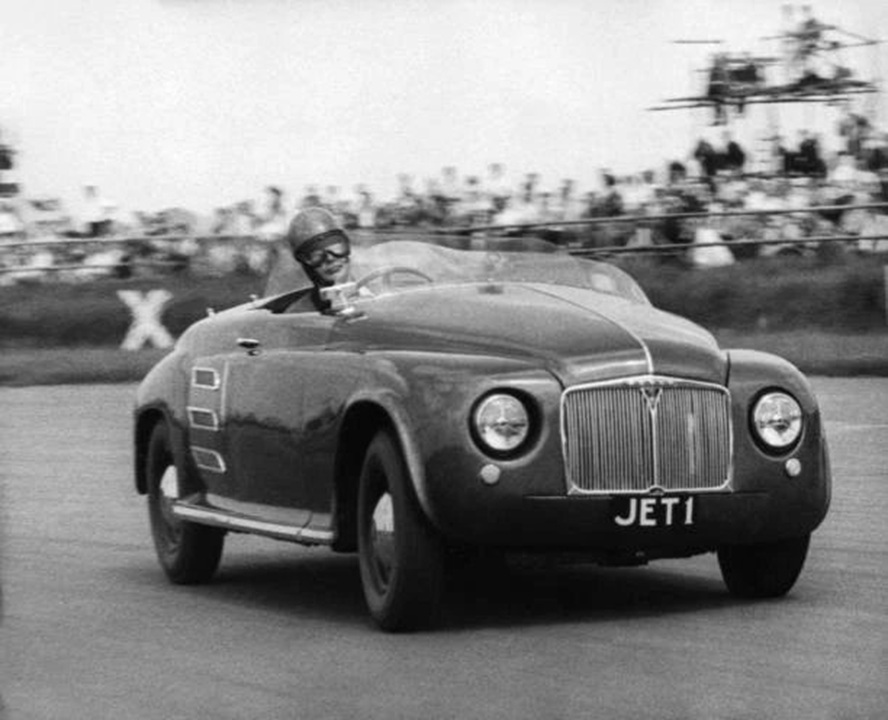
This wasn’t the end of Rover’s involvement in turbine engines, however. After the hostilities ended, Rover began to look at the turbine engine again, but this time for use in a road vehicle. The United Kingdom’s Science Museum Group explains how Rover built the earliest-known gas turbine car:
Prototype Rover gas turbine motor car, JET 1, built by the Rover Company, Solihull, England, 1946-1950. JET 1 was the world’s first gas-turbine-powered motor car. It was made by Rover, the car company which had been intended as the main producer of the new Whittle aircraft jet engine in the Second World War. Work on a small gas turbine suitable for powering a motor car began in 1946, and the finished vehicle was unveiled to the public in 1950. In 1952 JET 1 was fitted with an uprated engine and achieved a world record speed (for gas turbine cars) of 152 mph (244 km/h).
When JET 1 was launched, the gas turbine ‘jet’ engine was seen as a symbol of modernity and of British technical prowess. Many viewed it as the power source of the future, but test driving showed that its poor fuel consumption and slowness to respond to the throttle made it unsuitable for road transport. Rover continued to develop gas turbine car designs until 1965, and work was subsequently carried out on gas-turbine-powered trucks. Many other companies also started to explore gas-turbine-powered cars, trucks and railway locomotives.
For all these small-scale applications the gas turbine has proved, up to now, too costly to manufacture, and the problems of control and fuel economy still exist. However, higher-power gas turbines are very successful in aircraft, ships, and for generating electrical power.

One of the hurdles that Rover had to traverse was the fact that the gas generator stage spun at over 40,000 RPM. This wasn’t a problem in a turbojet, but it wasn’t going to work to drive a set of wheels. A direct linkage would mean that idling would be impossible, and exacting speed control would be difficult, at best. Rover’s solution was a second turbine, a free power turbine, that was not mechanically connected to the first turbine. Hot gases from the gas generator drive the power turbine, which in turn spins reduction gears to drive the car. Future ground vehicle gas turbine designs from around the world would follow a similar concept.
Rover would find that a turbine-powered car would be vastly more expensive than a gasoline equivalent, and thus uncompetitive. Instead, Rover would take its turbine development in a different direction.
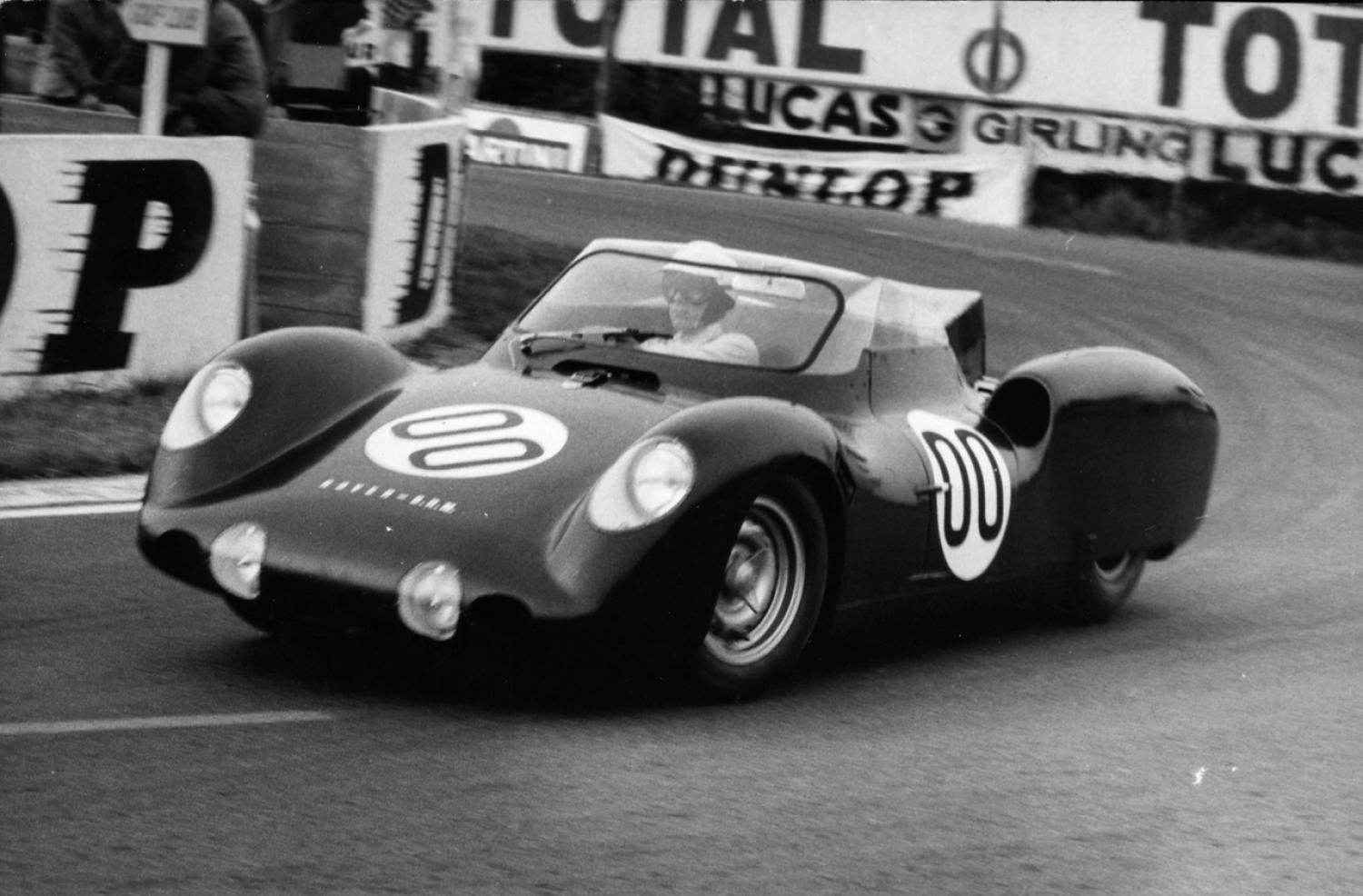
Rover would partner up with British Formula One constructor British Racing Motors. Together, they would build a series of racing cars that were tested in the 1963, 1964, and 1965 24 Hours of Le Mans. The turbine wowed in racing. Despite being unproven in endurance racing, the car finished second in class in the 1965 race. However, the turbine suffered from excessive heat and fuel consumption.
Eventually, Rover’s turbine cars would be retired from testing and placed in museums, but it still wasn’t done with turbines yet.
Leyland’s Turbine Trucks

Rover would be purchased by Leyland Motors in 1967, and Leyland’s director of engineering, Bertie Fogg, had a grand idea. By now, Rover had shown that turbines were too expensive and too thirsty to be practical in cars, but Fogg believed that the turbine might have had a place out in the open road, powering trucks. By this time, there had already been gas turbine truck efforts in America that had shown that there was potential.
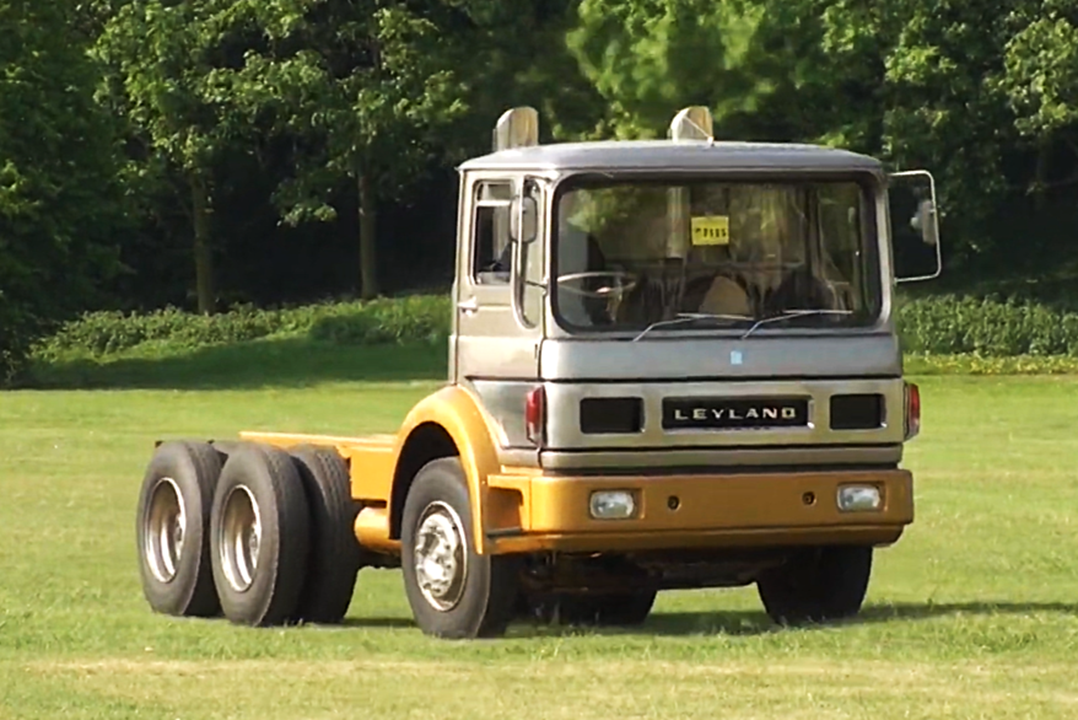
Rover’s efforts were consolidated into a subsidiary called Leyland Gas Turbines Ltd., and in 1868, the 150 shaft horsepower engine from Rover’s turbine car was fitted into a Leyland Ergomatic Super Comet cabover tractor. The truck was slow, but drove smoothly. It was a proof of concept that a turbine could work in a British semi-tractor. Check out a video of a Leyland turbine running:
Engineers at Leyland Gas Turbines would take the basic concept from the Rover gas turbine and scale it up to a much more powerful truck engine. In 1968, Leyland, which was now British Leyland after a merger with British Motor Holdings, presented its creation to the press. The Commercial Motor wrote this report:
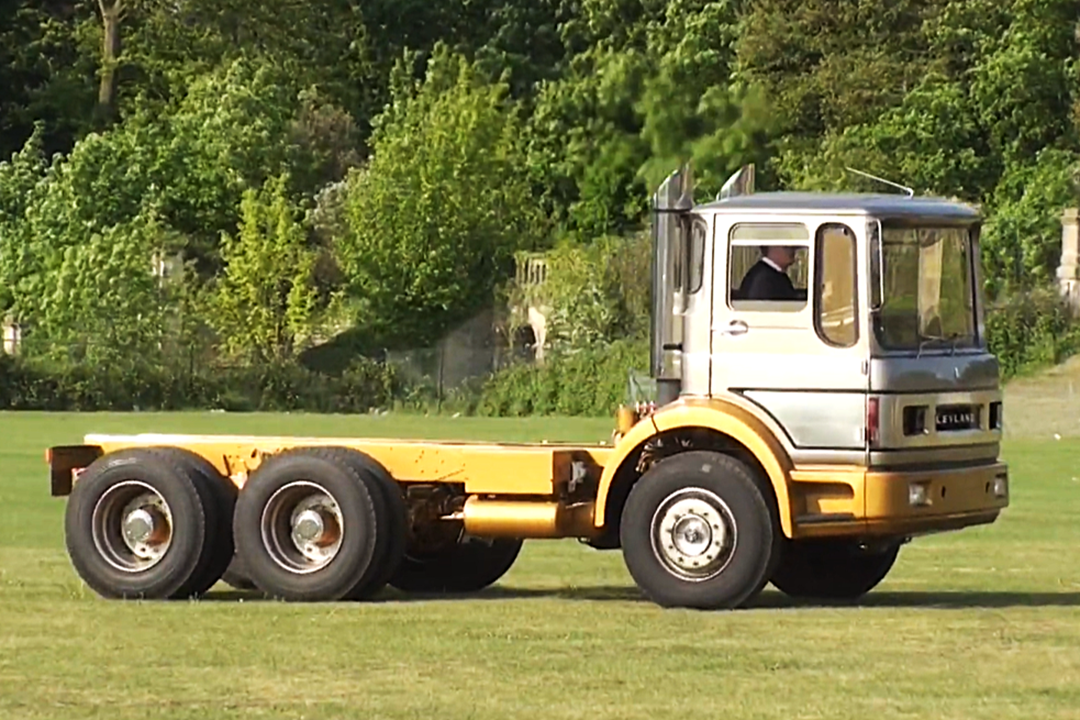
THIS WEEK British Leyland Motor Corporation unveiled the gas-turbine-engined truck (see page 80) which it is showing at the Commercial Motor Show that opens at Earls Court today. Known as the GT truck, it is a six-wheeled double-drive tractive unit with a Rover-styled luxury cab based on the Ergomatic. The Leyland 28 /350/R turbine develops up to 400 bhp (BS AU 141 rating) and weighs under 1,000lb, which is approximately half the weight of a comparable quality-built diesel engine. Because it is a two-shaft machine, peak torque is available at zero output speed and the favourable torque/speed relationship provides peak performance characteristics with a limited number of gear ratios.
A regenerator comprising two rotating low-speed heat exchangers provides a substantial reduction in fuel consumption by pre-heating the intake air from the compressor and variable power-turbine nozzles augment fuel economy in addition to affording overrun engine braking. Life expectancy is in the region of 12,000 running hours, which is equivalent to 300,000/500,000 vehicle miles. Servicing is facilitated by the use of a small number of self-contained subassemblies.
Dr. Albert Fogg, British Leyland’s director of engineering, states that the unit is “the first prototype of a model that will go into limited production late in 1970”. Adds Dr. Fogg: “It is not an engineering experiment or a purely prestige exercise.”
Mr. Noel Penny, general manager of Leyland Gas Turbines, has been largely responsible for the development of the turbine which is based on the Rover unit. The 38-ton-gross six-wheeled tractive unit to which the prototype gas turbine is fitted is described as eminently suitable for longdistance trans-continental operation at speeds around 70 mph. Because of the inherent flexibility of the gas turbine it is also suitable for stop-start urban running. Leyland technicians point out that the turbine offers a substantial noise reduction in addition to a cleaner exhaust gas. Lowfrequency vibration is eliminated, which is of benefit to the driver and is conducive to longer chassis-component life. By removing heat from the exhaust gas the regenerator eliminates the nuisance of a “hot blast” from the exhaust stacks which are located vertically behind the cab.
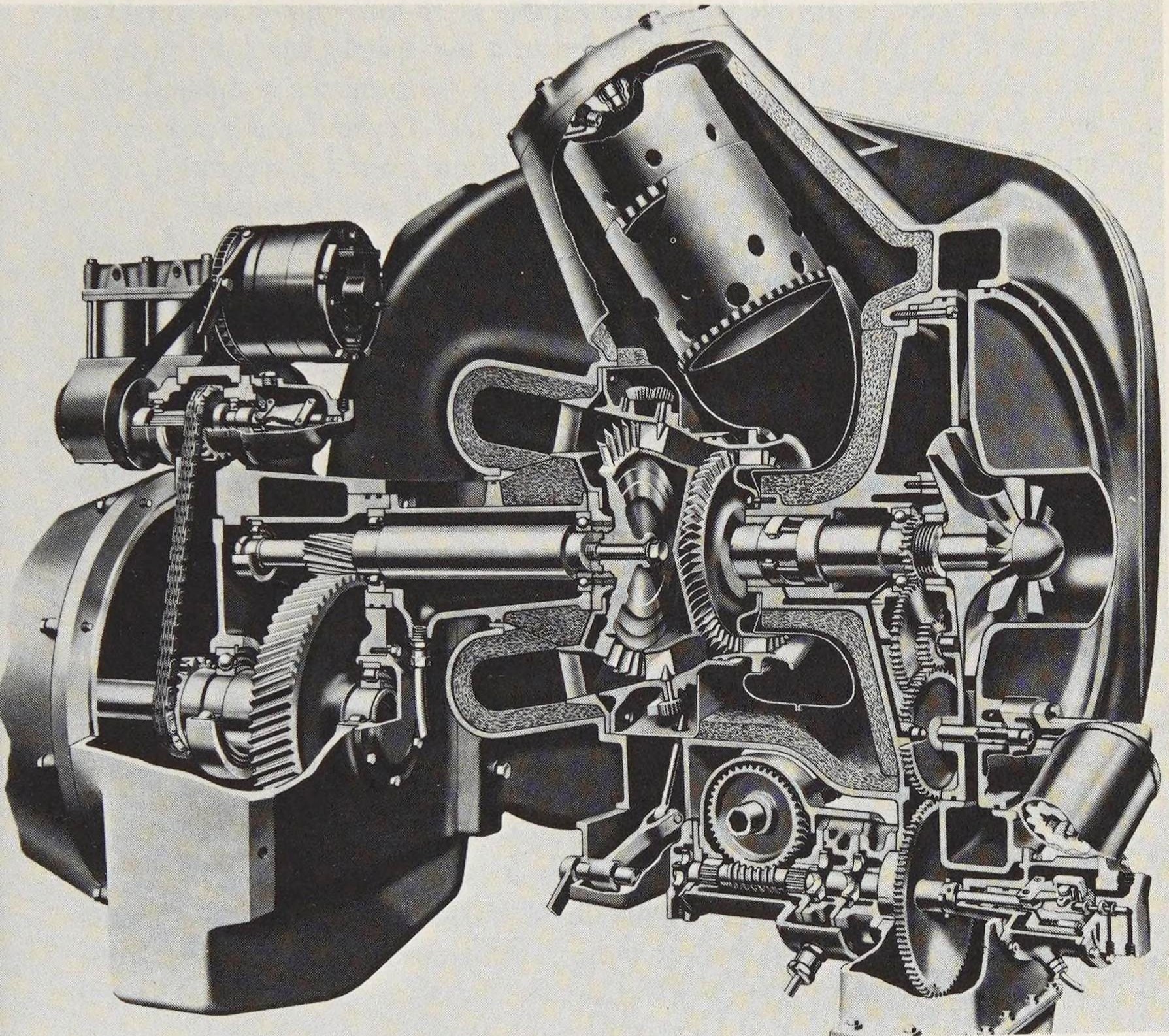
If you’re interested in reading about the engine’s technical details in depth, click here to read a 15-page paper from the American Society of Mechanical Engineers. Otherwise, the Commercial Motor summarized the engineering details of the truck as follows:
The “gasifier” section—compressor and turbine—has a maximum speed of 38,000 rpm, while the power turbine operates at a maximum speed of 30,000 rpm. This is reduced by a single-stage helical gear to an output speed of less than 3,000 rpm. Easy starting from cold is facilitated by a hightension ignition system. While the unit is normally operated on diesel oil, paraffin or a low-lead-content petrol, it can also be run on a variety of alternative fuels. These include any standard type of distillate fuel, liquid petroleum gas and gaseous fuels. The rating of the turbine quoted earlier is the heavy-duty rating, the standard rating being 370 bhp. Minimum fuel consumption is 0.392 lb /bhp /h at 68deg F and 0.399 lb /bhp /h at 80deg F. The unit operates on a relatively low pressure ratio of 4 to 1 (at 80deg F) while the mass flow at this temperature is 3.75 lb /sec. Gasifier idling speed is 19,000 rpm and the full-load output-speed range corresponds to a maximum powerturbine speed of 0/3,250 rpm. The capacity of the wet sump of the lubrication system is 2gal. Dimensions include an overall length excluding starter of 51in., a width of 28in. and a height of 44.2in.
Power is relayed through a five-speed fully-automatic epicyclic gearbox that is hydraulically operated and electrically controlled. There are two forward-drive positions of the control lever which is mounted centrally in the cab, the “low” position providing a selection of ratios that gives optimum performance and the “high” position a selection that affords optimum fuel economy. The ratio range comprises ratios of 5.22 to 1, 3.23 to 1, 2.125 to 1, 1.5 to 1 and (top) 1 to 1, the reverse ratio being 3.7 to 1. A gearbox full-torque power take-off runs at engine output speed and is controlled from the cab. The primary structure of the engine is a close-grained iron casing which in plan view follows an H form, with the long sides forming the inner supports for the heat exchanger discs which are set longitudinally (rotating in the same plane as the road wheels). The compressor turbine is integrally cast with blades of low-stress design to give long life. The gas generator assembly (compressor and compressor turbine on a common shaft) is supported on a roller bearing adjacent to the turbine and a ball bearing adjacent to the compressor.
The reverse-flow combustion chamber is mounted on a flange raised in the top of the pressure casing, between the regenerator discs. Integrally cast, the single-stage power turbine is carried in a ball bearing at the turbine end and roller bearings at either side of the high-speed pinion in the reduction box. The glass-ceramic heat exchanger discs are the product of many years of development in conjunction with the Corning Glass Co., USA. This material is chosen because it combines high-temperature capabilities with low thermal expansion and high heat-storage capacity. Pressure-loaded seals have been evolved to give low wear and low leakage, yet without absorbing a lot of driving power. The discs are self-cleaning. Standard paper filters are fitted in the intake chamber to give adequate protection under normal road conditions; with six of them the replacement period is 1,000 hours. Twin 8in. exhaust ducts are swelled locally to 13in. diameter to incorporate silencers. The engine is controlled solely by the starter switch and the throttle pedal.
The Turbines Were Heavy And Hot
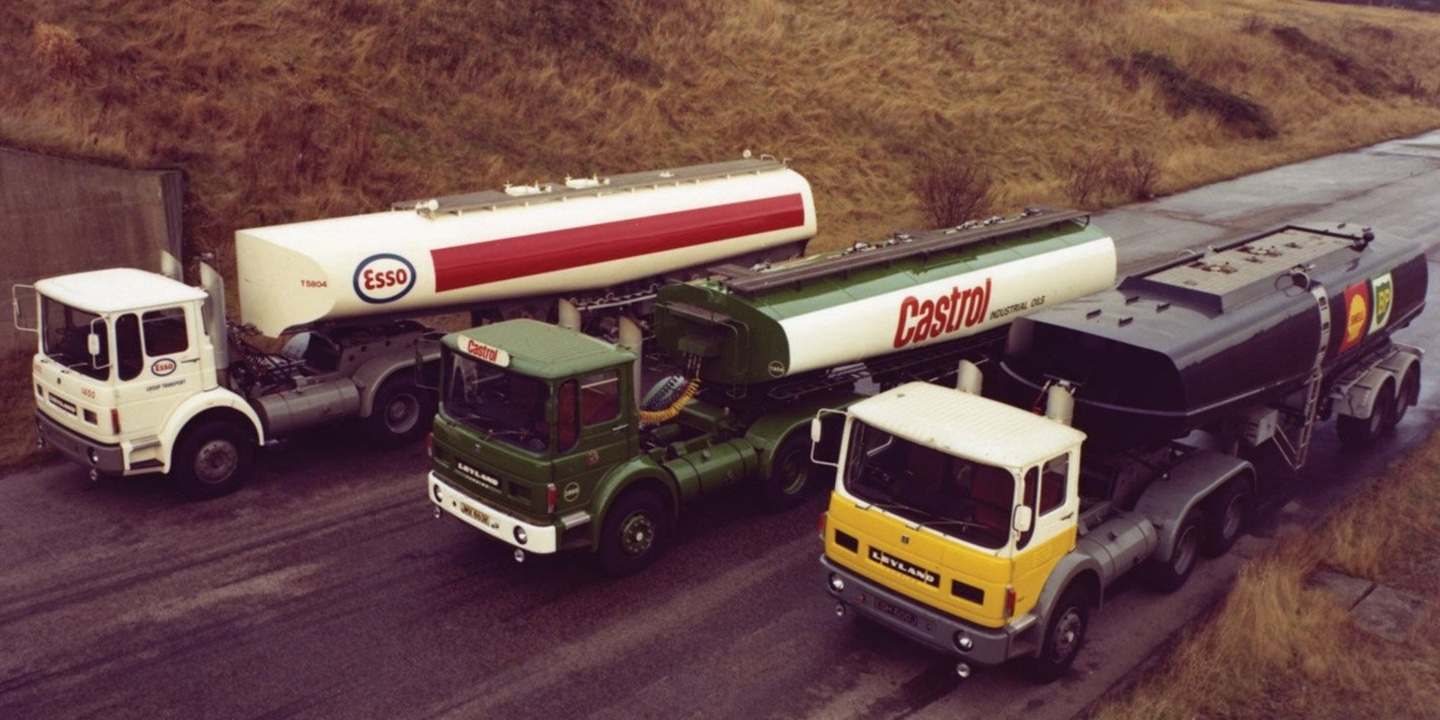
Cracks were showing in the program early on. British Leyland told the press that their turbine engine would weigh under 1,000 pounds; the weight ballooned with the parts needed to make it work in a truck. According to Fred Boulton, an engineer who worked on the project, after adding the reduction gearbox, the heat exchangers, a drive for an air compressor, and a drive for the alternator, the finished engines weighed closer to 2,000 pounds. One of the headlining benefits of the turbine was that it was half the weight of a diesel, but now, Leyland’s turbines weren’t much lighter at all.
There was more. In service, the trucks were expected to burn up to 25 percent more fuel than an equivalent diesel. However, diesel was so cheap back then that fuel costs made up less than 10 percent of an operator’s running costs. Likewise, the belief was that the turbines would be more reliable than diesels, anyway, and therefore make up the difference in fueling costs in reduced maintenance costs.
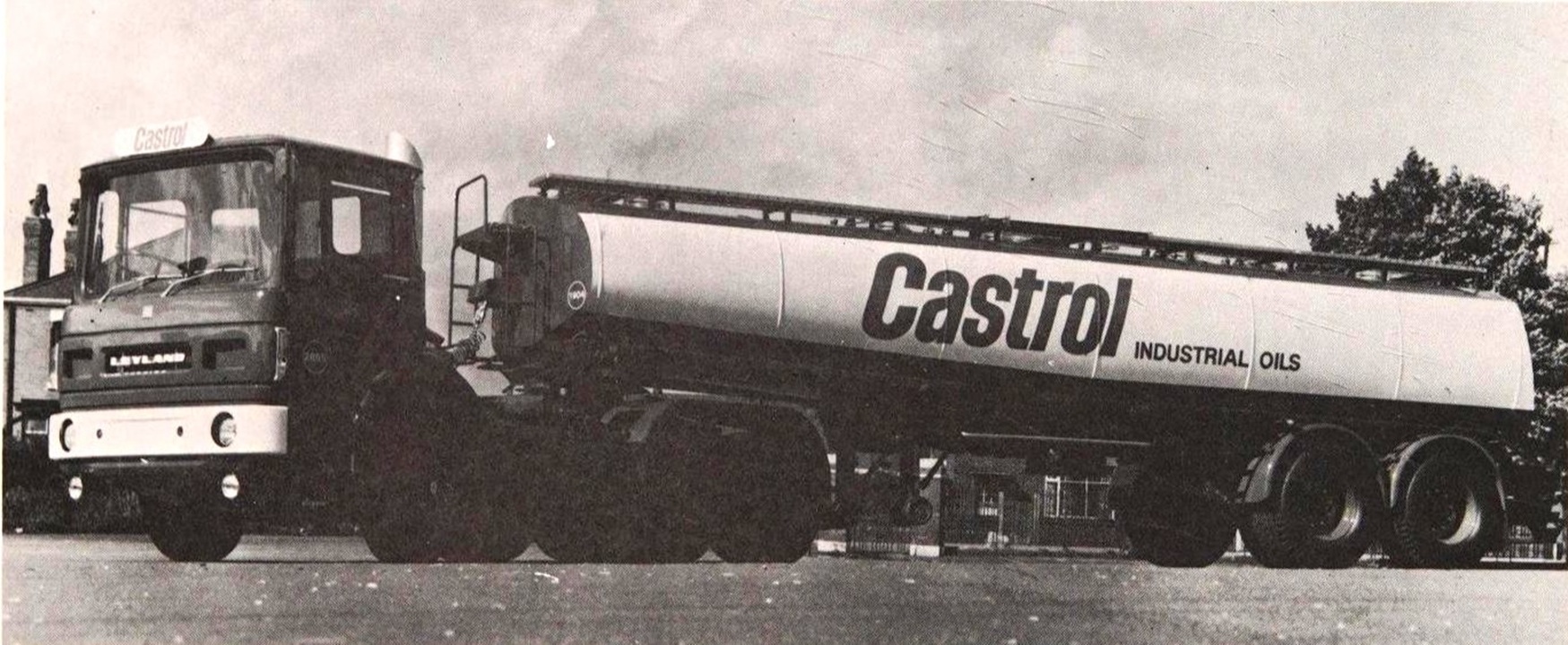
A total of seven Leyland turbine trucks were built. The 1968 prototype was built with the specifications noted above, while the other five featured weight-saving efforts implemented in the trucks’ suspensions, chassis, brakes, fuel tanks, and even battery boxes. Later, engineers would come up with a simplified turbine design with only one heat exchanger, and mocked it up on one more truck. In 1972, three of these updated trucks were loaned out to Castrol, Esso, and the Shell-Mex & BP joint venture under the premise that they were lighter than an equivalent diesel.
On paper, British Leyland’s trucks were the holy grail. Leyland said its turbine trucks were faster than equivalent diesels while transmitting less noise and vibration. They even made the bold claim that the turbine exhaust was non-toxic and that turbines would have exceptionally low maintenance costs. Or, more specifically, Leyland said that the turbines were going to be 50 percent cheaper to maintain than diesels.
Unfortunately, the reality was far harsher.
Diesels Caught Up, And So Did Fuel Prices
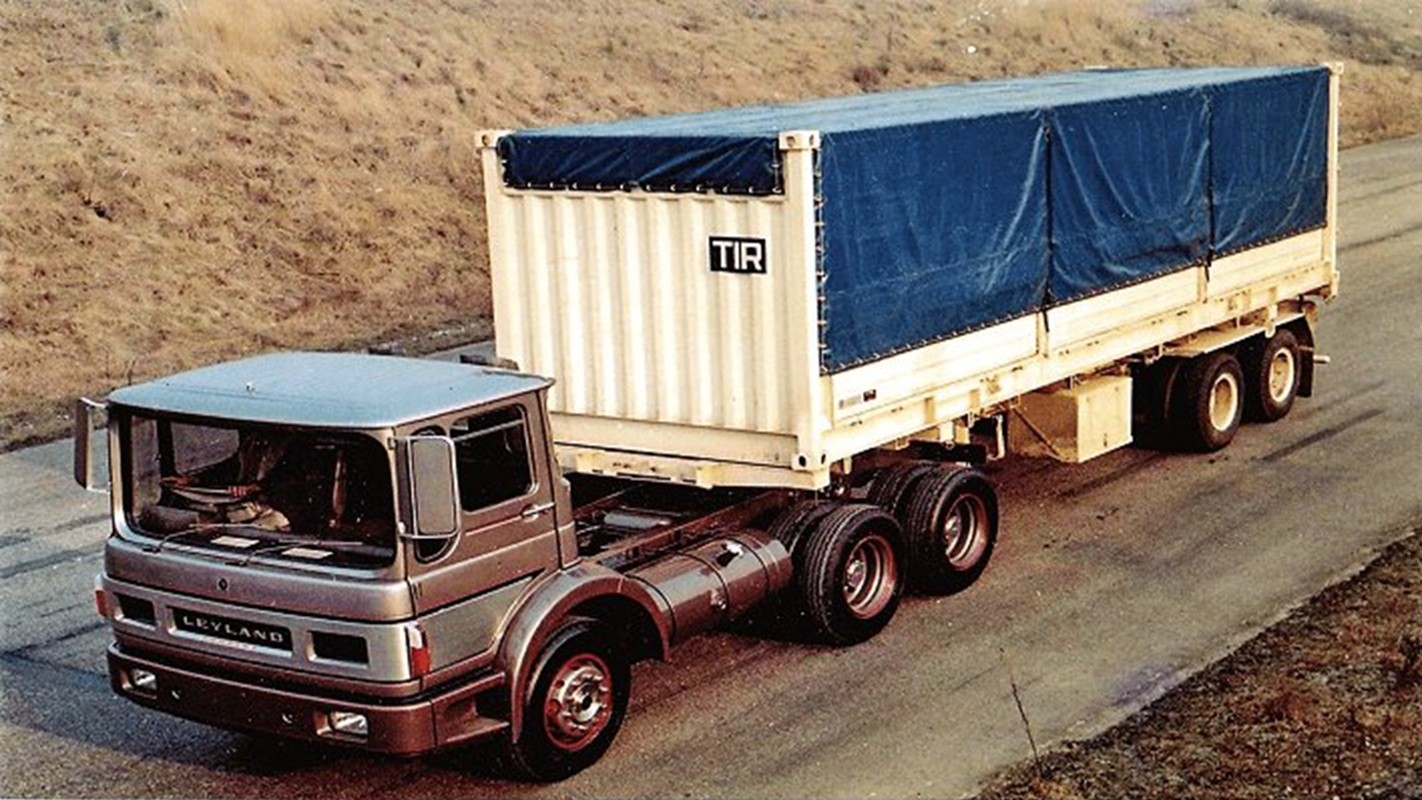
According to Fred Boulton, the trucks really did have rather amazing performance characteristics, but only for a short while. Apparently, due to issues with the tip clearance of the output turbine and the heat exchangers, the engines had a problem with building up too much heat, eventually leading to an overheating condition. The engines would have to throttle down to compensate, which led to a secondary issue with the automatic transmissions, as their shifting parameters assumed the engines would be throttled up. So, not only were the trucks down on power while they were hot, but the trucks weren’t shifting when they were supposed to, further decreasing performance.
Thankfully, as development continued, the size of the heat exchangers was increased, and the engines were able to run for longer without overheating. Leyland planned subsequent generations of its turbine engine that could have further worked out the kinks.
But there were a few issues that were far harder to overcome. In testing, it was found that the heat exchangers were unreliable. Apparently, the Shell-Mex & BP joint venture kept its truck for only a year, citing breakdowns due to heat exchanger failures. Castrol and Esso turned in their trucks a year later.
Another problem was the diesel engine. When the turbine project was conceived, British diesel engines were in a transitional period where their performance and efficiency were still low enough that turbines seemed like a good alternative. However, by 1972, turbodiesels had made measurable gains in performance while achieving even better efficiency. In December 1972, British Leyland sold the Rover turbine program to Lucas Aerospace.

Then there was the nail in the coffin, which was the event that killed so many turbine projects in the 1970s. When the oil embargo of 1973 rolled around and multiplied the cost of fuel, the last remaining benefit of the gas turbine vanished. British Leyland began winding down the program in 1974, and by the mid-1970s, it was all over. Despite the big promises, no Leyland turbine truck ever entered series production.
Thankfully, it’s believed that all of Leyland’s turbine trucks were saved from the scrapper. The British Commercial Vehicle Museum at Leyland had the original Super Comet demonstrator and an engine cutaway, while the Coventry Museum and Knowles Transport had two other test trucks. Sadly, one of the test turbine trucks was lost in a building fire.
A Promising Idea At The Time
To be fair to Leyland, the problems it experienced weren’t much different from what engineers faced here in America. Poor fuel economy, unexpectedly high repair costs, and the oil crisis also doomed many of America’s gas turbine projects. Like the American efforts, there was even a chance that if Leyland just had more time, they could have made competent trucks. But by the mid-1970s, gas turbine power just didn’t make any sense anymore when diesels were getting more reliable, more powerful, and more efficient every year.
Thus, the Leyland turbine truck, like all turbine trucks, was a product of its time. Turbine trucks made some sense when they were conceived because fuel was cheap and diesels hadn’t yet grown into the powerhouses that they are today. But it took too long to develop gas turbines into practical road-going engines, so diesels caught up.
Likewise, the gas turbine was a bit like the Wankel, where its promises were bigger on paper than in reality. Still, it’s so awesome that these projects even happened in the first place. One by one, all of these truck brands put their engineering talent on display and, if only just for a moment, made people imagine a future where maybe we’d all be buzzing around in vehicles powered by turbines. For some companies, getting people pumped about the alone was worth the cost of admission.
Top graphic image: British Leyland/Screenshot: YouTube/Anyscammell



‘The First Turbine Car Was Also British’.
No, it was not!
I’ll have you know that Ferdinant Verbiest mounted a turbine on a car in the seventies. The SIXTEEN seventies! As in 1672!
Granted, this was a steam turbine, and the car couldn’t carry a driver, but it is still a full century before Cugnot got its act together.
https://en.wikipedia.org/wiki/Ferdinand_Verbiest
This comment is a bit more tongue-in-cheek than my usual, but there is still some truth in there.
My wife was watching some trivia show and they asked who invented the first car. She was not impressed with my tirade about who they expected for the answer vs who the actual right answer was.
Were they working on a Time Machine as well? 🙂
Side-note: if you’re ever visiting London, the Science Museum is def worth the visit, much like the Natural History Museum next door (although the Science Museum usually has next to no queues, unlike it’s neighbor)
The big British museums in London are all worth a visit. Just hit the British museum first thing in the day, and same with the Imperial War Museum the following. Both can easily suck up most of a day.
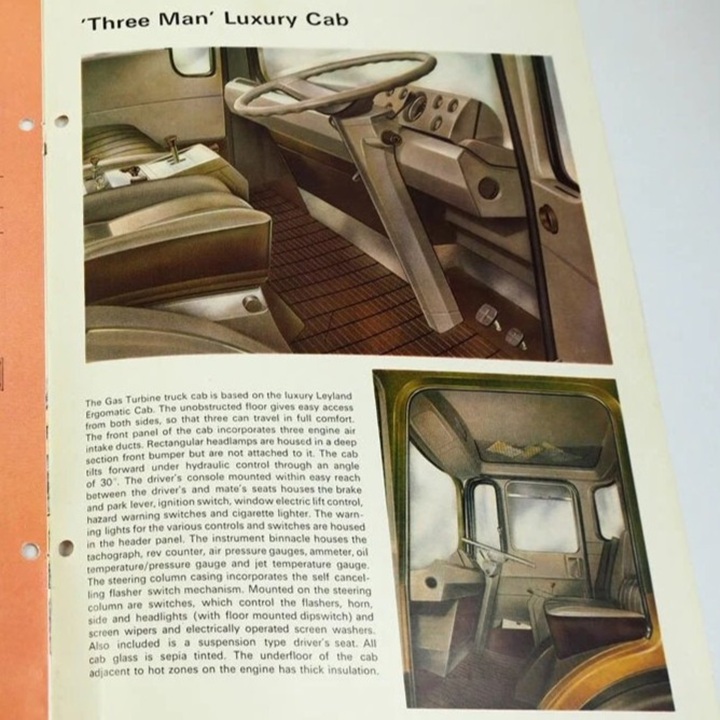
Wow, that is a beautiful lorry cab! So nice design. Must be by one of the great ones, I’ll have to research on that… Up there with Marcello Gandini’s Renault Magnum.
The giant manly chimneys are very cool as well 😎
Leyland was really the GM of Britain: Trying all kinds of wild experiments costing millions and millions, only to amount to not very much in the end.
[ADDED:] Ha! I knew it! It was designed by Michelotti.
“Modern life would not be possible without these engines of industry.”
The electric motor enters the chat.
We COULD get by without the diesel. We can not say the same for the electric motor, especially given its alter ego is the generator.
As an EV-evangelist, I will say the following:
At this moment in time, we can absolutely not live our modern lives without diesel engines.
Our whole peace depends on global trade, which is primarily dependent on merchant vessels traversing the vast oceans. And they will not go without diesel for the next decades and more.
That is not said we can do without the electric motor. But this was not the original statement.
“Our whole peace depends on global trade, which is primarily dependent on merchant vessels traversing the vast oceans. And they will not go without diesel for the next decades and more.”
We’ve had non compression ignition engine options since we’ve had big ships. First we had sail, then coal fired steam piston engines, then turbines and for the past 70 years those turbines can be nuclear powered. We also have the petrol engine which in an Atkinson cycle hybrid configuration is also quite efficient.
Compression ignition has been the (dirty) lower cost option but if compression ignition engines were to become absolutely untenable we would have those other options for global shipping.
“That is not said we can do without the electric motor. But this was not the original statement.”
I agree, it was not; however IMO the electric motor/generator is a better example of what our modern life really depend on.
So will there be turbine powered range extenders in EV’s any time soon? Sounds like a project…
I doubt it. Atkinson engines are already more efficient, quieter and scale better.
I feel like we are ripe for revisiting turbine trucks. Maybe I will make a microturbine-based frunk REX for my Slate
(wow what a sentence)
Thanks to Jay Leno, I knew about there being turbine cars. I never knew about the trucks, though! That is fascinating.