

It sometimes feels like we’re entering the ‘soft bigotry of low expectations’ phase when it comes to the non-hybrid EV market. There has been a lot of bad news lately and the market has softened a lot. I look at it the other way, and see that EVs were victim of a somewhat opposite effect: the hard bias of high expectations. Yes, EV sales dropped this quarter, and politics is partially to blame, but prospects aren’t all that terrible.
The rest of The Morning Dump will be consumed by some familiar topics. Stellantis sales for the whole globe were reported today and the company’s sales are increasing, thanks mostly to America. Time continues to be a flat circle as UAW President Shawn Fain is reportedly under the eye of the DOJ over claims he used his position to help out his family.


Volkswagen’s plans to cut jobs cratered due to labor, which has claimed a lack of trust in the current CEO and helped to kill his massive plans.
It’s Hard To Know What The EV Market Should Look Like
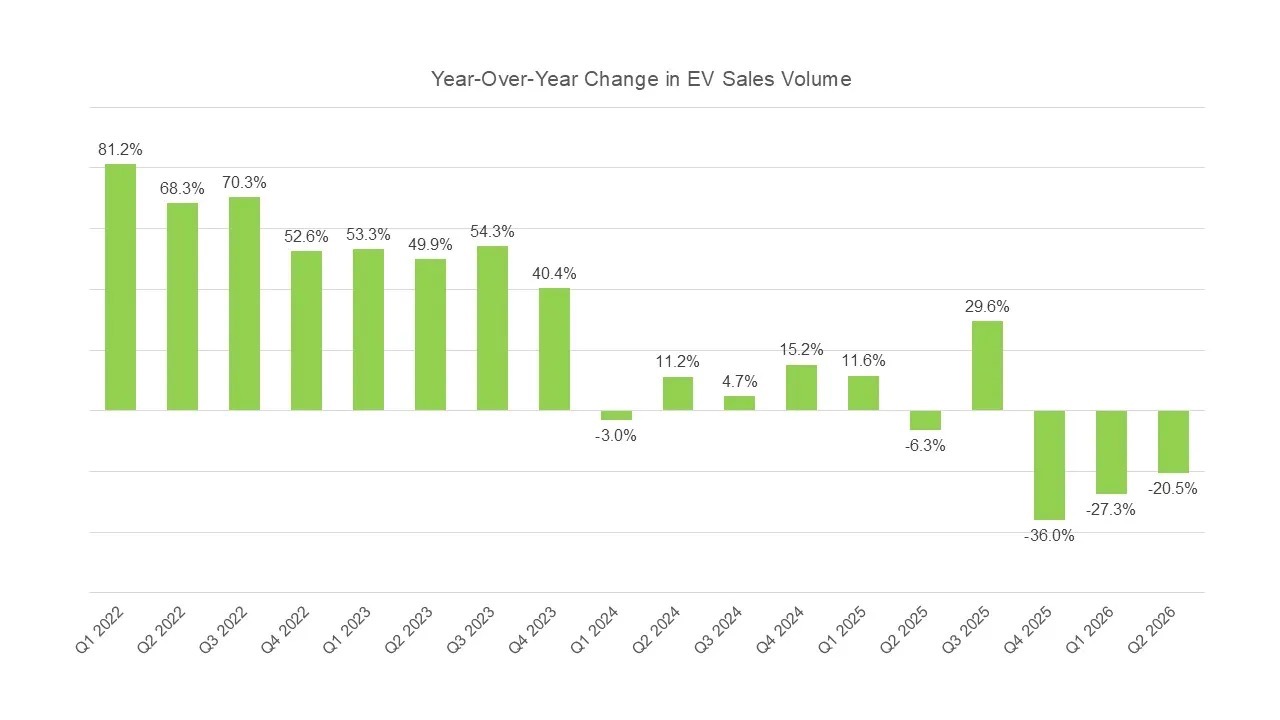
There are two ways to look at this graph of year-over-year changes in EV sales volume from Cox Automotive. If you’re an EV pessimist, you see a quickly declining graph of acceptance that shows people do not want electric cars. If you’re an EV optimist, you see the evil work of the government interfering in the market (or, well, stopping its interference in the market).
I disagree with both views, which is easy to do since they are rhetorical devices I invented myself for the purpose of having something to disagree with, though I believe they are generally valid. What’s interesting to me here is that year-over-year sales briefly peaked before the Inflation Reduction Act went into effect in Q3 2022 and have never quite recovered.
This was one of the moments for me when my doubts that we’d see a 50% EV market by 2030 were solidified. Quarterly sales graphs sometimes hide what this sales momentum chart show. The reality is, with the EVs that we were given, sales momentum was always going to continue to drop. In a way, the Inflation Reduction Act could be viewed as a massive pulling-forward of EV sales for some who were interested. Given how automakers were also subsidizing EV development through massive losses, there’s also a large amount (especially with leases) of on-the-fence buyers opting for great deals.
Sales growth was down 20.5% year-over-year, but that’s an improvement over the last three quarters. Because of the sugar rush of sales before the IRA expired in Q3 2025 I suspect that this trend will reverse itself and we’ll see a huge drop in Q3 2026, before a recovery in Q4.
Without the push-and-pull of the IRA, there probably would have been a large leveling off, but that still would have meant growth. My rough guess is that roughly 10% of the current US car market would be fine with an EV today, if only automakers offered enough good affordable EVs. Last quarter we were at about 5.8%.
That isn’t great, and I think this means there’s probably growth to be had here:
New product launches, state-level incentive programs, and continued consumer interest are helping support demand. While the market is smaller than it was, Cox Automotive continues to believe the long-term trajectory for EV adoption remains positive. As Stephanie Valdez Streaty, director of Industry Insights at Cox Automotive notes, “The next phase of EV growth will likely be driven not only by advances in the technology itself, but by how effectively automakers translate those advances into products that meet consumer expectations for affordability, utility, performance, and ownership experience.”
This is where products like the upcoming Ford Ranchero will be interesting to watch.
Stellantis Caring About The United States Is Starting To Pay Off
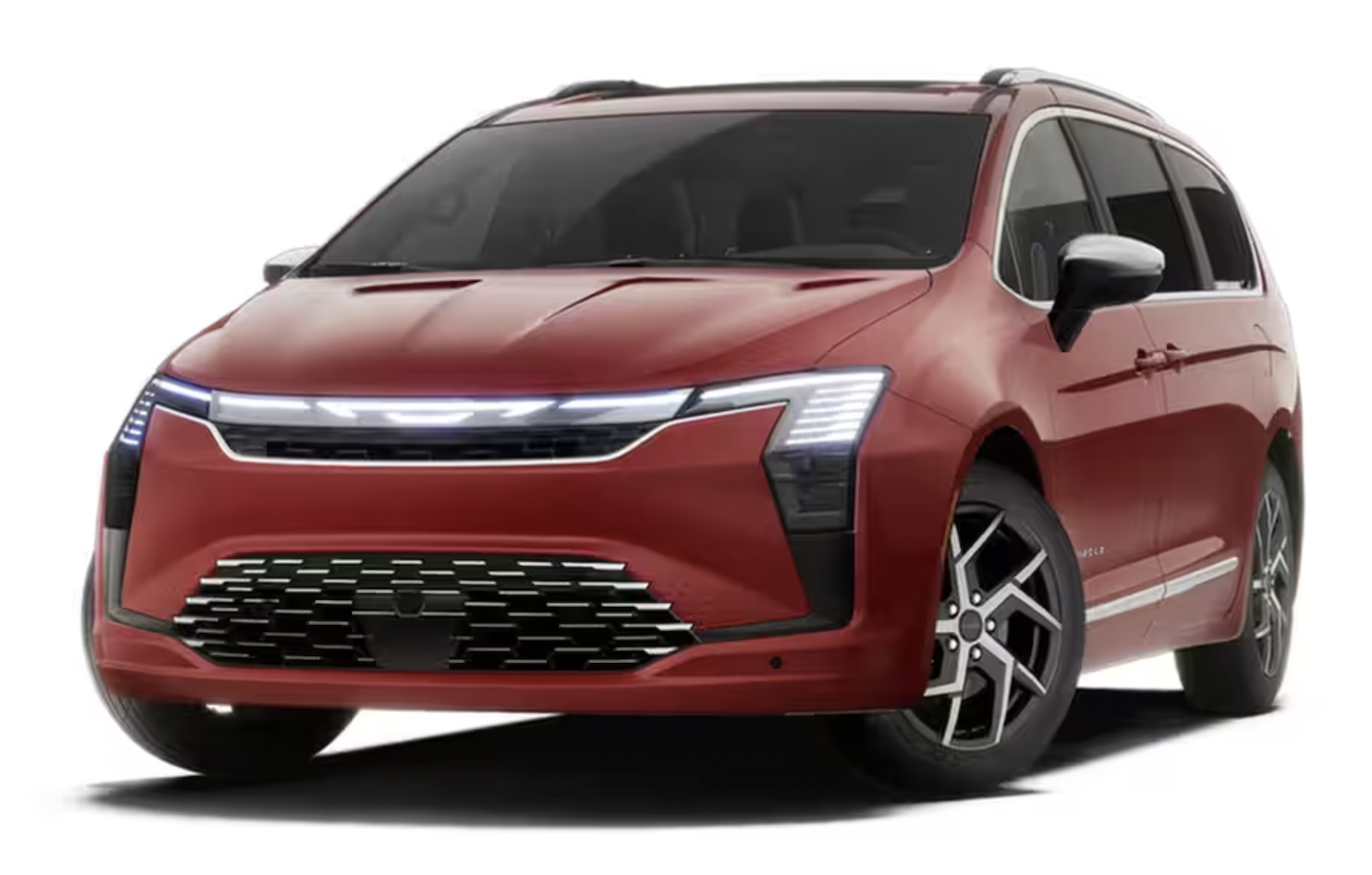
I finally saw a new Pacifica with the redesigned nose and, you know what, it looks good. I like it. This has always been an attractive, functional van and I enjoy the changes. I’m looking forward to driving it at some point in the future. I’d say the same for the current Ram 1500, which also carries over the brand’s longstanding aesthetic.
Buyers in America agree, and thanks to Ram and Chrysler, Stellantis saw a 38% year-over-year improvement in sales. That’s by far the greatest increase for any region, as Stellantis overall saw only a 5% rise in Europe, no change Asia (where it’s barely a player), and losses in both South America and the Middle East/Africa.
From the company:
The majority of the growth was driven by new or refreshed products and powertrain offerings, including the Ram 1500 (light-duty) HEMI® V8, the new Ram 1500 TRX SRT, the refreshed Jeep® Grand Wagoneer and Grand Cherokee, and the refreshed Chrysler Pacifica, in addition to the continued ramp-up of the all-new Jeep® Cherokee and the all-new Dodge Charger 2-door and 4-door SIXPACK; it also reflects preparations for the planned summer production shutdown.
The company seems to be telegraphing a potential period of slower growth in Q3 as production shifts, so we’ll see.
UAW’s Shawn Fain Under DOJ Investigation

United Auto Workers President Shawn Fain came in with a pledge to restore the union to greatness after a long period of unrest and, notably, so many legal issues that the court appointed a federal monitor (under the Biden Administration). While the UAW has experienced enormous success in negotiations, that monitor has consistently alleged that Fain has flouted rules and used his position to punish foes and aid his family members.
Now, per the Detroit Free Press, the Department of Justice is investigating Fain. While the claims appear consistent with what the monitor found, Fain says he’s being targeted ahead of a union election:
“We are going to fight back hard,” he said in a statement July 12.
Fain also decried the investigation, blaming current UAW Vice President Rich Boyer for attempting to undermine Fain’s credibility before the two face off soon in a six-way race for the UAW presidency. Boyer, who has feuded with Fain since 2024, has long claimed Fain disciplined him after he objected to Fain trying to influence him over bonuses at the fiancee’s place of work.
The news of the investigation comes about two weeks after the monitor overseeing the union for the federal government published a scathing report in federal court, alleging that Fain did, indeed, retaliate unfairly against Boyer in 2024. At that time, Fain stripped Boyer of his duty overseeing the Stellantis Department — the sector of the union with about 40,000 members who work for the Chrysler, Dodge, Jeep and Ram family of companies.
Whatever you believe, it’s messy as hell.
VW CEO Takes It On The Chin

Friday was all about Volkswagen CEO Oliver Blume’s big package to save the company. That was swiftly rejected, and the reason was that VW’s labor union has a lot of votes on the board and they’re not… on board.
Labor officials wrote to the company’s employees blaming management for stoking fear over job losses and demanding Blume and his team respond by Friday to more than 80 questions to explain their restructuring plan.
After he failed to comply, the works council distributed a special edition of its newspaper to the workforce on Saturday saying Blume will have to answer directly to staff at meetings to be held after the summer break.
There has already been “a massive loss of trust” in Blume, who had portrayed himself when he took charge as someone who wanted to do the job “for the people,” the council wrote.
I generally like the German model of having labor and management work together as, often, it avoids the kind of us-vs-them mentality you get in the United States. The division in a company like VW is a lot more complex, as it’s: large shareholding family v. the government of Lower Saxony v. labor v. management.
What I’m Listening To While Writing TMD
I somehow missed that Japanese Breakfast’s song “Men in Bars” features Jeff Bridges. Yes, that Jeff Bridges.
The Big Question
What % of the new car market in the United States, in a vacuum, do you think should be electric cars?
Top photo: Cox Automotive/Cadillac


To answer TBQ with utmost accuracy, 100%. Because ICE vehicles wouldn’t function in a vacuum. I’m not sure what the point would be as we’d all be dead, but you’d be better off with an electric vehicle.
Dammit!
On the plus side, maybe tacked on touchscreens are a better UX for pulverized red mist. You never have to take your eyes off the road because you simply don’t have them. Or anything else.
But wouldn’t the liquid crystal in those liquid crystal displays boil off in a vacuum? Another win for physical buttons.
If that were to suddenly happen Jason has a great article on getting the Lunar rover functional https://www.theautopian.com/heres-the-minimum-it-would-take-to-get-the-lunar-rovers-running-again-when-we-get-back-to-the-moon/
Just go off-track from the “Whalers of the Sea of Tranquility” ride.
Is that the full name of the ride? I can’t tell you how many times I’ve missed that and thought the Whalers on the Moon was just a non-sequitur
How did I miss this when first published?
So what’s the speed of a light electric vehicle in a vacuum? Never mind, they’re all heavy.
Technically correct. The best kind of correct.
You could do cool stuff with hydrogen peroxide as a fuel. That does not need oxygen. Unfortunately, it would not stay cool for long without an atmosphere for the cooling system.
But then the same would be true for cooling an electric vehicle.
As long as they carry supplemental oxygen tanks, I don’t see the problem
In a vacuum 100%, since all combustion engines rely on oxygen in the atmosphere to operate. We actually don’t have to guess at this – if we look at other (non-US) celestial bodies such as the Moon and Mars which lack oxygenated atmospheres, we indeed see 100% electrification.
I really opened myself up to this one.
A vacuum will do that to ya
But a lot of them are EREVs, recharging from onboard nuclear power stations.
brb starting a debate on the ontological difference between this and driving a BEV in a location where nuclear power makes up a major component of the electrical grid.
Well, we don’t make the distinction necessarily where any EV charger gets its electrons. So the difference is whether the power generated is on-board the vehicle or not. Gas generator going to a fixed charger going to vehicle is a BEV. Gas generator onboard charging the onboard battery, EREV. So your point still stands, that all extra-terrestrial wheeled vehicles are EVs.
RE: EV sales in the US.
Is it me or do people not react to high gas prices anymore? When I was a kid growing up in the late 70’s-80’s and early 90’s every time there was a recession or gas prices went up what people drove changed. A lot of people drove small econo cars. I just randomly looked and the best selling vehicles in the US in 1985 was the Chevy Celebrity, Ford Escort, and Chevy Cavalier. When I later moved to California in the late 90’s and when the recessions and gas shocks came in the early 2000’s the used car lots were FULL of cheap full sized trucks.
But now? Right now, as in June of 2026 the best selling vehicles in the US are Ford F-150’s, Chevy Silverados, GMC Sierras, Ram trucks and Honda CR-V’s for some reason. In other words, unlike all of the other times in US history where people reacted to high gas prices by buying more fuel efficient cars they’re STILL buying these YUGE things, apparently super happy to pay $5-6 a gallon to run them too.
WTF happened? Are people just happy to stay in debt indefinitely?
Well, I think one of the things that happened is that there are so many fewer visibly smaller actual cars to distinguish from the mass of large, blobby crossovers and crew cab pickups.
Also, people are locked into longer-term loans for larger amounts of money, so they can’t pivot as quickly.
Also also, marketing has convinced people that they need the 100% solution 100% of the time, so they are less willing to just get “an car” that is cheap and basic and efficient, but can’t carry 7 people, a dog, and a month’s worth of luggage while towing a boat for the one time in their life where that situation occurs.
Also x3, there just aren’t as many people with the readies to just buy a used car (which aren’t available in the quantities for cheap as they used to be) to deal with a sudden surge in gas prices.
Also^4 I think that pay at the pump using a credit card has somewhat divorced the reality of high gas prices from when you had to lay down actual folding cash on the counter.
On that fourth point, I have made 99% of my “cash” transactions using a debit card, so it still feels like spending money.
How does spending money on a Debit car feel more like spending money than spending it on a credit card?
I do both. Restaurant spending on a PayPal debit card to get the 5% cash back. Gas on the Costco card to get 5% cash back. The rest on the GM card to get 3% cash back.
I also churn a few cards each year to get the signing bonus. Many cards will pay $500 to $800 for signing up and doing a minimum spend.
I meant it feels as much like spending money as using cash.
How? Both are tapping or swiping a card.
They feel the same to me.
Relatively speaking, gas isn’t as expensive as back then, and even “inefficient” gasoline cars are NOWHERE near as inefficient as the gas guzzling monsters of the ’70s. My old man went from driving a big-ass Chrysler wagon that got 12mpg on a good day to one of the “new redesigned ” 1980 Subaru hatchbacks that got 40mpg. Today that would take going from a 20mpg pickup to an 70mpg car – but that Subaru was cheap ($4300, $19K today). It also had 65hp, no A/C, manual everything including brakes and steering, an AM radio, and the crash safety of a wet cardboard box. And even then, he only bought a new car because the Chrysler would no longer pass inspection due to rust. Back then, used cars were a terrible bet. People just aren’t willing to drive that sort of thing today.
I think people have also gotten used to the fact that these gas price spikes are temporary. This is simply not the new normal. And the current one is self-inflicted by our Idiot-in-Chief.
What happened is:
1) Median income is higher, even inflation adjusted. No one here likes it when I say this, but the typical person lives better than their parents, and that is even more true for the types of people buying a $60K truck.
2) Large vehicles get much better fuel economy than before, so small economy cars aren’t as necessary to save money. My parents have a Grand Highlander Hybrid that seats 7 adults, but gets 33 mpg. Full size trucks can get 20, not 11 as they used to.
It’s a rare person who actively wants a small car; most who buy them feel compelled to. Nowadays that’s less necessary.
I think its less to do with higher median incomes and the level of debt both banks are willing to stomach and consumers willing to get into it. Right now the average debt of the typical American household is over $150,000. A lot of that is related to credit cards, auto loans, and other stuff they’re on the hook for. That works out to a phenomenal 20 Trillion dollars of debt for the entire country. To put that into perspective the entire US economy is worth around 30 trillion. So think about that for just a second. That is insane. And its so far removed from any resemblance of fiscal responsibility.
And we are partially like this because nobody every paid the price for the last few recessions. The government bailed it all out every single time, printed money, and now we as a country are some 40 Trillion in debt. The recessions were never really allowed to run their courses, which is a good thing in general as it cuts the chaff and snaps people back into reality.
So now we have a whole country filled with people having grown up and existed in a country that has put itself into an insane amount of debt so it can both pay off the irresponsible debt and financial decisions the average American makes-whether its in buying overpriced McMansions or jacked-up Silverados getting maaaaayyybbeeee 17 MPG at $6 a gallon.
You and I have an insurmountably different understanding of the economy I think.
Household debt to GDP suggests consumers owe less as a portion of the economy than any point in the last 20 years:
https://fred.stlouisfed.org/series/HDTGPDUSQ163N
Household debt as a percentage of income is similarly low:
https://fred.stlouisfed.org/series/TDSP
There are worrying signs with the national debt. Budgets have become untethered from reality and neither party seems willing to address it seriously. That is not the same as consumers feeling confident enough to buy a $60,000 truck and pay $4 a gallon to refuel it.
Nah. I think I explained it pretty well and one fed person from St Louis ain’t changing that reality. People are simply in way more debt, are more comfortable with debt, and as a result will never retire. But that’s another subject all together
https://www.newyorkfed.org/microeconomics/hhdc
Three quick questions regarding that data:
-Is a dollar in 2004 worth the same as one now?
-Is the number of households in the US the same in 2004 and now?
-Given the obvious answers to the above, would “total nominal debt across all households” have any real meaning at all?
I was kind of busy today so I stepped away from this thread. But I think a lot of people gave you the answers that you were trying to get from me. I’ve lived all over the country. I understand economics quite well and I’ve seen what happens over the decades and how things are absolutely way way more expensive than they ever were decades ago and that is when you put inflation as well as rise in incomes. Either way, I think that’s part of the problem. When your average room temperature person thinks things are all hunky-dory when their own government as well as the corporate interests that currently control it are out there fucking them over
Nope, he’s right. America is richer than ever before and richer than the vast majority of the world. Everything feels expensive because we’re buying higher quality food, housing, and transportation than are available pretty much anywhere else on Earth.
This sounds like something someone who never goes anywhere else would say. We objectively do NOT have better food, education or healthcare than a LOT of the rest of the world. Freaking Mexico kicks our asses on basic things like those, AND they have more EVs because they aren’t scared of competition.
Our country is good at one thing, and that’s blowing stuff up. Though it appears we aren’t even that great at that.
I have no problem for a little bit less richness (was going to write wealth but that is debatable) for my welfare state and universal healthcare.
I would too!
Nah, I think Europe has closer to the correct tradeoffs than we do, but it’s as close to an objective truth as you’re going to get that the American consumer has an incredible amount of power. I don’t really like what most of our neighbors do with that, but they do.
I’ve lived in Europe. Yeah, if you are poor, you are certainly better off there than in the US. Upper middle class and above (which is a LOT of Americans, but seemingly not a lot of Autopians) you are better off here in the US. Would I give up some disposable income to have a European-style social safety net – sure, in theory. But I am not so sure I would give up my standard of living for it.
Our military is stupendous at winning battles. Our politicians are equally stupendous at losing wars. And recently, starting them for the most idiotic of reasons. Be careful who you vote for.
Poor people are not better off anywhere. And upper middle class people are fine everywhere. We seem to be dead-set on making as many people poor as possible by getting rid of anything other than rich.
We haven’t properly declared war since WW2 and I question if we’ve won any “skirmish” since. My (late) Dad didn’t seem to think we won in Korea and my brother sure doesn’t think Iran or Afghanistan were worth much. They were soldiers, btw. I skipped that part of my life.
Sure the poor are better off elsewhere. You can be poor and secure in much of western Europe(and even some of eastern Europe today – that whole social safety net thing means you will almost certainly have a roof over your head, enough to eat, if not particularly exciting food, and if you get sick it’s not a dire financial problem. None of those things are necessarily a given in the US (especially if you live in a “red” state).
But there are far more upper-middle class people in the US than in much of the rest of the world as a percentage of the populaton. Actual middle-class (as opposed to the working poor), have it about the same on either side of the pond. More security over there, more disposable income and a generally higher standard of living over here – pick your poison. Most people actually don’t get horrendously sick or ever need much of that social safety net.
We have bigger houses and cars because we have a shitload of space compared to most rich countries. I don’t know how high you need to be to think we have better food…
We don’t have, like, better-balanced diets. But we have more luxurious food, for sure.
Not sure what “luxurious” means to you, in terms of food. Lots of it? When it comes to quality, it is bottom rung for developed countries.
Sorry, lived in Europe, and have been to most of the EU countries. There isn’t much in it for food quality IMHO. But I am by no means a “foodie”.
The quality and taste of a simple vegetable is night and day. American strawberries taste like red dust. Standard butter in Europe is imported and sold for three times the cost here (and no, that’s not snobbery, it is taste and water content). The amount of additives and poisons that exist in American foods is staggering. Animals are pumped full of hormones to grow fast, which is a big part of the obesity problem. American flour has much higher gluten levels and also added glyphosate and potassium bromate. There is simply no comparing basic food quality.
Whatever dude. You can buy the same stuff here if you want to. And you can buy shit over there if you want to as well. They ban some ingredients we allow, we ban some ingredients they allow, it all works out in the wash.
Nope. The baseline is miles above. These kinds of additives are not allowed in Europe, not to mention the hormones, and they shouldn’t be. The only way to buy that kind of food in the US is to use farmer’s markets or organic stores, and to pay through the nose. The food supply over here is unacceptable.
Whatever dude.
You can eat at any standard you want in the US.
Yes, this is what I mean. Any medium sized city in the USA has an absolute cornucopia of cuisines from all over the globe, at nearly any price point. I can drive three miles to a grocery store with a bunch of normal vegetables plus flown-in tropical delicacies that I have to Google how to eat – and that’s where the poor people shop!
Exactly. I’ve lived in *London* and had no better selection of food than I have in my suburban area of SW FL – and it was rather more expensive. Out in the countryside, good luck. Just within a mile or two of my house I have multiple Chinese restaurants, American (of course), BBQ, Thai, Peruvian, seafood, Indian, Mexican galore, Polish, Caribbean, Soul Food and more I am forgetting. And I can buy the ingredients to make absolutely ANY of those cuisines at home if I want to. And like you say, every exotic fruit you can import to the US. And this is an hour from a medium-small city, and two hours from a “major” city. Make the drive and have even MORE choices. My summer haunt of Portland, ME is even MORE diverse and a bit of a foodie paradise these days.
You can choose to eat like a king in the US, or you can choose to eat utter crap – but it’s a choice you get to make.
1. Real income has come up about 35% while real cost have risen around 70% since 1985. It’s a known fact that we’re in the first period of American history where young people are living worse off than their parents. The average American is priced out of a new car, so only the rich can buy them. This is reflected on the rising average age of the American car, the rising average age of the new car buyer and the rising average purchase cost.
2. Yes, but small cars have also gotten better. A car car can make between 40 and 50 mpg. There’s just less of them since manufacturers have been incentivized to produce crossovers.
What do you think “real” means in this context?
Adjusted for inflation and accounting for all explicit costs (gas, gallon of milk, etc) and implicit costs (changing preferences, tech, manufacturing shifting, etc). On the costs side. For income, similar deal, capturing the wage numbers for explicit and accounting for shifting job make up, benefits packages and so on for implicit.
Right, my point is that higher costs since 1985 are already accounted for in real income. The average household has 35% more purchasing power, to use your figure.
Yes. Which doesn’t account for the massive spikes in cost of living over the same period. 35% increased income, not spending power, does not make up the 70% real cost of living increase. Costs have risen faster than income increases. Even the basics like shelter. The average house to income ratio has gone from 3.5 to 5.0 since 1985. Median rent, adjusted for inflation, has doubled in that period. So a 35% increase in income does not cover the almost doubling of housing much less all the other costs.
Real income accounts for those housing (and other) cost increases and I don’t know how much more clearly I can state that.
There are dozens of us who recognize this. Dozens of us!
Maybe not, like, on this website. But in the country.
You could try harder, for one. I guess you are on the younger side? All of my kids are into their mid 20s or older, graduated college, and have good jobs. The only way they were able to afford houses was because my mother left them money when she passed away. In their age group, they are the few who don’t rent.
I don’t know what Trumpistan version of the world you live in, but the cost of living vs. income is most certainly not better than it used to be.
I don’t know why I bother replying, but words like “real income” have simple and clear definitions, the relevant data are tracked by non-partisan government agencies, for example right here:
https://fred.stlouisfed.org/series/MEHOINUSA672N
and using a vibes-based narrative to doom and gloom in spite of facts bothers me, maybe more than it should.
You can check my comment history, I’ve been here making the same points about this topic no matter which party controls the government.
I don’t know why you bother, either. If you earn 20% more but things cost 30% more, you haven’t “increased” your buying power.
Due to the insane load times here if you are logged in, I seldom do. I’ll not research your post history just to confirm that you don’t understand the economic reality of the country.
Tell me how many HS kids you know who can afford a Mustang GT slinging pizza after school. Or how many graduating seniors come out college with zero student loan debt.
Whatever reality you think you are revealing with your links is simply not what the majority of the country is experiencing.
Insane that such a simple definition can be so poorly understood.
Last thing I’m going to say is that this vibes-based understanding of the economy and cost of living (in spite of how good we collectively have it as a country) is how we ended up with the president that you (and I) despise. It’s why I care about this stuff. You don’t need to believe else anything I say, but dwell on that for a bit.
I don’t have to “believe” anything you post because I can see what is actually going on and travel to other countries.
We got this stupid stain on the country because your average US “American” is too god-damned stupid to understand that what is making them poorer is not other poor people, and that giving more money to rich people does not, will not, and never has helped them in any way.
All that great food that we have access to has somehow decreased our life expectancy, increased our obesity and become more expensive than ever.
I could throw up some graphs, but apparently everything is great according to FRED.
I’m getting out of here now.
Life expectancy in the US has largely decreased because of all the idiocy around covid and vaccines. And because poor people avoid seeking medical care in general in the US.
There is no shortage of fat people in Europe once you get out in the countryside.
As V10omous says – words have meanings.
Real income means income that has been adjusted be inflation. Inflation is by definition the increased cost of living.
If you look at median household wages in 1985 and 2024 and adjust them for the the inflation over that period of time the data says that income increased 35% more than prices.
That does not mean that everyone is doing better but the average family is.
Because of things like this. The longtime American benchmark has been buy a home. Realistic or not. I’m 30. I have a good job that cannot be remote, but in HCOL area. I will not be able to afford a house around here by myself for probably another 10 years.
My parents met because they were neighbors, in their early-mid 30’s who owned houses next to eachother, albeit they were multifamilies and renting out the 2nd unit.
Housing prices got out of whack with years of low rates sure, but prices cant be lowered without putting a good chunk of people underwater.
https://www.realtor.com/news/trends/map-earn-income-home-purchase-every-state/
https://www.resiclubanalytics.com/p/housing-market-income-needed-purchase-typical-home
Btw these two on buyer ages have some disagreement, due to methodology. But both show an increase
https://www.redfin.com/news/median-homebuying-age-2025/
https://www.nar.realtor/press-releases/first-time-home-buyer-share-falls-to-historic-low-of-21-median-age-rises-to-40
So bluntly put – move. The best financial move of my life was leaving the extremely expensive Northeast for a much lower cost of living area. Pay for a given job doesn’t vary anything like as much as cost of living does. SOME parts of the country have become wildly expensive – but many parts have not.
I get that it’s “hard” to pull up stakes and make a better life for yourself elsewhere. But I also don’t have much sympathy for those unwilling to do it for “reasons”. IMHO, you don’t get to bitch about it. If you have a job that is tied to a particular geographic area (Hollywood, or Wall Street, or whatever), then that’s a choice you made that you will have to live with.
I studied a pretty niche engineering subject, got a masters and everything. Took a while to find a job that actually applied it. Options are basically Salt lake, where i am, Alabama or getting into NASA, which isnt the most stable right now.
I pulled up stakes to get here. and have worked my ass off to pay back student loans. Dont have any grandparents left to help for a down payment either.
Like I said, if you are in a field where there are limited options for a job, well, that’s a choice you made that you get to live with.
I have an accounting degree and a law degree, though I have spent 30 years in IT. I can find a job absolutely anywhere.
I am going to bet you make a hell of a lot more than the $35K/yr I made when I bought my first dump of a house. And I too had HUGE student loans for the day from a combined eight years of school. I did luck out in that I was able to consolidate my loans before Congress jacked interest rates through the roof. Still took 20 years to pay them off.
I’m pushing 60, and absolutely NONE of my cohort were doing anything but renting in our 20s, and in most cases, well into our 30s. 20-somethings buying houses has been mostly a fantasy for a long, long time. I bought my first house at 31, the first in my circle. It was 5X my annual income, despite being one of the cheapest houses in the area, and I was only able to buy it because my grandparents helped me out with the down-payment. AND I had roommates in that house. Still do actually.
The only difference between now and 30 years ago is the kids have a much better platform to complain about how terrible thier lives are than we did. We just got to work.
If you’re pushing 60, then you were looking to buy a house well after the Civil Rights Act ended apartheid in the US. The ‘everything was golden’ loons are talking about how great it was for white men when they had a black underclass to exploit. It’s just a white supremacist propaganda meme.
I bought in 2001, and I am not white.
I wasn’t suggesting you are one of those people. I was commenting on the people who talk about a time when houses were cheap, and everything was golden. They’re talking about how great it was when the US still had segregation.
Yeah, in retrospect I am getting what you are saying. But I don’t think the end of segregation really had THAT much to do with it. It just gave the white power idiots an easy target (that immigrants have somewhat taken the place of).
A big part of it is the US was the only great power who didn’t get bombed flat in WWII, which lead to a time of absolutely INCREDIBLE relative working-class prosperity as we helped the rest of the world rebuild. That prosperity was unsustainable, which was accelerated greatly by the rise of the Wall Streeters and the export of jobs to cheap 3rd world countries to make ever greater margins. We very quickly transitioned from a manufacturing economy to a services economy, and without a good education you probably aren’t getting anywhere, unlike in the days when you could just go to work in the local factory as a human robot and make decent money. Those days are long gone and not coming back.
I think you’re kind of missing the point.
“the days when you could just go to work in the local factory as a human robot and make decent money”
Those days were when _white_ men could do that, because their purchasing power was boosted by the effects of segregation. The factory jobs were the good jobs, relatively well paid because they were only available to a certain group: black people were restricted to the shit jobs.
I’m not missing the point at all. That certainly was an issue in SOME parts of the US – but those parts of the US that had large black populations did not have large amounts of factory jobs to start with.
Do you want to think about that a bit?
I have no need to.
You don’t think there might be a relation between the composition of the population and the location of the factories?
In any case, the spending power of factory workers was unquestionably boosted by segregation.
You are entitled to your opinion. Mine is that it was a minor effect, at best. The black population, for obvious reasons, was (and largely still is) concentrated in the agrarian south. The manufacturing might of the US was concentrated in the north, particularly in the rust belt. There simply were not that many blacks to be kept out of those factories.
It’s well-documented that black Americans were put off moving to those areas because they were excluded from any but the very worst jobs.
Sure. But it’s not like there were 10’s of millions of people who wanted to move. Those that did moved anyway. It was a relatively small number affected by this. And it’s not like there was some absolute ban on blacks in factories. There was no shortage of black factory workers in northern states even then. I can see it being prevalent in the south for sure – but relatively speaking, there wasn’t much manufacturing in the south. There is no way this moved the needle on post-WW2 prosperity for white folk to any meaningful extent. And it was 70 years ago – get over it.
This is a “we are going to agree to disagree on this” situation.
It typically doesn’t. Real income, as a statistical measure, typically only accounts for inflation, employment mix, etc. It doesn’t factor in how costs rise, living or discretionary.
We need to start using median incomes, rather than average incomes.
The median real income is also higher.
Not anywhere at the same rate.
35% higher than 1985 is a reasonable estimate for median income as well.
https://fred.stlouisfed.org/series/MEHOINUSA672N
I’m going to come in on your side of this with a quick example of “Stuff is harder to afford than it used to be”
When I graduated and moved out to where I am now to be an engineer, my starting salary was $50K a year. My first apartment was a 1Br. that cost $325 a month. That was in 2003. The current starting pay for that same job is $77K. The rent for that same apartment is now $750 a month. So for JUST RENT (not utilities, food, fuel, student loan debt, etc), we’ve gone from 7.8% of income to 11.7% of income. That’s not an improvement.
On the car front, I bought a 2003 Sentra SE-R Spec V when I moved here. That car’s MSRP was $17,200, which was 34% of my annual salary. But I also financed it at 0% through Nissan. The 2026 equivalent, the Sentra SR (Inferior equivalent in all driving-fun related metrics) has an MSRP of $25K, which is only 32% of our notional salary. However, the best financing from Nissan is 4.9%, which makes it a worse deal for the notional me who has been time-shifted 23 years into the future.
I don’t even want to think about what my student debt burden would be, given what my alma mater’s tuition rates have increased to.
So, despite what V10omous’ St. Louis Fed links say, life is not appreciably more affordable in any kind of meaningful way on the day-to-day for someone coming out of college and into the workforce in an apples-to-apples comparison.
Sir, I get 12mpg, not 11. Thank you very much.
“Sir, I get 12mpg, not 11. Thank you very much.”
Are you putting it overdrive?
Yes, and he leaves the fuel shark plugged in all the time.
No, but I’m thinking of lifting it and hanging a bunch of giant flags off it. Maybe that’ll help.
Only helps when used with Truck Nutz.
Yes median income went up. But I don’t think that explains the trend I think it is more likely that in the last 6 years the top 15% of income earners went from buying 18% of new cars to 29% of new cars. That’s also some of the reason why average new car prices have gone up the middle class has moved away from buying new cars (they prefer to buy a more optioned-up used car). The top 15% earn enough to not care about gas prices. Also should be noted new car buyers age has also risen a ton (now 52 up from 49 a decade ago and 43 20 years ago) and drivers over 55 tend to travel less, but this trend has been happening alot longer then the income one.
“but the typical person lives better than their parents”
100% true.
Mind you some people will argue that they can’t buy cigarettes for as cheap as their parents generation or you can’t get a base model car and only pay an extra $500 to get the V8. And since there are no cheap V8 cars or cheap cigarettes, therefore they are worse off… or some other faulty logic like that.
And then there is the freedumb crowd. These days we have way more freedom than we had when our parents were young in the form of access to abortion, dressing how you want, expressing non-straight sexuality, NOT being expected to get married if you get a girl pregnant and a bunch of other little freedoms.
Except the freeDUMB/MAGA/Trump crowd does want true freedom for people who are not like them and are actively working to take away people’s freedoms while loudly chanting ‘FREEDOM’.
“It’s a rare person who actively wants a small car”
It’s not that rare. Just ask/observe people who have to drive and park in a city. And I’m not taking about suburb-like cities like Atlanta. I’m talking about cities like NYC, Toronto, Paris, London, etc where the roads and parking situations are genuinely tight and having a large vehicle is a pain in the ass.
Most people don’t actually live in those types of city. ALL of the major population growth for decades has been in sprawling sunbelt cities like Atlanta, Dallas, Pheonix, etc. And many who do live in old cities don’t own a car at all, even in the US. The US is a very suburban country at this point, and I doubt that is ever going to change in any significant way. The average American simply values space FAR more than “walkability”. Myself included. It was fun living in a dense, walkable downtown area when I was a kid out of college, but by the time I was in my early 30s I was MORE than ready to get out of that madness to a house in the ‘burbs.
You can have both space and walkability, if suburbs are designed properly.
To illustrate one way, imagine a suburb designed around a single road shaped like a couple of wide esses stacked on top of each other. Quicker to drive than walk, obviously. Now put a footpath down the middle, like the bar on a dollar sign. Quicker to walk. Do that repeatedly around a central point, stick a few shops, maybe the local doctor and a school, and the bus stop or station, where the paths meet, and you have a suburb where kids walk to school and that doesn’t require a car journey to buy a bottle of milk.
https://www.google.com/search?q=twittens+hampstead+garden+suburb
My suburban area is perfectly walkable/bikeable. Both of them actually, summer and winter homes. I don’t walk anywhere because I don’t want to, not because I can’t. It’s too damned hot or cold or wet most of the time. I do a fair amount of bicycling for fun and exercise. Which I did not do when I lived downtown – too dangerous.
Kids in both places walk to school as both houses are inside the distance where they are bussed. K-12 at my winter place, elementary school at my summer place, the jr high/high school is on the other side of town there.
Oh, I can bang on about this for hours. One of the often overlooked factors in walkability is protection from the weather. Shade, in hot places, maybe canopies in wet ones.
Whether to walk or cycle or not is your choice, but people should have the choice (in suburbs and cities) rather than being restricted by poor planning and lack of provision of appropriate facilities.
Excellent point about larger vehicles getting ever better fuel economy.
If we flip fuel economy from miles per gallon to something more easily comprehended like gallons to travel 100 miles, this makes more sense. A modern F150 can indeed do 20 mpg combined with the 2.7 TTV6. That’s 5 gallons per 100 miles. A 1975 F150 got about 10 mpg combined from the 4.9 I6. Or 10 gallons per 100 miles. So in 50 years a F150 halved its fuel consumption. While managing to be a much more capable and comfortable vehicle to boot. Going 400 miles on 20 gallons is a lot more palatable than going 200 miles.
Count your likes; lots of us appreciate hearing the truth. I rarely agree with your slant, but your facts are always dead on. This entire chain is so incredibly frustrating. Watching seemingly good people intentionally delude themselves to wrap their preconceptions in truthiness is a very scary and frustrating thing. I lack your patience and could not have held the line as long without going pure insult.
There’s a saying about dehydrated horses or something, and my tactic of holding their face in the water and kicking them squarely in the dust bunnies so they’ll accidentally swallow some water has never actually helped the horse. Some horses aren’t going to learn and can best be put to use as an example to horses closer to survival.
I sometimes regret getting into these arguments because it’s incredibly frustrating that some people seem not to wish to understand, and the political consequences of that refusal are apparent around us.
It’s been a while since I’ve done this, and I’m not sure I’ll bother again for a while.
I appreciate your comment, seriously. Whether or not we agree on everything *should* have no impact on whether or not we can agree on what is factual. Unfortunately, that seems to just be wishful thinking, and in more cases than just economics.
I have more friends of “the opposite” ideology than my own. Not that I allow an assigned ideology based on some litmus tests to decide my views for me. I’m a fan of economics, not a practitioner. I do try to promote using facts in decision making. Thanks for fighting for Truth yesterday.
You could simply check the Gini coefficient (inequality is increasing fast and has been since 1980) and compare house prices versus inflation. Also, people in the 1980s had pensions. Healthcare costs have significantly outpaced inflation since 1935 – $1K in healthcare in 1935 costs $58,038.20 today, whereas the straight inflation is $24,461.53.
In the 1980s, childcare was typically ad hoc or low cost – average weekly cost in 1985 was $125.15 in today’s dollars, now it is from $280 to $332.
Income may be up on paper but disposable income is not, except for the top layers of society.
Agreed. Not to mention many people are downright bad at math. A 11 to 20 mpg jump is massive compared to 20 to 33.
At the same time average loan terms have climbed multiple years making it much easier (and more expensive long term) to spread out the cost.
Setting aside full size trucks (which have basically retained market share over the decades) the typical crossover gets way better fuel economy than an old sedan. The best selling non-trucks are the CR-V and RAV4. More than half of the CR-Vs that Honda sells are hybrids that get 37 mpg. 100% of RAV4s are hybrid that crack the 40 mpg barrier.
As to debt? Yes, a large percentage of US households are happy to stay in debt indefinitely. They think based on monthly payments not actual cost. Which is also why there is backlash right now as interest rates went from a decade of almost free back to historical norms. That Highlander buyer is having to go to a 72 year loan to keep the same payment as what they had a few years ago and the dealer is happy to do that for them. The dealer mantra is to never talk price – only payments.
I don’t know if households are happy to stay in debt so much as they are conditioned to do so. Or uneducated about credit. Or driven by social pressure to live beyond their means. Or stuff is just too expensive.
But yeah, everyone will be happy to give you credit and high interest loans for long periods as long as they think you will at least pay most of it back. As a consumer, you have to look out for yourself and your best interests.
It’s expensive to be poor in this country, and even more expensive when you let others convince you to stay poor by making horrible financial decisions.
I can give examples from my own family of people staying behind the eight ball due to poor financial decisions. But in my circle that is very much the exception. Most people do actually live within thier means. You simply don’t ever hear about the people who are living comfortably within thier means.
Yep. The family I have that make bad decisions won’t listen to sane advice either. But yes, I struggle to teach my kids, and even the wife that the people who are doing well hide in the shadows and don’t flaunt it. Most of the people with the big houses and expensive cars are deeply in debt but will never tell you.
Or the people with big houses and expensive cars just have lots of money. Which is the norm in my experience. YMMV.
But a modern sedan still gets notably better fuel economy than a jacked-up overly heavy crossover. Not that I have any love for sedans (I find them useless), but I prefer my wagons to be sedan weight (my BMW wagon is only ~150lbs heavier than the sedan and ~50lbs of that is the mandatory panoramic sunroof) and have sedan (or often better) aerodynamics and thus sedan fuel economy, aka the proper station wagons we no longer get in this country.
It was always fun to tell dealers that I could pay for the thing with one payment or as many as it has months of warranty, and the interest rate would determine what I did.
I’m also a fan of wagons and have been driving them for 30 years now. Not enough buyers in the USA agree so we don’t have them anymore.
However, the point remains. Fuel prices don’t affect buying nearly as much as they did the the past because average fuel economy has increased significantly and gas is cheaper than in the past when adjusted for inflation. During the 70’s gas crunch the average new car sold got 13 mpg. In the 2007/2008 recession it was 20 mpg. In 2024 that was up to 28 mpg.
I’ve also personally found that 40 mpg is the point where increasing fuel economy really doesn’t save much fuel or or money. A quirk of MPG having a nonlinear relationship to fuel consumption. Someone driving 15,000 miles per year and paying $4 a gallon will save $1500 a year going from a 20 mpg vehicle to a 40 mpg vehicle. 40 mpg to 60 mpg saves $500. Some that can afford to buy a new car isn’t going to sweet paying another $10 a week for fuel.
Today hybrid crossovers are reaching that 40 mpg sweet spot.
The manufacturers figured out that people will pay more for a wagon if they jack it up and slather black plastic all over it, and they advertise it as a “lifestyle vehicle” to people who will do nothing more with it than drive to work and back. It’s marketing, and nothing else.
Agree with the rest of your analysis. Gas is too cheap in the US for most people to give more than lip service to efficiency, and the gains have largely been forced by CAFE, not because people care. That additional efficiency is coming at a pretty steep price, somewhat up front but definitely down the road. There are going to be a LOT of mechanically totaled hybrid crossovers in a decade or so. Toyota has it nailed, but I have zero confidence the rest of the industry does. But you pay a hell of a Toyota tax upfront these days. TANSTAAFL.
It doesn’t matter why buyers decided they want a crossover – they did. Wagons have never been very popular in the USA largely because our cars as so big.
Yes, fuel economy is almost completely driven by CAFE. Manufacturers do the minimum required to meet the standard and when fines are low they will chose to just pay the fine. You can see this in EPA’s reporting – the fleet economy tracks CAFE
Not sure what you mean by “mechanical totalled” hybrids . Are you saying that the battery will be dead in 10 years? The 25 year history of hybrid says that is unlikely. 18 to 20 years is the typical life for a typical regular hybrid.
Wagons were historically available across product lines, and typically made up 10% of sales of a model. Certainly more of them were sold than such naff bullshit as “coupe crossovers”.
Historically, the overwhelmingly vast majority of hybrids have been Toyotas with thier brilliantly simple drive system. Only Toyota and a relatively few Fords use that. Literally every other hybrid system has been a disaster. GM hybrids – disasters. Even Hondas were terrible. The German attempts were also terrible, but so few were sold you never hear about them. Stellantis can’t even get thier NEW hybrids working correctly. Do you seriously think that the KIA/Hyundai systems with turbo motors and an automatic (conventional or CVT) and electric motors and batteries are going to be as long-term reliable as the Toyota/Ford system? The battery might be fine, but you can bet there rest of it won’t be.
Toyota has it nailed, but as I said, you pay a hell of an upfront tax on them. Even if MSRP isn’t too bad, they quite often have a steep dealer add-on, especially here in the Southeast.
Lots of good reasons below, but also; the scale of consumer impact has not reached the levels of the 1970s.
Prices weren’t just high, supply was so low stations were just plain running out of gas. Lines were long enough to last hours, fuel amounts were rationed, and prices tripled. Even with the recent surge, that hasn’t happened, my local prices for premium went from right around $3/gallon to at it’s peak just over $7.
While that sucked, it wasn’t park the car and walk levels of disparity, and at that price I’m still getting 30+ MPG out of my Civic.
Six months before the first gas crisis hit my Dad bought a brand new Dodge Ramcharger with fulltime 4WD. He literally could not afford to fuel his vehicle, and still to this day asks me about “Gas Prices Up there” every time we talk. Generations since have never experienced that level of impact, and their reactions are framed a such.
I remember in way more recent times when people had more “reasonable” reactions. That was during the 2007-2008 recession when gas prices reached a similarly high level. And the lots were just crammed with cheap full sized trucks. We’re not seeing that now and instead seems like the opposite is happening with people happily slapping down 100k on the Ford King Scorpion Badass 9.0 whatever
This is my recollection as well. Rows of Tahoes and Suburbans on the used lot are burned into my brain. Honda couldn’t pump out Civics fast enough. I expected a similar shift this time for fuel efficient cars and rapidly shifted from my Bronco dream to a PHEV, in an effort to beat the expected price increase from higher demand.
The best selling vehicles in 2008 were the Ford F series and Chevy Silverado, just as they have been for the past 50 years.
Fleet sales gonna fleet sale.
Fleet sales are a chunk of that, but nowhere near the majority. (google sez 15-25%)And if anything, fleets care MORE about fuel economy than the average punter.
The vast majority of pickup trucks are hauling nothing but thier owner’s asses to work and back every day. Sedans with a back porch.
I gave it a look as well, said somewhere between 35-40% depending on year. That’s a pretty good chunk. Fleets care about fuel economy, but still need the form factor of a pickup. I think the hybrid F150 being the default fleet purchase and the biggest model line of full sized trucks reflects both realities.
Yeah, but it gets like 500 miles of range on a tank, I get to sit up higher, I feel safer, and I wouldn’t want to take little Olivia and Carter to practice in a *gasp* minivan!
500 miles on a 30 gallon tank. Math is so hard… Then they complain about how much a tank of fuel costs.
IT was a blip though, and the gas supply wasn’t constraining in the same ways. I never had to wait for gas, or decide I had to take the bus to work, nor did anyone I know; including people with Tahoes and Suburbans.
I suspect those trade ins were panic buyers who DID live through the 70s and thought the bad old days were back.
I think there’s a whole lot of “Fuck it” going around right now.
People have learned that these spikes are temporary. A year or two from now and these high prices won’t even be a memory. How often do you think about the similarly high prices during the pandemic recovery? Actually, they were MUCH higher then in most of the country. Summer of ’22 I was paying well over $5/gal during my migration from FL to ME. And that was a HUGE spike because the pandemic had suppressed demand and thus prices so much. I paid something like $1.89/gal for a good chunk of 2021 when the world was shut down. I hadn’t seen prices like that in decades. Prices haven’t even gone above $4 in my area in the latest nonsense.
You are misremembering what happened in 2007-2008. Gas prices surged BEFORE the recession in 2007, largely driven by speculation, then crashed to under $2/gal as the recession took hold in 2008 and demand cratered.
Ultimately, gas prices go up, and gas prices go down, but on average adjusted for inflation over time gas is simply not wildly more expensive than it ever has been. Gas was $1.09/gal when I got my driver’s license in 1986. Adjusted for inflation that is just about what I paid at BJ’s in Florida last weekend, and a lot more than I was paying before Trump’s Iran fiasco. The Subaru I drove back then got low 30’s mpg with my heavy teenage foot driving it, which is better than my Mercedes or BMW does today – but not wildly better. I don’t really care THAT much about fuel economy, though the cars I prefer tend to be reasonably efficient.
Its easy to overestimate how much gas costs in the overall picture.
Lets assume you drive a truck that gets 15 mpg and you drive 18,000 miles per year and gas is $5/gallon.
Thats 1200 gal x 5 so $6000/yr. If gas drops back to $2.50/gal its still going to cost $3000 which most Americans seem to feel is affordable.
Is $3000/yr short term enough to get people to sell their ICE truck, pay a premium for an EV, higher insurance and a vehicle that might not meet their requirements or desires?
The market clearly seems to indicate no. If you happen to drive less in a far more fuel efficient vehicle the financial case becomes even less appealing.
There is a market for EV’s, it just seems to me that the people who actually want one is somewhat tapped out at the moment in North America at least.
Gas is cheap.
Where?
A sustained period of high gas prices might influence my next purchase, but I can’t just go get a new car because gas prices go up, so it won’t really impact the timeline for my next purchase.
Gas prices are being artificially deflated in Red states with the most number of trucks and SUVs, while they are being artificially inflated in Blue states with the most number of hybrids and smaller cars. Don’t believe me? Lots of websites will tell you what gas posts on average in TX vs CA or any other state. Was in the mid-west a few weeks back and gas there was higher than normal, no doubt, but not nearly the jump compared to back home (coastal blue state).
Also in general ALL vehicles are more fuel efficient than a comparable vehicle was 10 or 20 years ago. So higher fuel costs sting less. And while companies are turning away from this, many more people work a hybrid schedule than before. Would have been mostly unheard of for a regular office worker to work-from-home even 1 day a week in the 90s, but its not that uncommon these days.
I wish I could say that public transit has gotten better in the last 10 or 20 years, but for the vast majority of Americans, that is definitely not the case.
California in particular has largely self-inflicted gas pricing woes that are exaggerated compared to the rest of the country.
People on a budget cannot afford a new car of any kind. The ones who can afford a new car can apparently justify fuel expenses to get what they think they want.
Ultimately, people just buy what they want. They say they care about fuel economy, but not really THAT much in most cases.
And yes, the average new car buyer doesn’t really need to care about fuel efficiency. Gas is cheap.
It costs what it costs when it costs that. On the Neo-Con Right Wing you got high gas prices via foreign wars and oil tariffs, on the Socialist Left Wing you got high gas prices via high gas taxes and burdensome regulation whose cost gets passed onto the consumer.
The moderates on the right and on the left win F all elections, and the radicals on either side that don’t want high gas prices/do care about gas prices rarely win, and when they do the establishment has massive interest in getting them out of their political system (Like Thomas Massie).
Frankly if you don’t need to tow over 4000lbs, or need more than 4.5ft of bed, I think the Maverick Hybrid AWD with the 4K towing package is the way to go.
Honestly I’m hoping they’ll update the Maverick Tremor with the Hybrid Drivetrain, if they did that I’d have a very hard time not buying one, though with how much I’m liking the height adjustable air suspension on my new Ram I’d probably be better off just buying the 4K towing Maverick hybrid and having a custom height adjustable air suspension setup put in it.
For those of us who don’t care about status nearly as much as financial security, we’re laughing all the way to the bank while driving our dull, boring, paid off cars.
Citation needed.
Obviously, all the new EV buyers are waiting for their Slate reservations now. /j
I definitely can’t give percentages. I think a lot more new cars should be EVs.
I’ve settled on an idea for what I expect with the future of ICEVs. Not that they’re going away anytime soon, or losing a significant share of the market. I simply conclude there will be fewer gas stations.
We have a lot of gas stations. I think we will reach the point where we find we have too many. I think that could happen, easily within the lifetime of much of Gen Z.
The face-lifted Pacifica looks like it could have come from S Korea. And that’s not a bad thing. I like they styling of many products coming from there these days. My one-man jury is still out on the engineering, but I am happy with what I have now and hoping not to buy another car any time soon.
Fain seems like a mini-DJT and I despise corruption at any level. I wish the DOJ would look as closely at 47 and his family’s dealings but I’m not holding my breath.
I don’t know about VAG. They’re dead to me. I don’t care.
QOTD: I’d like to see more “last mile” delivery vehicles be EVs. But for OTR big rigs and our personal daily drives, I’m ok with the market sorting itself out organically. Right now, once a month or so, I need to be able to cover 700 miles in two days. I could go EV (and my scooter) for local errands and rent an ICE car for those trips down to California. But I like my current and paid-off car, it will last another 10 years, and I don’t want to deal with getting to a rental car facility and then driving a car I don’t like as much for a week or so.
If I needed to make decisions based on bev sales I’d look at this chart to spot short term stressors immediate effects, market share of vehicle types to understand macro effects on the entire vehicle market, and a nice simple BEV sales over time graph to keep myself from being fooled by the specialty charts. You frequently select whichever type of chart throws the darkest shadow on the BEV market.
I’m going to get an EV to replace my Impreza when it dies because I have no desire to deal with has when EVs are quieter, more reliable, and more convenient, but it would be great if Europe stopped taunting us with great EV hatchbacks that we aren’t going to get here.
I’d gladly buy an EV4 hatch, Inster, Renault 5, Grande Panda, or Ioniq 3, but nooooooo. We can’t have nice things.
Could Stellantis at least throw us a bone of an EV van badge engineered into a Chrysler?
Matt your be too negative. Sure EV sales have crashed 20% which is harsh. But EV sales are only like 10% of the market. So EV sales compared to the whole market only fell 20% of 10% or 2%.
What % of the new car market in the United States, in a vacuum, do you think should be electric cars?
Honestly 100%
Pure electric is a lot smaller than 100%, but range extended EVs should be the norm.
A properly permitted and installed L2 charger is…not cheap where I live.
I don’t think we’ll see a meaningful increase beyond where we’re at now because people who can afford to do the home-charging infrastructure tend to be well-off, relatively speaking.
If we didn’t have to care about that? Every “appliance driver” who does less than 200 miles/day under normal load should probably have an EV.
We did an EV on a 120V plug for 2.5 years on a 40 mi commute with no issues. Only had to fast charge on road trips, and yes, we only take our EV on road trips because it’s nicer than the ICE.
You and I are living in two different realities. To not see this administration’s catering to the oil/gas industry, in everything from paying foreign renewable energy companies public tax dollars to stop constructing renewable energy projects to wholesale sabotage of the US EV industry, then you can see why the country is so divided.
Until the administration gives a $7,500 rebate to everyone buying an ICE vehicle new or used I refuse to see anything but a biased push to buy inferior cars.
Yep — quite recently, they’ve paid out billions of public tax dollars to stop offshore wind plans in favor of fossil fuel plans — among other sickening expenditures. Beyond that, the government has done (and continues to do) it’s greatest interference in the market by subsidizing oil with far greater investment than EVs and clean energy ever received.
My state keeps suing to try to close the old scheduled-for-closing coal plants they keep forcing open with 90 day emergency royal decree spam.
“Time continues to be a flat circle as UAW President Shawn Fain is reportedly under the eye of the DOJ over claims he used his position to help out his family.”
I know it’s been claimed before, but irony is officially dead.
America has never had a President who has used his office to attain financial benefit for himself and his family like the one we have now. The DOJ seems to exist soley to go after his enemies both real and imagined.
What’s happening now makes even some of the most dystopian futures imagined by Philip K. Dick seem like fairy tales.
If everyone had their heads out of their a$$es, and took the dire warnings of climate scientists seriously when they were first widely reported, there would have been an Apollo-program-level effort to build out all necessary infrastructure and EV tech (with very serious supporting incentive/disincentive legislation) such that most vehicles sold were EVs — like, two decades ago — and now they’d all be EVs with rare exceptions.
Honestly, if we’d just followed through on the hybrids from the Partnership for the Next Generation of Vehicles and kept the CARB rules that led to the 90s EVs, we’d be in a decent place. Now it’s gonna take a lot more work and we’re gonna miss the targets.
The oil company climate scientists figured it out in the late 90s. The boards spent decades getting the PR strategies tuned and capturing regulatory agencies to be able to do this. This kind of immorality is baked into our current interpretation of incorporation.
I don’t know what % should be electric cars. My guess is 10-15% of drivers are really actually interested in this. Gas is just too cheap to compel the majority of drivers to be bothered making the switch. And trucks and big SUV’s, which seem popular here in the USA, don’t seem to be good candidates for full electric. So that’s a big chunk of the market of the table right off the top. I really think we need hybrids to make much deeper inroads before we can think about drivers converting to full electric en masse. But, really, gas is too cheap and we have a remarkable, mature, system for delivering it. Wherever I go, I’ll find gas; I don’t need an app, I don’t have to hope the pump is functioning or takes my credit card or whatever. There will be gas.
Any newer chargers take credit cards (it was required to qualify for NEVI funds), and Ionna doesn’t even offer one. I think we’re past the app madness for EV charging.
I’d argue we have a more robust network for delivering electricity, since I bet you’re closer to a 240V outlet than a gas station.
We always planned our stops on road trips before we went anyway, so a charger isn’t any harder, and now that Google Maps has charger routing built-in, it’s even something the general car buying public can figure out.
All that said, people are change averse, so I think we’ll only see a major shift once gas gets really expensive or we have incentives again.
You imply you’re impartial – but you’re still pushing a negative EV narrative.
Just a light gloss over that the stats show that Q2 2026 EV sales are 14% better than Q1 2026, which was itself better than Q4 2025. And while you say that as a percentage of overall sales is 5.8%, you don’t state that this has been a relatively steady percentage over the past few quarters – so EVs are not actually losing ground at all, as your headline implies.
Given the overall economic effects of tariffs, the stupid war, and resulting inflation and unemployment – it’s not surprising that new car sales are down from last year – but they’re improving.
A neutral headline would have been something like “EV sales holding steady at 5.8% of new car sales”, and clarified that overall sales are down from last year, but also improving across the board quarter over quarter.
But that wouldn’t get the clicks I suppose.
You do realize in Q1 people are paying taxes and Christmas bills and in Q2 they are getting tax refunds. That is why you compare Q1 to w1 and Q2 to Q2. That’s why Christmas spending is greater in Q4 when Christmas is.
I think bev could be around 75% in 15 to 20 years. But that’s when they are cheaper and objectively better then ice cars in almost everyway.
Separating them from a tech product image is a big part of that. The regular people buying regular sort of boring bev appliances are likely to drive the market. Just like hybrids it won’t be because they are green washed and viewed as high tech it will be because they are better and more economically viable.
Average age of the us fleet is
up around 13 years old. Bev are showing it’s possible to meet the average age. But the economics of the repair costs to get it there scare people.
The 13 year old hybrid maybe had a $1k to $2k battery rebuild or replacement.
The ice car is likely to have had a $2k to $4k rebuilt transmission
.
The bev probably had a $3k to $8k battery replacement.
Dealer numbers easily will double all. So that $16k battery replacement that allegedly has to be done at the dealer that’s not a dealer is the fear. And a huge reason the average person isn’t buying a bev now.
3rd party rebuilds and replacements will keep many from being mechanically totaled. Along with better batteries and battery chems. LFP might not need to be replaced at that current fleet average age of 13. So your $25k to $30k bolt or slate or Ford thing might just be on the road at 13 years old with no major repair bills.
If it lives it’s life on cheap level 2 charging then its undoubtedly payed for its self and saved your money in the process. Thats when mass adoption happens because it’s cheaper with less unknowns.
They will never be cheaper as the mining and rarity of rare earth metals required will only be hugely expensive
That was probably true maybe a decade ago. But great strides have been made. The rare earth metals aren’t all that rare it’s just the processing that makes a huge mess of things. Lots of research being done to remove the rare earths from the batteries that have already brought down the cost alot. Now there is work being done to remove the rare earths from the motors. Lots of work being done to improve lithium refining. Plus lithium free batteries like sodium. Cobalt probably the most problematic rare earths has already largely been removed in most of the battery chemistrys used.
TBQ – honest question, what do you mean by vacuum? An area devoid of air? No environmental concerns? No political influences? Let companies meet market demand and enable people to buy what they want. I have no idea how many people woild buy an EV if they were sold at market value and without gov subsidies.
EV sales are down… but that’s just in the US market. EV sales are growing globally and the lousy/idiotic decisions the Crooked Trump administration makes will only mean the USA will get left further and further behind.
“Stellantis Caring About The United States Is Starting To Pay Off”
Yeah will the old Chrysler part of FCA is what made most of the money for FCA.. and I imagine it’s a similar story under Stellantis.
The previous CEO was a complete idiot for not recognizing that. And it was/is idiotic that Dodge and Chrysler have been starved of product for so long.
And not putting Ram back under Dodge continues to be idiotic.
“What % of the new car market in the United States, in a vacuum, do you think should be electric cars?”
100%… with the option of a gasoline ICE range extender for those who need it.
Global warming is real. Pollution from ICE engines is real. People disabling pollution controls is real.
Going 100% BEV helps solve these problems in the long run.
Man 8 people are actually believe this?
I’m sure at least 9 people will believe me.
EVs in a vacuum.
We actually sort of have that information.
Go back 40 years ago. Most Americans lived, worked or played within 10 miles of a gas station. They likely drove past a gas station to do life all the time without even noticing it, because gas stations were (and still are) so common.
15 or so years ago, when EVs really started getting available in the US, the biggest complaint was (and still is) that there isn’t a good enough charging system and it isn’t even close to that of gas stations.
There’s a chicken and egg thing going on in the US. Without chargers, people are reluctant to get EVs and without EVs, it doesn’t make sense to put in chargers. To make matters worse, EVs need a different layout of chargers than ICE and not everyone understands this, so the EV chargers that do go in aren’t really that used.
Meanwhile in China…
15-20 years ago, the Chinese car market was just starting to take off. The Gas station network wasn’t super robust. As EVs became available, they didn’t compete against the existing corner gas station, but against the planned one. The EV charging network could (and was) laid out in a manner that fit the needs of EVs and not ICE vehicles.
The result?
2/3rds of Chinese car sales are EVs.
So, if we started developing cars as transportation today with a Blank Slate ™, then it looks like at least 2/3rds of car purchases would be EVs. However, since we developed ICE car network basically 100 years before EVs…
Interesting points and I agree. We did have a long-term plan for how to regulate, support and finance the production of EVs and the charging network, but we abandoned it. Now we are back to letting the market, which currently incentivizes ICE at great expense, do whatever it wants.
People want familiar. The Chinese didn’t have phones 40 years ago (generally). When they went to get phones, they got the superior cell phones and didn’t bother with landlines. America is 20+ year behind China with giving up on landlines, because that is what we all grew up with.
I grew up with ICE cars. It’s what I am used to. Single pedal driving an EV isn’t a selling point, I 3 pedal drive my current ICE, I can’t imagine adapting to single pedal driving and would want to 2 pedal drive it. I can keep going, EVs feel un-natural to me and scary. I know they make more sense, but.. the familar is comforting.
I saw a new Pacific for the first time in the flesh last Friday, and I have to STRONGLY disagree that it looks good. The new front end is so incongruous with the rest of the design that it looks awful. I guess it did evoke a strong reaction, unlike the old design which was innocuous, but I doubt it is the reaction they want.
Oh, I think Stellantis is perfectly happy with polarization. If they aren’t desirous of that, they have been doing a piss-poor job of it for a while now.
Hahaha! Well played.
I hated it when I first saw pictures of this facelift. Said the front was ugly and that it didn’t match the back half.
Then I saw one in person.
Now I think the front is meh and that it doesn’t match the back half.
Matt Hardigree, do you have a feel for if the decline in EV sales is mostly consumer driven, or have the manufacturers cut production to the point where they aren’t there to sell? I was seeing used EV prices rise while gas prices were on the rise and somewhat expected new EV sales to increase. I guess they did, but just not back to the levels they were at before incentives went away.
With TBQ, I feel like 10% is still a reasonable volume in the short term, but it really depends on having more stuff like the Bolt and new Leaf at the low end of the market, and the dealerships need to actually get people to drive them. They are much more refined feeling and have much more power than a comparable entry level ICE like a Trax or a Sentra. I genuinely enjoy driving our Bolt EUV. As a commuter car or errand runner, it’s perfect and with a charger at home, it’s really convenient. Operating costs are way lower too, though Michigan way overcharges for registration of EV’s now.
Bought a gently used Ioniq 5 that came off lease 2 months ago. It was fully loaded for $35k. I absolutely love this thing for my 45 mile round trip commute. Spent about $1700 for the charger and installation. I usually drive it 3 days, then plug it in overnight to 100%. The torque is just really addictive at any MPH and its ridiculously quiet. I dont think i would have spent the extra $20k for a new one, but used its a great deal. Gas savings alone is about $300+ a month.
I just bought a new one for $42k (before tax). Fully loaded. Limited AWD.
Love it so far.
Wow the limited ones have come way down in price. $42k is very good
’26 models got a $10k reduction in MSRP over the previous year, and right now there’s $7k incentives stacked on top of that. Those incentives were higher earlier this year.
No wonder they are selling so well. I probably would have paid the extra $7k for a new one if they had some significant updates. Its a great car.
Same, though I bought a used EV6. With my commute I average at least 1500 miles a month and for the month of June it only cost me $40.20 in electricity.
You might look at setting your charge level to 80% for day to day use. EVs with NMC batteries like to say between 20 and 80 SOC for optimal life.
I can see a reasoning for the UAW investigation.
There’s a terrorist group called Sinn Fein. This was the radical arm of the IRA. For this DOJ, this is close enough to wonder about Sean Fain.
“It starts with I. R. A.”
“No, I don’t care that it’s not a country in the middle-east”
Didn’t they work with the Libyas?
There you go, close enough! Investgate!
(In its heyday, the IRA was NOT to be messed with, they were very mixed up with every terrorist group. We in the US don’t get it, because their focus was on the UK. I went to the UK in 1991 when the IRA had an active threat against the British and there was a feeling that I could only describe as just after 9/11 in the US)
I was in Belfast only a few years after the GFA. You could definitely get more than a feel of it (you still can, in some areas).
Oh missed the obvious joke there. As if anyone that thinks Sean Fain and Sinn Fein are the same can read a map well enough to know Ireland isn’t next to Iran. They are on an alphabetical list of country names aren’t they?
In all honesty: picking just about any Irish or Northern Irish political party, there’s only a wee sliver of space distancing any of them and former paramilitary groups during the Troubles on either side of the political aisle. Not to mention the meddling from outside influences. It’s all messed up, and not really in a funny way.