

An alternative version of the headline for The Morning Dump was going to be “the one chart that has me worried about Stellantis,” but I may be to the acceptance part of my relationship with the company. Maybe this is who they are, and I’m the weirdo for thinking they should change.
Yes, I’m talking about inventory, and that starts with I, though it certainly doesn’t rhyme with pool. If you’re the CEO of Stellantis do you view this as a transitory phase or do you maybe think that you’ve got trouble? The same can probably said for Japanese automakers, who keep thinking that they’ll get out of this tariff mess without much further injury and keep finding themselves back under the Eye of Sauron, or the eye of something that rhymes with Sauron. Volkswagen seems fully aware of how this affects the company and is going to save billions of Euros by cutting jobs.


The great Canadian hockey player Gordie Howe did plenty in his life to merit a bridge being named after him between Canada and the United States. Here’s hoping it opens at some point!
Stellantis Brands Have Twice The National Average When It Comes To Inventory
I haven’t asked AI to write a TMD for me because writing TMD is something I love to do. If it did I’m sure it would say something like “I want to talk to you about my favorite chart.” I’m realizing I say this all the time, and that it covers a wide range of charts. Maybe I just love charts?
Anyway, I want to talk to you today about my favorite chart…
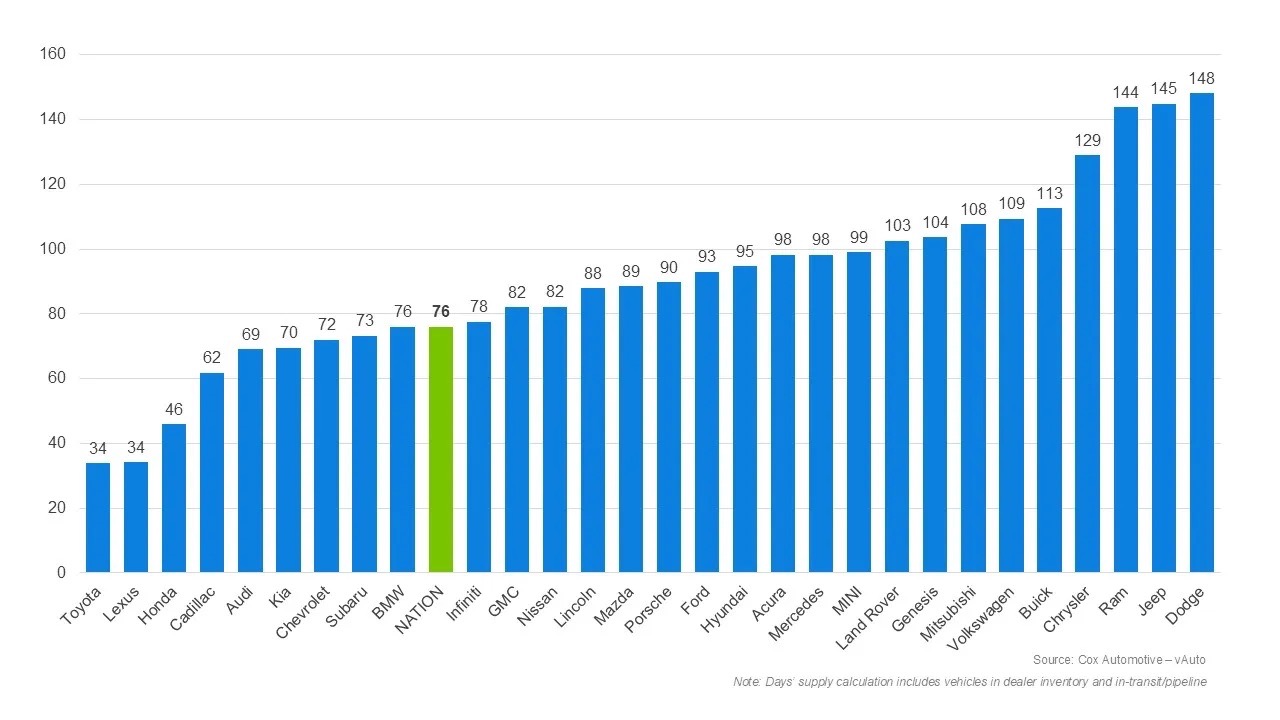
This comes via Cox Automotive and shows the amount of inventory for each brand and the nation as a whole, which it measures in Days’ Supply, which is to say how many days at the current selling rate it would take for all the inventory to be depleted. The national average is about 76 as of May, which is a healthy and patriotic number that has come to a reasonably healthy balance lately.
Generally, if you’re to the left of that line it means you’ve got a lot of demand (Honda), not a lot of supply (Audi), or some mix of both (Toyota and Lexus). People tend to claim that Toyota intentionally keeps the market squeezed by maintaining tight supply and that’s maybe true, but it seems to be working out for them. For small brands, the rollout of a new product or other production changes can shift this some. Generally, though, healthy is somewhere around the average.
Erin Keating provides a general view of what’s going on:
May inventory reached 2.89 million units, up from 2.86 million in April, 5.6% above January, and 13% higher than a year earlier. Even so, the broader pattern remains one of steady supply rather than renewed accumulation. That year-over-year increase also reflects a tougher comparison base: Spring 2025 inventory was depleted by a sales pace that ran above 17 million SAAR in March and April, draining dealer lots.
At the brand level, Nissan remains the clearest example of the broader thesis: Days’ supply fell to 82 in May, down from both April and a year earlier, largely because sales accelerated. The opposite pattern remains most visible at Stellantis, where Chrysler, Dodge, and Jeep continued to post materially higher supply levels year over year as inventory growth outpaced demand. Together, those cases explain the market well: Tighter supply where sales are working, looser supply where sale volume is not clearing inventory fast enough.
Yeah, so, Stellantis. I’m excited for what the various Stellantis brands are going to be selling in the next few years, including a Jeep Scrambler, a new Dakota and Rampage, and some other cool stuff. Very little of what they’ve talked about is for sale now, though, and that’s a problem. While V8 Hemi-powered trucks and SUVs will definitely help find some lost customers, and the Jeep Cherokee fills a hole in the lineup, there’s still not enough there there.
The CDJR brands are still volume brands, and that means that the company needs to sell a lot of them to be profitable, and that means getting vehicles to dealers. Where the company has run into trouble in the past is that it ended up with a glut of inventory and then had to heavily discount that inventory with incentive spending. Based on the above, it seems like there are a lot more cars on lots than there are customers to buy them.
If you’re in the market for a vehicle and are willing to try a CDJR brand this might be a good time to get a deal. The brands are doing a big marketing push and it’s possible this will all correct itself. With new models coming, there’s probably a little bit of cupboard-stuffing so dealers don’t run short, though I sort of doubt that’s most of what we’re seeing.
It’s something I’m going to keep my eye on for the next few months.
Various Tariff And Regulation Changes Could Cost Japanese Automakers $40 Billion By Next Year

There are still plenty of tariffs in place, and they’re hitting even companies that make a ton of cars in the United States, like Honda and Toyota. Then there’s the whiplash of regulations around electrification and emissions. It’s tough, and every time Japanese automakers think the government has it figured out, The White House tweaks something, or threatens to tweak something, or threatens to not tweak something.
Currently, Automotive News thinks all of this is going to cost Japanese automakers about $40 billion by March of next year. So, the Chairman of Toyota may be happy wearing the President’s face on a shirt, but it’s the CEO who has to account for it:
Adjusting to the new realities is a work in progress, Toyota CEO Kenta Kon said last month in announcing the company’s financial results for the fiscal year ended March 31. Toyota’s North American unit slumped to a rare loss, causing parent company operating profit to fall for a third straight year.
“Our response to changes in the operating environment has been limited to measures that can be implemented in the short term, while progress on the business structure transformation that should be pursued from a mid- to long-term perspective remains only partway complete,” he said.
“We were not able to fully offset the impact of U.S. tariffs.”
And this all comes after automakers followed Biden era policies around electrification and then had to take huge write-downs to cover investments that haven’t panned out.
Volkswagen Will Cut 19,000 Jobs By The End Of The Year

I’ve covered Volkswagen’s issues here in detail, but the bottom line is that the company has way too much capacity relative to demand for its products, and that means a lot of jobs gone. According to Handelsblatt, that number will start at 19,000 jobs gone this year:
According to its boss, Oliver Blume, Volkswagen is making progress in its cost-cutting efforts. The workforce at Volkswagen AG in Germany, including the plants in Saxony and Osnabrück, will decrease by 19,000 by the end of the year, according to the text of the speech for next week’s annual general meeting, published on Thursday.
More than 28,000 exits have been contractually agreed upon by 2030. Factory costs at the German sites have been reduced by more than a fifth.
Volkswagen launched its first cost-cutting programs at the end of 2023 and reached an agreement with employees shortly before Christmas 2024 on the elimination of 35,000 jobs by 2030. According to the prepared text of his speech, Blume stated that the first financial effects of these measures are measurable. Sustainable cost savings of around one billion euros have already been achieved.
I hope our guy is spared.
Will The Gordie Howe Bridge Ever Open?
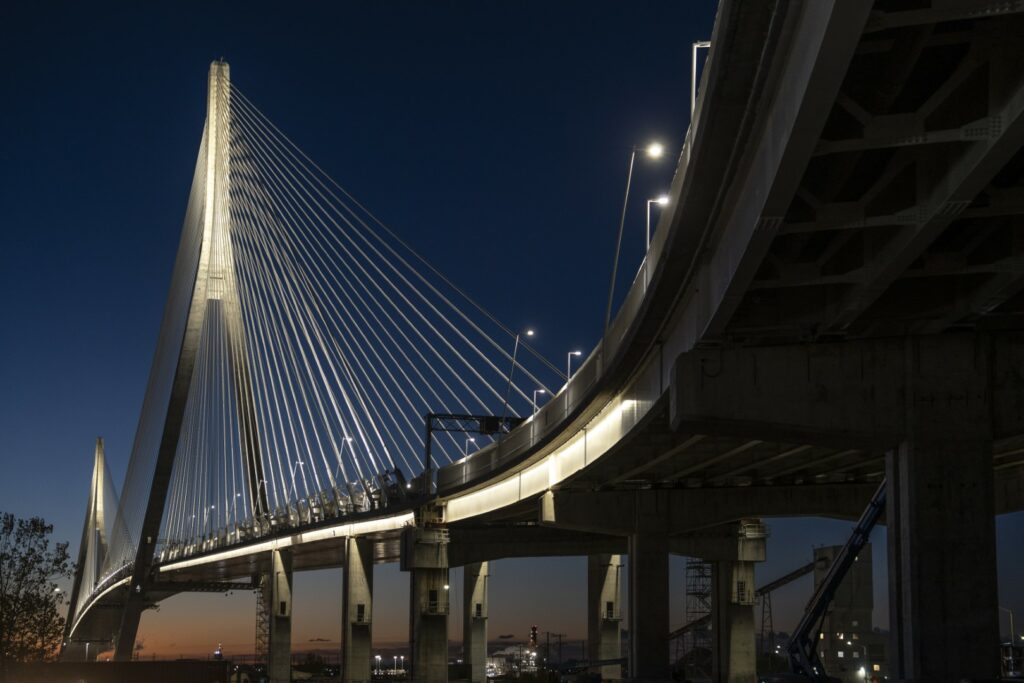
The Gordie Howe International Bridge–named for a Canadian hockey player who represented the Detroit Red Wings–is supposed to be an important link between neighbors who do a lot of business together. That it’s become a political footba… hockey puck is a little sad but not surprising. The bridge, downstream of Detroit’s Ambassador Bridge, is supposed to be open soon, and it’ll maybe happen, at some point.
Here’s The Detroit News on the sad back-and-forth from current Governor Gretchen Whitmer:
Later Thursday morning, Whitmer was asked if she could provide any additional information about why the ribbon-cutting was delayed. The second-term Democratic governor said she didn’t have any more information to share.
“I don’t have anything more to share,” Whitmer added. “I don’t.”
When asked if it was a surprise to her that the ribbon-cutting ceremony in Windsor was called off for Friday, Whitmer said yes and no.
Then, she walked away from a Detroit News reporter who was asking her about the bridge.
The article basically makes it clear that no one is willing to say what’s happening, when it’ll open, or why it isn’t open yet.
What I’m Listening To While Writing TMD
If you did not get my reference earlier, it was to “Ya Got Trouble” from the classic The Music Man.
The Big Question
Is there any Stellantis vehicle you’d be interested in buying?
Top photo: DepositPhotos.com


“Is there any Stellantis vehicle you’d be interested in buying?”
Yes… the new electric Dodge Charger 4 door hatchback. But the one I’d want would be a cheaper long range RWD one without the insane level of speed/performance… something they don’t make… at least not yet
Stellanis: 1) Improve quality & reliability. 2) sub-$30k vehicles stat.
VW: You guys have over the decades have made some fun, niche, inexpensive vehicles (The Thing, Eos, New Beetle). Come up with something like that.
They need to bring back the Neon. Small and cheap, but perfectly serviceable as a basic commuter car. Maybe they can base it on the Nissan Altima chassis, since that has the same energy.
Jeep. Ram Trucks.
That only left of Dodge/Chrysler/Plymouth worth any money.
Glad to see that Mitsubishi is at least well ahead of the CDJR boyz… and not too far behind some big players like Ford and Hyundai.
What is truly shocking is the divide between the copycat twins of Kia and Hyundai… I wonder if this is the same elsewhere in the world?
There’s a great 99PI (percent invisible) podcast on the history and politics of the ambassador bridge if anyone is craving a deep dive
When I lived in Texas, I remember driving past Ford dealerships with literally acres of pickups on their lots and wondering how they were going to get rid of them. This was back in 2018/19. Well, they did. I don’t know if DJR dealers will.
The Gordie Howe Bridge looks amazing. I’ve taken the tunnel from Detroit enroute to and from London, ON a couple of times, but never the Ambassador Bridge.
Tariffs, a bridge and the Constitution… I am so farging tired of losing.
I’d buy a Pacifica, Sto n Go alone elevates it over other minivans in my opinion. I don’t need a van at the moment though.
Don’t see the point of swimming in the Stellantic Ocean these days. Water’s too hot, inventory’s too deep and the choices are shallow. Plus, jellyfish.
As an owner of a much maligned (but loved by me) Stelantis product, I would buy the one I have: a 2023 Wrangler 4xe. But literally just this VIN. I’ve had no issues, its passed every recall on the OG battery, and just routine maintenance. I love driving electric on my short commute, love the added torque getting on the highway and I hit the trails every other week. Nothing else has the same mix. It helps also having an unlimited battery warranty.